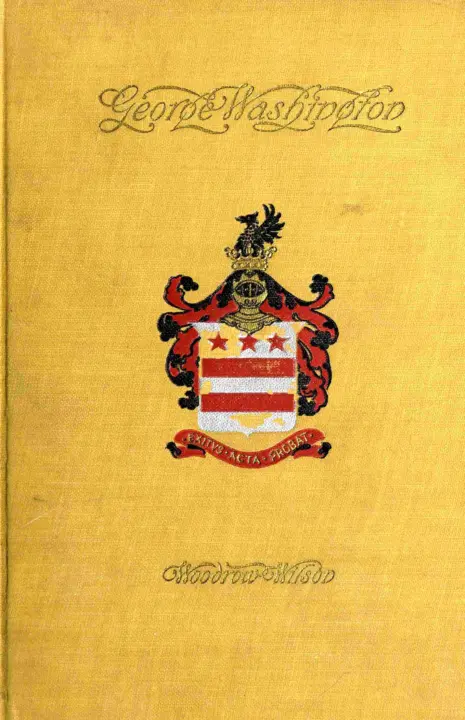
George Washington
Woodrow Wilson
THE CLASSIC COLLECTION · 1885
"Congresional Government: A Study in American Politics" by Woodrow Wilson is an academic publication written in the late 19th century. The work examines the distinctive characteristics of the federal system in the United States, focusing particularly on the centrality of Congress and how its structure and functions differ from other governing bodies around the world. Wilson intends to highlight the peculiarities of American Congressional governance, shedding light on its historical development and its practical implications. The opening of the text serves as a preface where Wilson reflects on the evolution of the United States' governmental structure since the Constitution's adoption. He emphasizes that while the Constitution was intended to establish a system of checks and balances, in practice, Congress has become the predominant force in American governance, often overshadowing the executive branch. Wilson notes the challenges in fully understanding the functioning of Congress due to its complex committee system, which often leads to a considerable amount of business being managed behind closed doors, limiting public insight. He argues for a critical assessment of the congressional system, exploring how it has deviated from its original design and what that means for the future of American politics.
Introduction adapted from the source catalogue; source summaries may be automatically generated.
Free to read · English · 80,327 words · No account needed
MAKE TIME FOR A GOOD BOOK
On by default. Untick to stop anonymous reading totals. Each page counts after 10 seconds in view. How this works.
Anonymous counting is on unless you have switched it off.
An illustration of what the House Committees find by special effort may be seen in the revelations of the investigation of the expenses of the notorious "Star Route Trials" made by the Forty-eighth Congress's Committee on Expenditures in the department of Justice.
[33] See General Garfield's article, already once quoted, North American Review, vol. cxxviii. p. 533.
[34] Essays on Parliamentary Reform.
[35] Green's History of the English People, vol. iv., pp. 202, 203.
[36] "G. B." in N. Y. Nation, Nov. 30, 1882.
[37] An attempt was once made to bring the previous question into the practices of the Senate, but it failed of success, and so that imperative form of cutting off all further discussion has fortunately never found a place there.
[38] As regards all financial measures indeed committee supervision is specially thorough in the Senate. "All amendments to general appropriation bills reported from the Committees of the Senate, proposing new items of appropriation, shall, one day before they are offered, be referred to the Committee on Appropriations, and all general appropriation bills shall be referred to said Committee; and in like manner amendments to bills making appropriations for rivers and harbors shall be again referred to the Committee to which such bills shall be referred."--Senate Rule 30.
[39] The twenty-nine Standing Committees of the Senate are, however, chosen by ballot, not appointed by the Vice-President, who is an appendage, not a member, of the Senate.
[40] In the Birmingham Town Hall, November 3, 1882. I quote from the report of the London Times.
[41] "No Senator shall speak more than twice, in any one debate, on the same day, without leave of the Senate."--Senate Rule 4.
[42] These quotations from Bagehot are taken from various parts of the fifth chapter of his English Constitution.
[43] These are the words of Lord Rosebery--testimony from the oldest and most celebrated second chamber that exists.
[44] There seems to have been at one time a tendency towards a better practice. In 1813 the Senate sought to revive the early custom, in accordance with which the President delivered his messages in person, by requesting the attendance of the President to consult upon foreign affairs; but Mr. Madison declined.
[45] North American Review, vol. 108, p. 625.
[46] English Constitution, chap, viii., p. 293.
[47] Atlantic Monthly, vol. xxv., p. 148.
[48] Something like this has been actually proposed by Mr. Albert Stickney, in his interesting and incisive essay, A True Republic.
[49] State, Treasury, War, Navy.
[50] As quoted in Macmillan's Magazine, vol. vii., p. 67.
[51] I quote from an excellent handbook, The United States Government,
by Lamphere.
Your reading position is saved on this browser. Take it to another device with a library code. Reading pages adapt to text, rather than matching a printed edition.
Woodrow Wilson
Woodrow Wilson
Woodrow Wilson
Woodrow Wilson
BEHIND THE BOOK
This eBook is for the use of anyone anywhere in the United States and most other parts of the world at no cost and with almost no restrictions whatsoever. You may copy it, give it away or re-use it under the terms of the Project Gutenberg License included with this eBook or online at www.gutenberg.org. If you are not located in the United States, you will have to check the laws of the country where you are located before using this eBook. Read the source licence.
The original source file, including credits and licence, is retained by this library. Request an original-format copy at no charge. Please include the book title and Project Gutenberg identifier #35861.
KEEP YOUR CURIOSITY GOING
Cécile Tormay

Moritz Busch
John L. Ransom
Frances Wright
Cécile Tormay

Mabel Potter Daggett