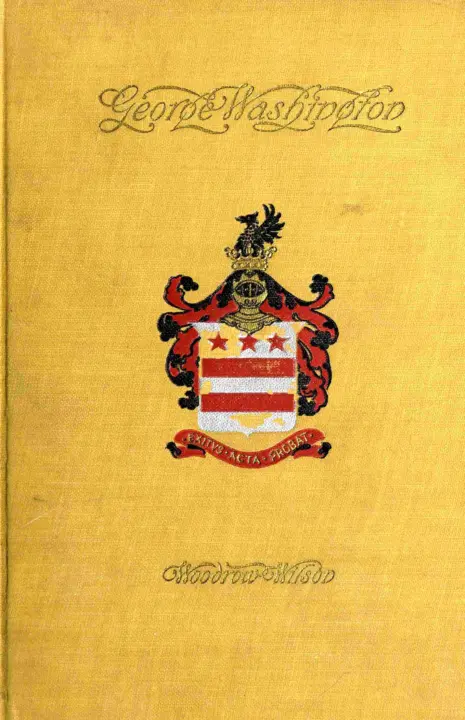
George Washington
Woodrow Wilson
THE CLASSIC COLLECTION · 1885
"Congresional Government: A Study in American Politics" by Woodrow Wilson is an academic publication written in the late 19th century. The work examines the distinctive characteristics of the federal system in the United States, focusing particularly on the centrality of Congress and how its structure and functions differ from other governing bodies around the world. Wilson intends to highlight the peculiarities of American Congressional governance, shedding light on its historical development and its practical implications. The opening of the text serves as a preface where Wilson reflects on the evolution of the United States' governmental structure since the Constitution's adoption. He emphasizes that while the Constitution was intended to establish a system of checks and balances, in practice, Congress has become the predominant force in American governance, often overshadowing the executive branch. Wilson notes the challenges in fully understanding the functioning of Congress due to its complex committee system, which often leads to a considerable amount of business being managed behind closed doors, limiting public insight. He argues for a critical assessment of the congressional system, exploring how it has deviated from its original design and what that means for the future of American politics.
Introduction adapted from the source catalogue; source summaries may be automatically generated.
Free to read · English · 80,327 words · No account needed
MAKE TIME FOR A GOOD BOOK
On by default. Untick to stop anonymous reading totals. Each page counts after 10 seconds in view. How this works.
Anonymous counting is on unless you have switched it off.
Senate, the, 193-241; overt character of contests of, with President, 48; efforts of, to control nominations, 49; usurpations of, and civil service reform, 49; semi-executive powers of, in regard to foreign policy, 49 et seq.; and treaty with Denmark, 50; and Alabama claims, 51; thoroughness of discussion in, 94; amendment of appropriation bills by, 155, 156; usual estimates of, 193, 194; character and composition of, 194, 195; conditions of public life, shaping character of, 195 et seq.; a select House of Representatives, 210; contrasts of, with the House, 211; organized like the House, 212; choice of Committees in, 212; absence of leadership in, 213 et seq.; character of debate in, 216 et seq.; equality of, with House of Representatives, 223; and House of Representatives, "latent unity" between, 224; not a class chamber, 225; limits democracy in Constitution, 226; dignity and remove from popular heat of, 227; a real check upon the House, 228; liability of, to biennial change in membership, 228, 229; "slow and steady" forms of, 230; share of, in control of executive departments, 231; and President, no real consultation between, 232 et seq.; and President, means of consultation between, 234; and nominations, 235, et seq.; "courtesy" of, 238; irresponsible dictation of, to President, 238.
Sherman, Roger, 268.
Silver Bill, the Bland, 185.
Slavery, character of contest over, 198-202, passim.
Smith, Robt., Secretary of Treasury, 162.
Smythe, nominated Minister to St. Petersburg by Pres. Grant, 235.
Speaker, of House of Representatives, appoints leaders of House, 60; prerogatives of, 103-108; appoints Standing Committees, 103; history of appointing power of, 104; power of appointing of, renewed with Rules, 105; chosen by party vote, 107; personal character of, 107; use of power by, in constituting and aiding Committees, 108; concentration of power in hands of, 110, 111; of House of Commons, functions and character of, 122.
Stages of national political growth, before civil war, 200; since, 202.
"Star Route" trials, 178, n.
State and federal governments, balance between, See 'Federal and state
governments.'
States, the, disadvantages of direct taxation to, 133.
Sumner, Chas., Chairman Senate Committee on Foreign Relations, 235.
Sumner, Prof. W. G., on task of legislator, 296.
Sunderland, Earl of, 314.
Supervision of elections by federal govt., 27.
Supply, Committee of, in House of Commons, 137-139; vital character of votes of, in House of Commons, 139; Committee of, in House of Representatives, 154; questions of, take precedence of questions of revenue in Congress, 174.
Surpluses, 173, 174, 179.
Suspension of Rules, bills passed under a, in House, 111, 112.
Swiss Constitution and bicameral system, 221.
Tariff of 1833, character of contest over, 198.
Taxation, sensitiveness of people concerning, 131; direct and indirect, 132, 133; Mr. Gladstone on direct and indirect, 134; direct, by States, indirect, by federal govt., 133.
Telegraph lines, constitutional interpretation in connection with, 30,
31.
Tenure of Office Act, 49, 277.
Terms of office, short, 255; of the Secretaries, 261, 264 et seq.
Tocqueville, De, on position of President, 266, n.
Townshend, Chas., 207, 208.
Your reading position is saved on this browser. Take it to another device with a library code. Reading pages adapt to text, rather than matching a printed edition.
Woodrow Wilson
Woodrow Wilson
Woodrow Wilson
Woodrow Wilson
BEHIND THE BOOK
This eBook is for the use of anyone anywhere in the United States and most other parts of the world at no cost and with almost no restrictions whatsoever. You may copy it, give it away or re-use it under the terms of the Project Gutenberg License included with this eBook or online at www.gutenberg.org. If you are not located in the United States, you will have to check the laws of the country where you are located before using this eBook. Read the source licence.
The original source file, including credits and licence, is retained by this library. Request an original-format copy at no charge. Please include the book title and Project Gutenberg identifier #35861.
KEEP YOUR CURIOSITY GOING
Cécile Tormay

Moritz Busch
John L. Ransom
Frances Wright
Cécile Tormay

Mabel Potter Daggett