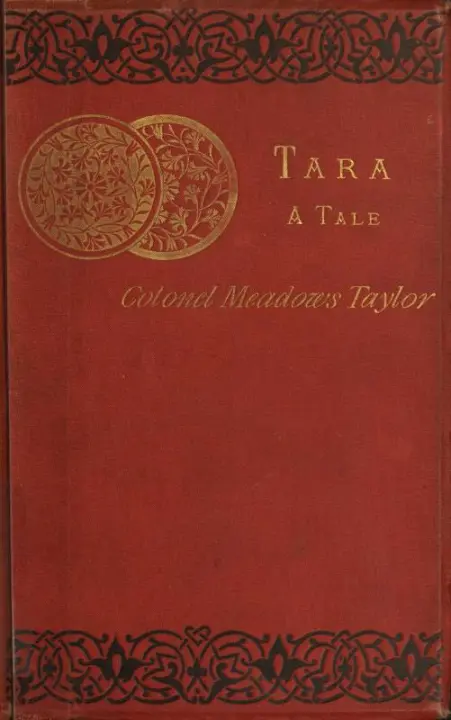
Tara: A Mahratta Tale
Meadows Taylor
THE CLASSIC COLLECTION · 1839
"Confessions of a Thug" by Meadows Taylor is a novel written in 1839 based on India's Thuggee cult. The story follows Ameer Ali, a fictional anti-hero who recounts his life as a thug—one of the "deceivers" who murdered travelers for money and valuables. Set from the late 18th century to 1832, this sensational tale of crime and retribution became a 19th-century bestseller that captivated readers including Queen Victoria, and popularized the word "thug" in English.
Introduction adapted from the source catalogue; source summaries may be automatically generated.
Free to read · English · 225,884 words · No account needed
MAKE TIME FOR A GOOD BOOK
On by default. Untick to stop anonymous reading totals. Each page counts after 10 seconds in view. How this works.
Anonymous counting is on unless you have switched it off.
"True, Meer Sahib; but no violence, I pray; have some consideration for my good name. If the Europeans heard of violence having been done, they would turn me out of my place."
"And you would turn Thug, I suppose. But quick, Potailjee, call the man
here."
He was absent for a short time, and returned with a short mean-looking fellow; and I could plainly see that rascal was written on his countenance. You know the old proverb--"Chor ke daree men, tinka" (there is always a straw in a thief's beard). Salutations were exchanged, and I came to the point at once.
"Look you, Duffadar Sahib," said I to him, "you may have guessed what we are?" He nodded assent. "This is good," I continued, "as perhaps you may have guessed at our object."
"Partly," said he; "but what do I know about you?"
"Exactly," said I--"the very thing I want; you need know nothing, and you will have nothing to tell if you are ever asked. Take my advice, and remain quietly within your village; and if the earth turns upside down you are not to stir out. For this you shall be well paid. But if you molest us, remember we are three hundred to seven--fearful odds, my friend."
"Nay, I am wise," said he; "what Bhojpooree is not? Nor do I wish to interfere. Do what you like; neither I nor my men will stir a foot."
"Can you depend on them?" said I; "can they be close?"
"As close as you wish them to be, Jemadar; but we must be paid."
"Certainly," said I; "I would not have it otherwise: but the reward
depends on what we get."
"Say two hundred rupees," said the fellow; "it is worth your while."
"Well, it is a bargain, Duffadar," I replied, "and the Potail is witness. And now I will give you further advice, which is, that you are to know nothing and see nothing, if even the lord Sahib were to ask you. You are to know only that travellers came and departed, and you kept no account of them."
"Of course," said the fellow; "I know this of old. I have met parties of your people in my own country, and have no reason to be dissatisfied with them: they have always behaved like men of honour, and kept their words with me."
"Then we are agreed?" said I.
"Certainly; you will see nought of us, and I will come to you at night
for my money."
"You had better come now, Duffadar, as I think we shall move on after
it is all over."
Your reading position is saved on this browser. Take it to another device with a library code. Reading pages adapt to text, rather than matching a printed edition.
BEHIND THE BOOK
This eBook is for the use of anyone anywhere in the United States and most other parts of the world at no cost and with almost no restrictions whatsoever. You may copy it, give it away or re-use it under the terms of the Project Gutenberg License included with this eBook or online at www.gutenberg.org. If you are not located in the United States, you will have to check the laws of the country where you are located before using this eBook. Read the source licence.
The original source file, including credits and licence, is retained by this library. Request an original-format copy at no charge. Please include the book title and Project Gutenberg identifier #44881.
KEEP YOUR CURIOSITY GOING
Cécile Tormay

Moritz Busch
Coulson Kernahan
John L. Ransom

Maurice Baring
Frances Wright