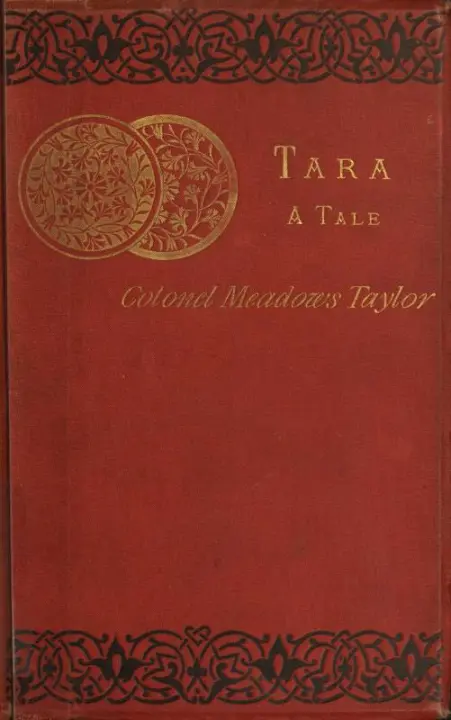
Tara: A Mahratta Tale
Meadows Taylor
THE CLASSIC COLLECTION · 1839
"Confessions of a Thug" by Meadows Taylor is a novel written in 1839 based on India's Thuggee cult. The story follows Ameer Ali, a fictional anti-hero who recounts his life as a thug—one of the "deceivers" who murdered travelers for money and valuables. Set from the late 18th century to 1832, this sensational tale of crime and retribution became a 19th-century bestseller that captivated readers including Queen Victoria, and popularized the word "thug" in English.
Introduction adapted from the source catalogue; source summaries may be automatically generated.
Free to read · English · 225,884 words · No account needed
MAKE TIME FOR A GOOD BOOK
On by default. Untick to stop anonymous reading totals. Each page counts after 10 seconds in view. How this works.
Anonymous counting is on unless you have switched it off.
I have forgotten, however, to mention to you an incident which befell us at Buhadoorgurh. We were encamped outside the town, and late in the evening we saw a body of men, whom we at first took to be Thugs, coming towards our camp.
"Who can they be?" said I to Peer Khan; "they look like Thugs, yet it is late for any party to be out."
"Some straggling party, I suppose," said he; "I will go and see."
"If they are Thugs and you know them," I added, "bring them, but say
not a word of our booty."
"No, no, I am not such a fool," said he laughing; "but I will bring you
the news."
He went, and returned with the leader of the party. I had purposely kept in my little tent, in order that my face might not be seen in case they were strangers; and to conceal it effectually, I tied a handkerchief over my mouth and chin.
"Salam Aliekoom," said a gruff voice, as a man with Peer Khan entered
the tent.
"You are welcome, friend," said I: "sit down." He was evidently weary with travel, and seated himself slowly.
"Your name," said I; "and who are you?"
"My name," replied the man, "is well known, I dare say, to most people, and they are afraid of it. I am called Lall Khan, or familiarly Lalloo."
"I have not heard it before," said I; "but who are you and your men?"
"Oh, we are free traders, who help ourselves to what we can get with a strong hand." Some wandering Pindharees, thought I; and I asked him if they were such.
"Not exactly," said he; "we are Dacoos."
"Worse and worse," said I, laughing; "and I suppose you are from Delhi?"
"Ay," replied he, "even so; we know you, though you do not know us. We know you to be Thugs by your encampment--but never fear us;--brethren should not interfere with each other; we have different ways of helping ourselves to spoil, but what matter; we are brothers in a general sense of the word."
"Good, we are; and if I can help you, say so."
"In no wise," said he, "but to give us room among ye for the night: we will be off early, if you do not go the same road."
"Room ye shall have, Khan, till the moon rises, and food too; but after that we are off; we travel northwards."
"Then it cannot be helped," he replied; "we will stay here till you go, and occupy your ground afterwards; we shall not be suspected."
"And where are you going?" I asked.
Your reading position is saved on this browser. Take it to another device with a library code. Reading pages adapt to text, rather than matching a printed edition.
BEHIND THE BOOK
This eBook is for the use of anyone anywhere in the United States and most other parts of the world at no cost and with almost no restrictions whatsoever. You may copy it, give it away or re-use it under the terms of the Project Gutenberg License included with this eBook or online at www.gutenberg.org. If you are not located in the United States, you will have to check the laws of the country where you are located before using this eBook. Read the source licence.
The original source file, including credits and licence, is retained by this library. Request an original-format copy at no charge. Please include the book title and Project Gutenberg identifier #44881.
KEEP YOUR CURIOSITY GOING
Cécile Tormay

Moritz Busch
Coulson Kernahan
John L. Ransom

Maurice Baring
Frances Wright