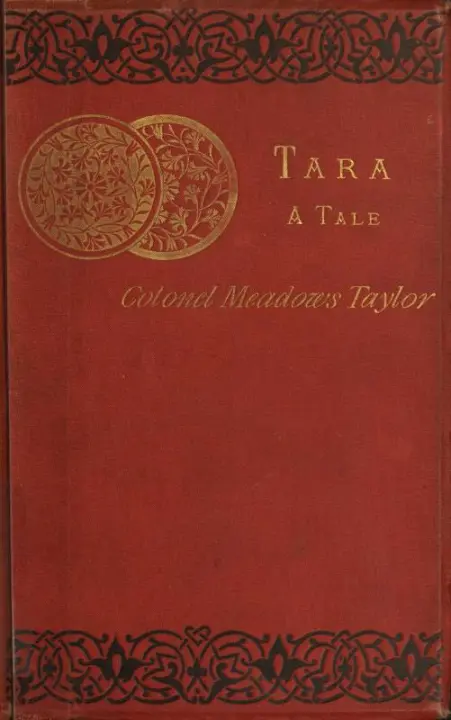
Tara: A Mahratta Tale
Meadows Taylor
THE CLASSIC COLLECTION · 1839
"Confessions of a Thug" by Meadows Taylor is a novel written in 1839 based on India's Thuggee cult. The story follows Ameer Ali, a fictional anti-hero who recounts his life as a thug—one of the "deceivers" who murdered travelers for money and valuables. Set from the late 18th century to 1832, this sensational tale of crime and retribution became a 19th-century bestseller that captivated readers including Queen Victoria, and popularized the word "thug" in English.
Introduction adapted from the source catalogue; source summaries may be automatically generated.
Free to read · English · 225,884 words · No account needed
MAKE TIME FOR A GOOD BOOK
On by default. Untick to stop anonymous reading totals. Each page counts after 10 seconds in view. How this works.
Anonymous counting is on unless you have switched it off.
"No; he is gone with a party of seven travellers towards Puttuncherroo, and has taken ten or fifteen of the best of the men with him; he will not be back probably before night, if then."
"Who were the travellers?"
"Bunneas, I heard," said Bhudrinath carelessly; "I did not see them myself, and Surfuraz Khan was in too great a hurry to give me any information."
"Out upon me!" I exclaimed, vexed at my idleness; "here have I been amusing myself while all this has been going on: for the sake of the Prophet, let us do something soon, that I may settle scores with my conscience, for I have hardly assurance enough to look you in the face after my behaviour."
"Well," said he, "come this evening; if we can't decoy any one, we will kill somebody for amusement and practice."
"I agree," said I; "for by Alla! I must do something. I am as melancholy as a camel, and my blood, which boiled enough yesterday, seems now scarcely to run through me;--it is not to be borne."
I found when I reached home that the dullal had arrived, and with him the sahoukar's clerk, and some porters to carry the goods, as well as fellows with matchlocks and lighted matches, and others with swords and shields, to escort them. I stared at them. "One would think you were going to battle, Séthjee," said I, "with all those fierce fellows; I am half afraid of them."
The fellows laughed; and the clerk replied, "They are necessary, and we always have them. If our goods were stolen, nay, carried off before our eyes, should we get any redress? no indeed: we therefore protect our property the best way we can."
"Now," said my father, "take your goods and be off with them; they are no longer mine, and I fear to allow them to remain under my roof."
"Surely," said the clerk, "they will be out of your way directly; and now let us speak about your money, or will you take some merchandise as part of it?"
"Not a bit, not a bit," replied my father; "I want all my money in rupees--no, stay, not all in rupees; give me five thousand in silver and the rest in gold, it will be easier carried."
"I suppose you mean five thousand rupees, and the rest in gold bars; well, you must purchase gold according to weight, and the best is twenty rupees a tola;--but you had better take bills, and the exchange is favourable."
Your reading position is saved on this browser. Take it to another device with a library code. Reading pages adapt to text, rather than matching a printed edition.
BEHIND THE BOOK
This eBook is for the use of anyone anywhere in the United States and most other parts of the world at no cost and with almost no restrictions whatsoever. You may copy it, give it away or re-use it under the terms of the Project Gutenberg License included with this eBook or online at www.gutenberg.org. If you are not located in the United States, you will have to check the laws of the country where you are located before using this eBook. Read the source licence.
The original source file, including credits and licence, is retained by this library. Request an original-format copy at no charge. Please include the book title and Project Gutenberg identifier #44881.
KEEP YOUR CURIOSITY GOING
Cécile Tormay

Moritz Busch
Coulson Kernahan
John L. Ransom

Maurice Baring
Frances Wright