
Ten Degrees Backward
Ellen Thorneycroft Fowler
THE CLASSIC COLLECTION · 1898
"Concerning Isabel Carnaby" by Ellen Thorneycroft Fowler is a novel written in the late 19th century. The story is set in a quaint old town called Chayford and primarily revolves around the Seaton family, particularly the lives of siblings Paul and Joanna, as well as their interactions with Alice Martin and Edgar Ford. The narrative explores themes of love, ambition, societal expectations, and the complexities of human relationships through its characters, each navigating their own paths and struggles. The opening of the book introduces us to the Seaton family, particularly with emphasis on their parents, the Reverend Mark Seaton and his wife Ruth, as well as their children, Paul and Joanna. It paints a vivid picture of their upbringing influenced by Methodism and discusses the duality of their lives: Paul, ambitious and set on succeeding at Oxford, versus Joanna, who is more reflective and earnest about her duties and desires. The dynamics of their friendships, especially with Alice Martin—who harbors feelings for Paul—are also established early on, setting the stage for evolving relationships that intertwine ambition, unrequited love, and the expectations placed upon them by their families and society.
Introduction adapted from the source catalogue; source summaries may be automatically generated.
Free to read · English · 103,240 words · No account needed
MAKE TIME FOR A GOOD BOOK
On by default. Untick to stop anonymous reading totals. Each page counts after 10 seconds in view. How this works.
Anonymous counting is on unless you have switched it off.
The artist bowed. "If I have misunderstood Miss Carnaby I humbly beg her pardon. By the way," he continued, "I once heard a story of a very devout Cornish wrecker, who never retired to rest, without praying for a storm. That always appeals to my sense of humour."
"Were his prayers answered?" asked Isabel.
"There were always plenty of wrecks, if that is what you mean."
"The wreckers were a terrible people," said Lord Wrexham, "and it was a terrible state of society which made such things possible."
"It is a comfort to think that these customs were confined to Cornwall and the last century," said Isabel.
"Were they?" asked Madderley.
"I think so," replied Lord Wrexham, "of course one has heard of wrecks and salvage on other shores; but I believe that the custom of deliberately causing wrecks by means of false lights was peculiar to Cornwall."
"I hope you are right," said the artist, "I cannot, of course, give names or dates, but I have an idea that I have heard of cases of cruel and avoidable wrecks in other counties than Cornwall, and considerably later than the last century."
"Indeed! I had believed that such savagery was extinct in England. I suppose, however, that the love of gain was the motive now as then?" And his lordship looked quite distressed.
"And the love of excitement."
"Dear me, how shocking!"
"Such things are shocking," agreed Madderley; "and doubly shocking to those who have witnessed their effects."
Isabel laughed a hard little laugh. "Perhaps Mr. Madderley will make
use of his artistic power to describe some of these harrowing
spectacles."
"I shall do nothing of the kind, dear lady; such descriptions would not be fit for pretty ears. I believe even the wreckers themselves would rather not see the consequences of their cruelty; therefore such things should be kept from the knowledge of refined and tender-hearted women, whose nature it is to be kind and pitiful."
"You are quite right, Madderley," said Lord Wrexham approvingly, "descriptions of horrors and cruelties are most unfit for women's ears, in my opinion."
But Isabel still looked defiant. "Perhaps, then, Mr. Madderley will tell us where these modern and fiendish wreckers are to be found."
The artist strolled to the sideboard to cut himself some ham. "On the sea-coast of Bohemia, and thereabouts."
"Don't take any notice of him, Wrexham," said Isabel petulantly; "he is only making up, just to irritate me."
Lord Wrexham was surprised. "Why, Isabel, what is the matter with you? You and Madderley used to be such friends."
"I know we used; but friendships don't wear for ever, any more than
clothes."
Your reading position is saved on this browser. Take it to another device with a library code. Reading pages adapt to text, rather than matching a printed edition.
Ellen Thorneycroft Fowler
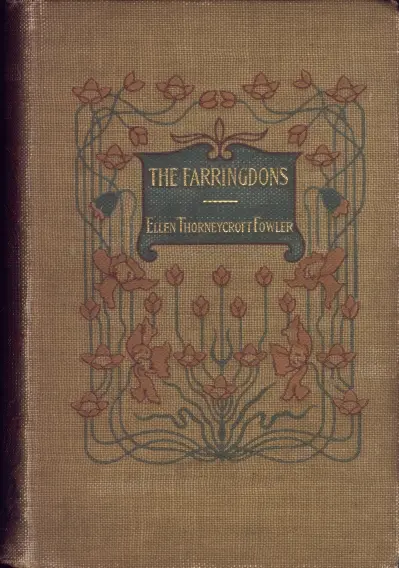
Ellen Thorneycroft Fowler
BEHIND THE BOOK
This eBook is for the use of anyone anywhere in the United States and most other parts of the world at no cost and with almost no restrictions whatsoever. You may copy it, give it away or re-use it under the terms of the Project Gutenberg License included with this eBook or online at www.gutenberg.org. If you are not located in the United States, you will have to check the laws of the country where you are located before using this eBook. Read the source licence.
The original source file, including credits and licence, is retained by this library. Request an original-format copy at no charge. Please include the book title and Project Gutenberg identifier #74380.
KEEP YOUR CURIOSITY GOING
Coulson Kernahan

Maurice Baring
Frances Wright
Cécile Tormay

Frederic Jesup Stimson

W. H. P. (William Henry Pope) Jarvis