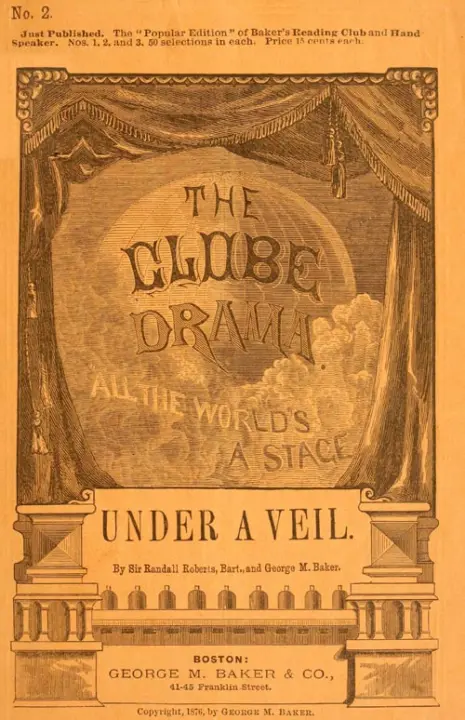
Under a Veil: A Comedietta in One Act
Randal H. (Randal Howland), Sir Roberts & George M. (George Melville) Baker
THE CLASSIC COLLECTION · 1877
"Comrades: A Drama in Three Acts" by George M. Baker is a play written in the late 19th century. The narrative revolves around the lives of several characters, including Royal Manning, his wife May, the tramp Matt Winsor, and Marcus Graves, who faces personal challenges tied to his past. Central themes appear to include friendship, the complexity of relationships, and social class struggles. The opening of the play introduces Royal Manning and May in their comfortable home, where they engage in lighthearted banter about matrimony and past lives. Royal reflects on his days as a soldier and his camaraderie with Matt Winsor, a former comrade from the war, who enters the scene as a drunken vagabond seeking assistance. Tensions arise as Royal and May discuss Marcus Graves, a man of mystery who has captured Bessie's affections. The playful atmosphere soon becomes heavier with the introduction of themes of shame and redemption, giving a hint of the deeper conflicts that will unfold through the characters' interactions and histories.
Introduction adapted from the source catalogue; source summaries may be automatically generated.
Free to read · English · 17,598 words · No account needed
MAKE TIME FOR A GOOD BOOK
On by default. Untick to stop anonymous reading totals. Each page counts after 10 seconds in view. How this works.
Anonymous counting is on unless you have switched it off.
SIMON. It is, Nancy. Your Simon. Come to my arms. (Advances with arms
outstretched.)
NANCY (thrusts the duster straight out before her. SIMON puts his face among the feathers). Hands off!
SIMON (spits and sputters). Phew! Pooh! Nancy, do you want to
strangle me?
NANCY. I don’t mean you shall strangle me. What are you doing here?
SIMON. Humbly, but earnestly, I trust, about my business.
NANCY. The candy business?
SIMON. No, Nancy; the saccharine and treacle elements have been
eliminated from my existence.
NANCY. What’s the meaning of that outlandish stuff? Can’t you speak
English?
SIMON. Yes; I’ve cut the sugar and molasses. In that line I burned to distinguish myself, but I burnt too much candy in trying to do it. So my employer requested me to cut stick.
NANCY. Sticks of candy?
SIMON. No, no, myself——leave, varmouse.
NANCY. Oh! you were discharged.
SIMON. Yes; I went off and became a policeman.
NANCY. A policeman! Simon, I always told you you would come to some bad
end!
SIMON. Well, the end of my career, in that line, was rather bad. Ah! but Nancy, you should have seen me in my uniform, brass buttons, and shield. You would have been proud of me, had you seen me on my beat with my billy.
NANCY. Billy who?
SIMON. Ignorant female! My weapon of defence; the stick with which I terrified old apple-women and young news-boys.
NANCY. Why didn’t you show yourself? I don’t think you needed any other stick to frighten them.
SIMON. Nancy, I was a hero on parade; but when it came to stepping into a row, I must say I felt more like knocking under than knocking over. In fact, my conscience became very tender on that point, one night, on having my billy taken away from me by a burly butcher, and being impressed, yes, several times impressed, with its hardness as he whacked me over the head with it. The situation struck me so forcibly, to say nothing of the billy, I quietly resigned my office, and retired to the humble but more healthy walks of life.
NANCY. Well, Mr. Stone, what next?
SIMON. Mr. Stone! Nancy, don’t be hard on me; call me Simon, pure Simon, simple Simon. Do! O Nancy! you are my life, my love! Do come to my arms! (Advances with arms extended.)
NANCY (advances duster as before). Stand back! I prefer my own arms!
SIMON (spits and sputters). Ah-choh! You’ll smother me with dust!
NANCY. Then behave yourself. Go on with your next occupation.
SIMON. It is that honorable profession in which our first great
ancestor won renown.
Your reading position is saved on this browser. Take it to another device with a library code. Reading pages adapt to text, rather than matching a printed edition.
Randal H. (Randal Howland), Sir Roberts & George M. (George Melville) Baker
George M. (George Melville) Baker
George M. (George Melville) Baker
Rachel Baker Gale & George M. (George Melville) Baker
BEHIND THE BOOK
This eBook is for the use of anyone anywhere in the United States and most other parts of the world at no cost and with almost no restrictions whatsoever. You may copy it, give it away or re-use it under the terms of the Project Gutenberg License included with this eBook or online at www.gutenberg.org. If you are not located in the United States, you will have to check the laws of the country where you are located before using this eBook. Read the source licence.
The original source file, including credits and licence, is retained by this library. Request an original-format copy at no charge. Please include the book title and Project Gutenberg identifier #48538.
KEEP YOUR CURIOSITY GOING
Maurice Baring
W. B. (William Butler) Yeats
Edward Martyn

John Brougham & Charlotte Brontë
Marguerite Merington
Leonid Andreyev