
Letters and social aims
Ralph Waldo Emerson
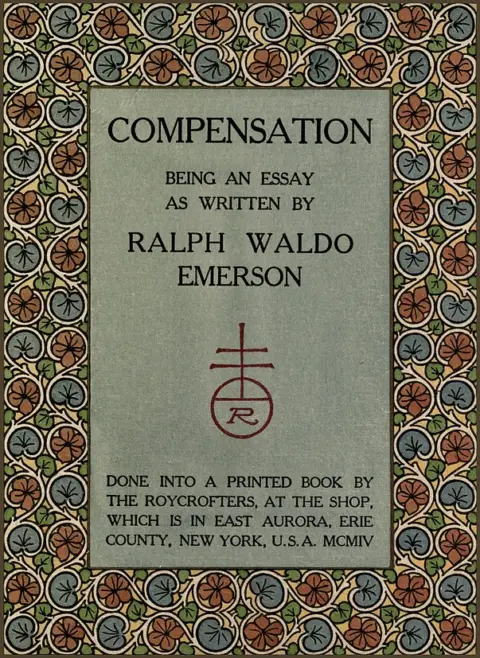
THE CLASSIC COLLECTION · 1903
"Compensation: Being an Essay as Written by Ralph Waldo Emerson" is a philosophical essay penned by Ralph Waldo Emerson during the early 20th century. This work delves into the concept of justice and balance in human life, focusing on the idea that all actions carry inherent consequences and that life operates on a principle of give-and-take. Emerson, a central figure in the Transcendentalist movement, draws upon observations from nature, human behavior, and moral philosophy to illustrate this enduring principle. In "Compensation," Emerson argues that for every pleasure or advantage gained, a corresponding burden or responsibility must be acknowledged. He discusses how life's dualities—such as good and evil, success and failure—are in constant interplay, shaping individual experiences and societal dynamics. Throughout the essay, Emerson uses a variety of examples, from personal virtues to societal laws, to demonstrate that justice is not only necessary but omnipresent. He emphasizes that every action has repercussions that can be felt immediately or unfold over time, ultimately reinforcing the notion that the universe maintains balance, and that true fulfillment comes from understanding and accepting this law of compensation.
Introduction adapted from the source catalogue; source summaries may be automatically generated.
Free to read · English · 7,936 words · No account needed
MAKE TIME FOR A GOOD BOOK
On by default. Untick to stop anonymous reading totals. Each page counts after 10 seconds in view. How this works.
Anonymous counting is on unless you have switched it off.
Thus do all things preach the indifferency of circumstances. The man is all. Every thing has two sides, a good and an evil. Every advantage has its tax. I learn to be content. But the doctrine of compensation is not the doctrine of indifferency. The thoughtless say, on hearing these representations: “What boots it to do well? there is one event to good and evil; if I gain any good, I must pay for it; if I lose any good, I gain some other; all actions are indifferent.” ¶ There is a deeper fact in the soul than compensation, to wit: its own nature. The soul is not a compensation, but a life. The soul is. Under all this running sea of circumstance, whose waters ebb and flow with perfect balance, lies the aboriginal abyss of real Being. Existence, or God, is not a relation or a part, but the whole. Being is the vast affirmative, excluding negation, self-balanced, and swallowing up all relations, parts and times within itself. Nature, truth, virtue, are the influx from thence. Vice is the absence or departure of the same. Nothing, Falsehood, may indeed stand as the great Night or shade on which, as a background, the living universe paints itself forth; but no fact is begotten by it; it cannot work, for it is not. It cannot work any good; it cannot work any harm. It is harm, inasmuch as it is worse not to be than to be.
We feel defrauded of the retribution due to evil acts, because the criminal adheres to his vice and contumacy, and does not come to a crisis or judgment anywhere in visible nature. There is no stunning confutation of his nonsense before men and angels. Has he, therefore, outwitted the law? Inasmuch as he carries the malignity and the lie with him, he so far deceases from nature. In some manner there will be a demonstration of the wrong to the understanding also; but, should we not see it, this deadly deduction makes square the eternal account. ¶ Neither can it be said, on the other hand, that the gain of rectitude must be bought by any loss. There is no penalty to virtue; no penalty to wisdom; they are proper additions of being. In a virtuous action, I properly am; in a virtuous act, I add to the world; I plant into deserts conquered from Chaos and Nothing, and see the darkness receding on the limits of the horizon. There can be no excess to love, none to knowledge, none to beauty, when these attributes are considered in the purest sense. The soul refuses all limits. It affirms in man always an Optimism, never a Pessimism. ¶ His life is a progress, and not a station. His instinct is trust. Our instinct uses “more” and “less” in application to man, always of the presence of the soul, and not of its absence; the brave man is greater than the coward; the true, the benevolent, the wise, is more a man, and not less, than the fool and knave. There is, therefore, no tax on the good of virtue, for that is the incoming of God himself, or absolute existence, without any comparative. All external good has its tax, and if it came without desert or sweat, has no root in me, and the next wind will blow it away. But all the good of nature is the soul’s, and may be had if paid for in nature’s lawful coin, that is, by labor which the heart and the head allow. I no longer wish to meet a good I do not earn; for example, to find a pot of buried gold, knowing that it brings with it new responsibility. I do not wish more external goods,--neither possessions, nor honors, nor powers, nor persons. The gain is apparent; the tax is certain. But there is no tax on the knowledge that the compensation exists, and that it is not desirable to dig up treasure. Herein I rejoice with a serene eternal peace. I contract the boundaries of possible mischief. I learn the wisdom of St. Bernard: “Nothing can work me damage except myself; the harm that I sustain, I carry about with me, and never am a real sufferer but by my own fault.” ¶ In the nature of the soul is the compensation for the inequalities of condition. The radical tragedy of nature seems to be the distinction of More and Less. How can Less not feel the pain; how not feel indignation or malevolence towards More? Look at those who have less faculty, and one feels sad, and knows not well what to make of it. Almost he shuns their eye; he fears they will upbraid God. What should they do? It seems a great injustice. But see the facts nearly, and these mountainous inequalities vanish. Love reduces them as the sun melts the iceberg in the sea. The heart and soul of all men being one, this bitterness of His and Mine ceases. His is mine. I am my brother and my brother is me. If I feel overshadowed and outdone by great neighbors, I can yet love; I can still receive; and he that loveth, maketh his own the grandeur he loves. Thereby I make the discovery that my brother is my guardian, acting for me with the friendliest designs, and the estate I so admired and envied is my own. It is the eternal nature of the soul to appropriate and make all things its own. Jesus and Shakespeare are fragments of the soul, and by love I conquer and incorporate them in my own conscious domain. His virtue,--is not that mine? His wit,--if it cannot be made mine, it is not wit.
Your reading position is saved on this browser. Take it to another device with a library code. Reading pages adapt to text, rather than matching a printed edition.
Ralph Waldo Emerson
Ralph Waldo Emerson
Ralph Waldo Emerson
Ralph Waldo Emerson
BEHIND THE BOOK
This eBook is for the use of anyone anywhere in the United States and most other parts of the world at no cost and with almost no restrictions whatsoever. You may copy it, give it away or re-use it under the terms of the Project Gutenberg License included with this eBook or online at www.gutenberg.org. If you are not located in the United States, you will have to check the laws of the country where you are located before using this eBook. Read the source licence.
The original source file, including credits and licence, is retained by this library. Request an original-format copy at no charge. Please include the book title and Project Gutenberg identifier #73035.
KEEP YOUR CURIOSITY GOING

David Patterson (Spirit) Hatch

David Patterson (Spirit) Hatch

David Patterson (Spirit) Hatch
Coulson Kernahan
Ralph Waldo Emerson

Maurice Baring