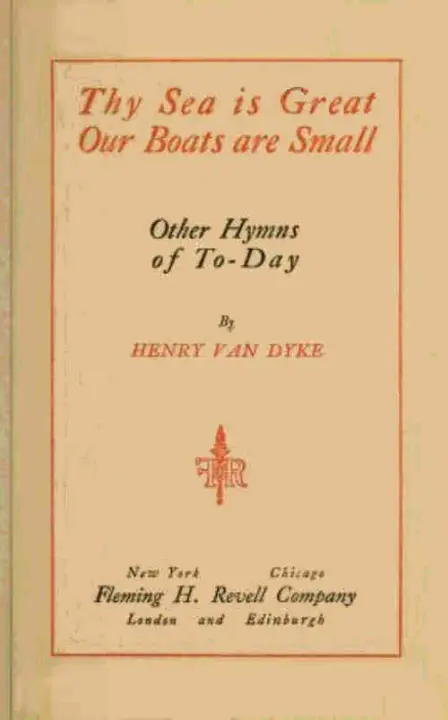
Thy Sea is Great, Our Boats are Small, and Other Hymns of To-Day
Henry Van Dyke
THE CLASSIC COLLECTION · 1922
"Companionable Books" by Henry Van Dyke is a collection of literary appreciations written in the early 20th century. In this work, the author reflects on books that provide lasting companionship and joy, emphasizing those that interpret nature and life in a beautiful and powerful manner. The text is structured as a series of essays that delve into the experiences and insights gained through reading these impactful works. At the start of this collection, the author sets the stage by discussing the concept of "companionable books," which he contrasts with those that are dull or quickly forgotten. He offers a personal perspective on literature’s ability to enrich our lives, encouraging readers to choose books that resonate deeply and can be revisited over time. The opening portion introduces the metaphoric tale of a prince and a tree that embodies life's nourishing qualities, drawing parallels to the Bible and its immense literary influence. Van Dyke expresses a passion for the written word, defining literature as a vital source of inspiration and human connection.
Introduction adapted from the source catalogue; source summaries may be automatically generated.
Free to read · English · 67,112 words · No account needed
MAKE TIME FOR A GOOD BOOK
On by default. Untick to stop anonymous reading totals. Each page counts after 10 seconds in view. How this works.
Anonymous counting is on unless you have switched it off.
“With an eye made quiet by the power
Of harmony, and the deep power of joy,
We see into the heart of things.”
Joy is indeed the master-word of his poetry. The dancing daffodils enrich
his heart with joy.
“They flash upon that inward eye
Which is the bliss of solitude;
And then my heart with pleasure fills,
And dances with the daffodils.”
The kitten playing with the fallen leaves charms him with pure merriment. The skylark’s song lifts him up into the clouds.
“There is madness about thee, and joy divine
In that song of thine.”
He turns from the nightingale, that creature of a “fiery heart,” to the
Stock-dove:
“He sang of love, with quiet blending,
Slow to begin and never ending;
Of serious faith, and inward glee;
That was the song—the song for me.”
He thinks of love which grows to use
“Joy as her holiest language.”
He speaks of life’s disenchantments and wearinesses as
“All that is at enmity with joy.”
When autumn closes around him, and the season makes him conscious that his leaf is sere and yellow on the bough, he exclaims
“Yet will I temperately rejoice;
Wide is the range and free the choice
Of undiscordant themes;
Which haply kindred souls may prize
Not less than vernal ecstacies,
And passion’s feverish dreams.”
Temperate rejoicing,—that is the clearest note of Wordsworth’s poetry. Not an unrestrained gladness, for he can never escape from that deep, strange experience of his youth. Often, in thought, he
“Must hear Humanity in fields and groves
Pipe solitary anguish; or must hang
Brooding above the fierce confederate storm
Of sorrow, barricadoed evermore
Within the walls of cities.”
But even while he hears these sounds he will not be “downcast or forlorn.” He will find a deeper music to conquer these clashing discords. He will learn, and teach, a hidden joy, strong to survive amid the sorrows of a world like this. He will not look for it in some far-off unrealized Utopia,
“But in the very world which is the world
Of all of us,—the place where in the end
We find our happiness, or not at all!”
To this quest of joy, to this proclamation of joy, he dedicates his life.
“By words
Which speak of nothing more than what we are
Would I arouse the sensual from their sleep
Of Death, and win the vacant and the vain
To noble raptures.”
And herein he becomes a prophet to his age,—a prophet of the secret of joy, simple, universal, enduring,—the open secret.
Your reading position is saved on this browser. Take it to another device with a library code. Reading pages adapt to text, rather than matching a printed edition.
Henry Van Dyke
Henry Van Dyke
Henry Van Dyke
Henry Van Dyke
BEHIND THE BOOK
This eBook is for the use of anyone anywhere in the United States and most other parts of the world at no cost and with almost no restrictions whatsoever. You may copy it, give it away or re-use it under the terms of the Project Gutenberg License included with this eBook or online at www.gutenberg.org. If you are not located in the United States, you will have to check the laws of the country where you are located before using this eBook. Read the source licence.
The original source file, including credits and licence, is retained by this library. Request an original-format copy at no charge. Please include the book title and Project Gutenberg identifier #61345.
KEEP YOUR CURIOSITY GOING

David Patterson (Spirit) Hatch

David Patterson (Spirit) Hatch

David Patterson (Spirit) Hatch
Cécile Tormay

Moritz Busch
John L. Ransom