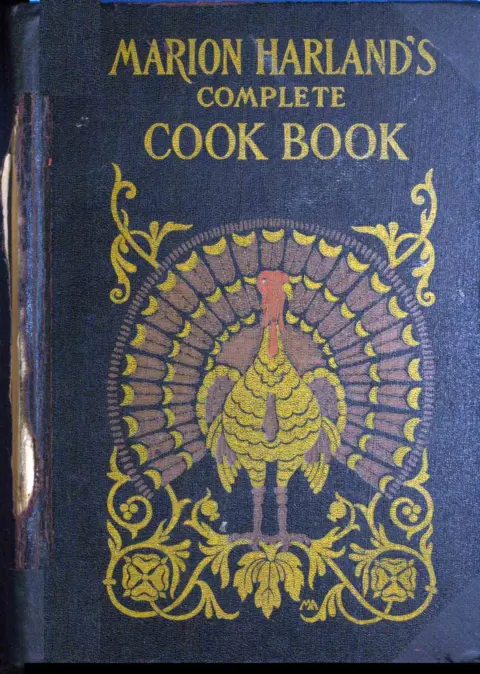
Marion Harland’s Complete Cook Book A Practical and Exhaustive Manual of Cookery and Housekeeping
Marion Harland
THE CLASSIC COLLECTION · 1880
"Common Sense in the Household: A Manual of Practical Housewifery" by Marion Harland is a practical guide written in the late 19th century. The book focuses on housewifery, particularly providing recipes and advice for housekeepers to manage their households efficiently. With a tone of camaraderie, Harland addresses her fellow housewives, offering insights born from personal experience, aiming to empower them in their domestic duties. The opening of the manual introduces the reader to the author's relatable approach, as she invites conversation and shares her own challenges as a housekeeper. Harland expresses the frustrations many women face regarding household management, suggesting that practical knowledge and skills in the kitchen are essential, regardless of educational background. Emphasizing common sense and methodical practice, she entertains the idea that while cooking may seem daunting, developing confidence and practical skills can lead to a rewarding and successful domestic life. The introductory section sets the stage for the collection of recipes and insights that will empower women to navigate their responsibilities with greater ease and expertise.
Introduction adapted from the source catalogue; source summaries may be automatically generated.
Free to read · English · 143,281 words · No account needed
MAKE TIME FOR A GOOD BOOK
On by default. Untick to stop anonymous reading totals. Each page counts after 10 seconds in view. How this works.
Anonymous counting is on unless you have switched it off.
Finally, dear sister, do not add to the real miseries of life by regarding the annoyance of a careless, slothful, or impertinent domestic as a real trouble. Class it with petty vexations which are yet curable as well as endurable, and live above it—a noble, beneficent existence in the love of your fellow-creatures and the fear of GOD—a life that can not suffer perceptible disturbance from such a contemptible rootlet of bitterness as this. It is only the feeble, the inefficient, or the indolent mistress whose peace of mind is dependent upon such casualties as a breeze, a hurricane, or a sudden vacancy in the department of the interior.
Recollect, when the infliction is sharpest, that brier-pricks are disagreeable, but never serious, unless the blood be very impure.
I have, for convenience sake, classed among pies all preparations baked in crust in a pie-dish. Many of these, however, are called puddings, such as custards of various kinds, lemon, cocoa-nut, and orange puddings. The reader will have no trouble in finding the receipts for these, if she will bear the above remark in mind.
Beat your eggs very light—and, if you put in only one or two, whip white and yolk separately, beating the latter into the sugar before adding the whites.
Fruit, rice, corn-starch, and bread puddings require a steady, moderate oven in baking. Custard and batter puddings should be put into the dish, and this into the oven, the instant they are mixed, and baked quickly. No pudding, unless it be raised with yeast, should be allowed to stand out of the oven after the ingredients are put together. Give one final hard stir just before it goes in, and be sure the mould is well greased.
1 pint stewed apples.
3 eggs—whites and yolks separate.
½ cup white sugar, and one teaspoonful butter.
1 teaspoonful nutmeg and cinnamon mixed.
1 teaspoonful essence bitter almond (for the méringue.)
Sweeten and spice, and, while the apple is still very hot, stir in the butter, and, a little at a time, the yolks. Beat all light, pour into a buttered dish, and bake ten minutes. Cover, without drawing from the oven, with a méringue made of the beaten whites, two tablespoonfuls white sugar, and the bitter almond seasoning. Spread smoothly and quickly, close the oven again, and brown very slightly.
Eat cold, with white sugar sifted over the top, and send around cream to pour over it instead of sauce.
6 large firm pippins (grated.)
3 tablespoonfuls butter.
½ cup sugar.
4 eggs—whites and yolks separate.
Juice of one lemon, and half the peel.
Your reading position is saved on this browser. Take it to another device with a library code. Reading pages adapt to text, rather than matching a printed edition.
Marion Harland

Marion Harland
Marion Harland
Marion Harland
BEHIND THE BOOK
This eBook is for the use of anyone anywhere in the United States and most other parts of the world at no cost and with almost no restrictions whatsoever. You may copy it, give it away or re-use it under the terms of the Project Gutenberg License included with this eBook or online at www.gutenberg.org. If you are not located in the United States, you will have to check the laws of the country where you are located before using this eBook. Read the source licence.
The original source file, including credits and licence, is retained by this library. Request an original-format copy at no charge. Please include the book title and Project Gutenberg identifier #48804.
KEEP YOUR CURIOSITY GOING

Charles G. (Charles Griffith) Ross
Hannah Webster Foster

Emily Lawless
Edwin Hamlin Carr

Charles De Lano Hine
Andrew Ure