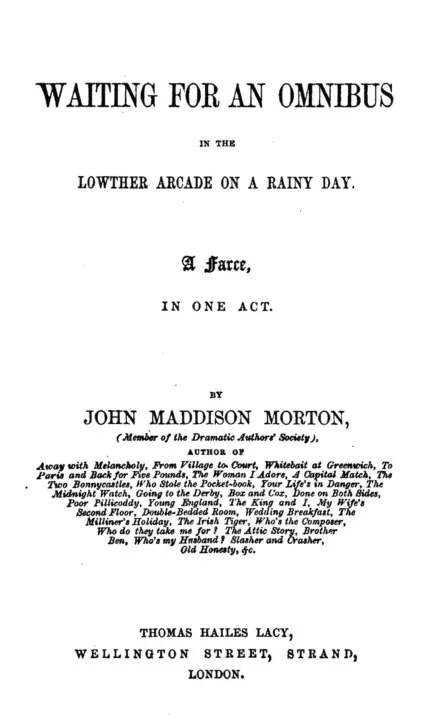
Waiting for an Omnibus in the Lowther Arcade on a Rainy Day: A Farce, in One Act
John Maddison Morton
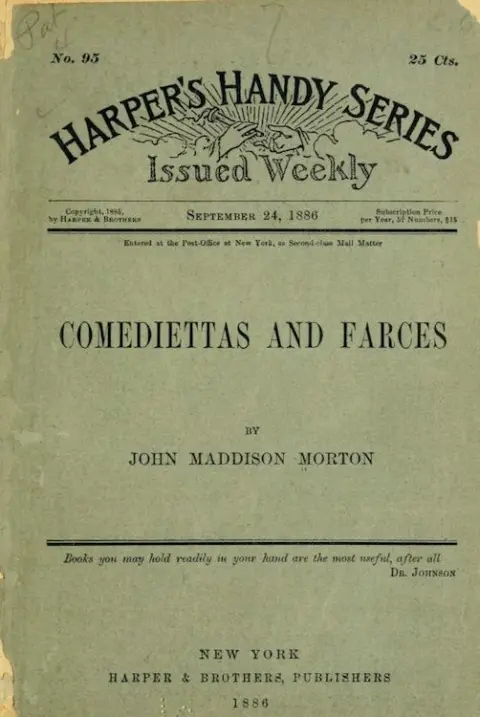
THE CLASSIC COLLECTION · 1886
"Comediettas and Farces" by John Maddison Morton is a collection of comedic plays written in the late 19th century. The work features a range of light-hearted theatrical pieces, including witty dialogues and humorous situations designed for private performances, appealing to amateur dramatics and enthusiasts of British farce. The opening focuses on one play, "Box and Cox," featuring two main characters, John Box and James Cox, who unwittingly share the same room while going about their respective lives as a printer and a hatter. The beginning of the collection introduces "Box and Cox," a farce that brings forth the comedic misadventures of two characters who occupy the same room at different times, unaware of each other's presence. The action unfolds as Mrs. Bouncer, the landlord, cleverly manages their separate lives. Box and Cox's humorous interactions revolve around misunderstandings regarding their living situation, each believing they alone have rights to the accommodations. The stage is set for a clash of personalities, misunderstandings, and lunch-time chaos, blending clever banter with the humorous consequences of double occupancy, which promises a delightful experience for readers and theater enthusiasts alike.
Introduction adapted from the source catalogue; source summaries may be automatically generated.
Free to read · English · 46,770 words · No account needed
MAKE TIME FOR A GOOD BOOK
On by default. Untick to stop anonymous reading totals. Each page counts after 10 seconds in view. How this works.
Anonymous counting is on unless you have switched it off.
ROYS. (aside). All right! At least, if it isn't this one, it'll be
the other! One of the two!
BART. What do you mean by "the other?"
ROYS. The "little, harmless, insignificant school-girl," you know!
BART. (aside). Confound the fellow!
ROYS. You first put the notion of marriage into my head, and I won't leave this house a bachelor; I'll marry somebody! I leave you together! You'll plead my cause, won't you?--and pitch it strong, won't you? I shall be all anxiety to know the result--because if she won't have me, I can fall back on the other. Don't you see? (shaking BARTON'S hand, and runs out at C.).
BART. (aside, and looking at JULIA). To have to plead the cause of another, when, in spite of me, her presence will recall the past, painful, humiliating as it is!
JULIA (with indifference). Your friend has left you, Mr. Barton?
BART. He has, Miss Templeton; but he has left an advocate to
intercede with you on his behalf.
JULIA (satirically). A willing and an earnest one, no doubt, who probably has already furnished him with a detailed catalogue of my tastes, habits, pursuits, disposition--
BART. (aside). He's been blabbing! (Aloud.) Surely he cannot have
betrayed my confidence?
JULIA (with suppressed anger). The charge of "betrayal of confidence" should rather be levelled at one who by his intimacy with a family, into which he is admitted on terms of friendship, is enabled to study the characters of its members for the purpose of retailing the result of his observations to others!
BART. I will not affect to misunderstand your reproof. It is true that I spoke of you to Mr. Royston in terms which you fully merit--that I even told him your heart was free.
JULIA. Perfectly, absolutely free! You undertook to be his advocate with such zeal, such earnestness, one might almost imagine you had some personal interest.
BART. And what if I had an interest--a powerful interest?
JULIA (quickly). Indeed?
BART. Yes. And after the somewhat harsh rejection I met with at your hands--which, no doubt, I fully merited--what greater proof can I give of the esteem in which I still hold you than to confide my secret to you?
JULIA (starting). A secret? (Aside.) What can he mean?
BART. That, on the eve of leaving your family, I should feel far less regret could I but indulge in the hope of ever becoming connected with it by a closer tie.
JULIA (aside, and joyfully). Can it be? Has he forgotten--forgiven? Can he still care for me? (Aloud.) But why this silence--this want of confidence in me?
BART. Frankly, because we feared you would oppose our wishes, our
hopes.
Your reading position is saved on this browser. Take it to another device with a library code. Reading pages adapt to text, rather than matching a printed edition.
John Maddison Morton
John Maddison Morton
John Maddison Morton
John Maddison Morton
BEHIND THE BOOK
This eBook is for the use of anyone anywhere in the United States and most other parts of the world at no cost and with almost no restrictions whatsoever. You may copy it, give it away or re-use it under the terms of the Project Gutenberg License included with this eBook or online at www.gutenberg.org. If you are not located in the United States, you will have to check the laws of the country where you are located before using this eBook. Read the source licence.
The original source file, including credits and licence, is retained by this library. Request an original-format copy at no charge. Please include the book title and Project Gutenberg identifier #59210.
KEEP YOUR CURIOSITY GOING
Maurice Baring
W. B. (William Butler) Yeats
Edward Martyn

John Brougham & Charlotte Brontë
Marguerite Merington
Leonid Andreyev