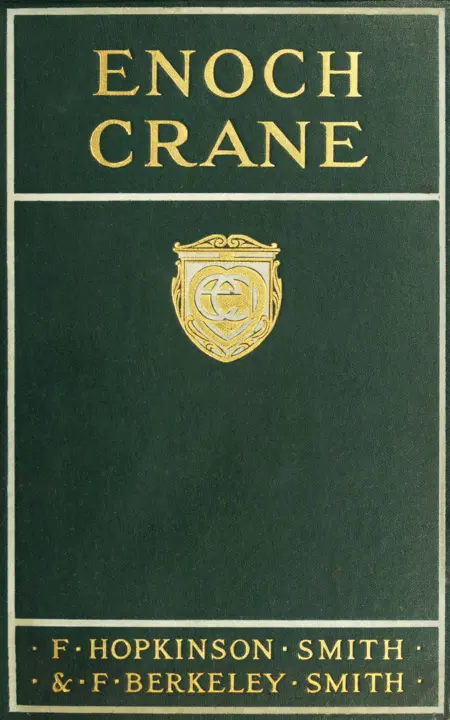
Enoch Crane
Francis Hopkinson Smith & F. Berkeley (Frank Berkeley) Smith
THE CLASSIC COLLECTION · 1903
"Colonel Carter's Christmas and The Romance of an Old-Fashioned Gentleman" by F. Hopkinson Smith is a light-hearted novel written in the early 20th century. The story centers around Colonel George Fairfax Carter, a charming and genteel character whose interactions reveal his values of hospitality, honor, and loyalty. The narrative unfolds during the Christmas season and features a cast that includes his beloved Aunt Nancy and a host of other acquaintances, reflecting the themes of friendship, generosity, and the complexities of human relationships against a festive backdrop. The opening of the story introduces us to the Colonel's world in New York, where he reminisces about past gatherings, particularly one involving a duel challenge against a financier named Mr. Klutchem. As the narrative progresses, there's a palpable tension regarding the Colonel's financial ambitions tied to a railroad project. We see him interact with his old servant Chad, and his friend Fitz, amidst preparations for the Christmas festivities. The stage is set for both celebration and potential conflict, particularly with the arrival of Klutchem and his daughter, who add further intrigue to the Colonel's spirited life. Overall, the beginning suggests a blend of humor, warmth, and a touch of drama as the characters navigate their relationships during the holiday season.
Introduction adapted from the source catalogue; source summaries may be automatically generated.
Free to read · English · 50,268 words · No account needed
MAKE TIME FOR A GOOD BOOK
On by default. Untick to stop anonymous reading totals. Each page counts after 10 seconds in view. How this works.
Anonymous counting is on unless you have switched it off.
"Glad to see you, Mr. Eggleston," exclaimed the treasurer, with one finger extended, into which the special hooked his own. The official did not see the junior partner; he dealt only with principals.
"Our attorney," he continued, nodding to his companion, "has got the papers. Are you all ready? Where is Mr. Colton?" and he looked around.
"I'm expecting him every minute," replied the special in a nervous tone; "but we can get along without him. My son is here to sign for the firm."
"No, we can't get along. I want him. I have some questions to ask him; these are President Stockton's directions."
Before Eggleston could reply the door of the private office was thrust open and Philip stepped in.
Mr. Eggleston sprang from his chair, and a combination smile showing urbanity, apology, and contentment, now that Phil had arrived, overspread his features.
"We had begun to think you were ill, Colton," he said in a relieved
tone. "Anything the matter?"
"No, I stopped to see Mr. Gregg. I am on time, I believe, gentlemen, half-past eleven, wasn't it?" and he consulted his watch. There was a peculiar tremor in Phil's voice that made his prospective father-in-law fasten his eyes upon him as if to learn the cause. Colton looked as if he had been awake all night; he was pale, but otherwise he was himself.
"Yes, you are on the minute," exclaimed the treasurer, picking up the bundle of papers and loosening the tape that bound them together. "You have just returned from the property, we hear. What do you think of it?"
"We have the certificate of the mining engineer," interrupted Mr. Eggleston in a bland tone, regaining his seat.
"Yes, I have it here," the treasurer answered, tapping the bundle of papers. "It is your personal opinion, Mr. Colton, that we want. The president insists upon this; he has a reason for it."
Colton stepped nearer and looked the treasurer square in the eyes.
"My personal opinion, sir," he answered in clear-cut tones, "is that the deposit is practically exhausted. I came here to tell you so. The engineer's report is, I think, too highly colored."
Both father and son started forward in their chairs, their eyes glaring at Philip. They could hardly believe their senses.
"What!" burst out Mr. Eggleston--"you don't mean to say that----"
"One moment, please," interrupted the treasurer, with an impatient wave of his hand towards Eggleston: "Do you think, Mr. Colton, that the issue had better be deferred?"
"I do. Certainly until the mine makes a better showing."
Again Mr. Eggleston tried to interrupt and again he was waved into
silence.
"When did you arrive at this conclusion?"
Your reading position is saved on this browser. Take it to another device with a library code. Reading pages adapt to text, rather than matching a printed edition.
Francis Hopkinson Smith & F. Berkeley (Frank Berkeley) Smith
Francis Hopkinson Smith

Francis Davis Millet & W. Hamilton (William Hamilton) Gibson & Will H. (Will Hicok) Low & John Ames Mitchell & Francis Hopkinson Smith
Francis Hopkinson Smith
BEHIND THE BOOK
This eBook is for the use of anyone anywhere in the United States and most other parts of the world at no cost and with almost no restrictions whatsoever. You may copy it, give it away or re-use it under the terms of the Project Gutenberg License included with this eBook or online at www.gutenberg.org. If you are not located in the United States, you will have to check the laws of the country where you are located before using this eBook. Read the source licence.
The original source file, including credits and licence, is retained by this library. Request an original-format copy at no charge. Please include the book title and Project Gutenberg identifier #27741.
KEEP YOUR CURIOSITY GOING
Coulson Kernahan

Maurice Baring
Frances Wright
Cécile Tormay

Frederic Jesup Stimson

W. H. P. (William Henry Pope) Jarvis