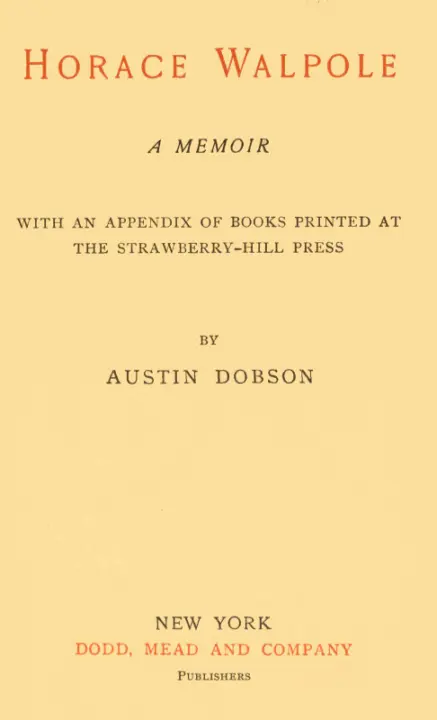
Horace Walpole: A memoir With an appendix of books printed at the Strawberry Hill Press
Austin Dobson
THE CLASSIC COLLECTION · 1895
"Collected Poems in Two Volumes, Vol. II" by Austin Dobson is a collection of poetry written in the late 19th century. This volume showcases a variety of lyrical poems that explore themes such as love, nostalgia, nature, and the passage of time, reflecting a keen observation of the world and a rich emotional landscape. The verses include ballads and more structured forms, often characterized by a light, playful tone mixed with deeper philosophical reflections. The opening of the collection presents a distinctly whimsical tone, beginning with the poem "At the Sign of the Lyre," where the poet welcomes readers to enjoy a selection of songs and ballads, promising pleasure and engagement with the lyrical form. The subsequent pieces, starting with "The Ladies of St. James's," juxtapose the charm of rustic beauty, embodied in the character Phyllida, with the artificiality of high society. Using vivid imagery and accessible language, the poems invite readers into scenes that are both relatable and richly decorated with emotional depth, setting the stage for the diverse themes and styles that Dobson employs throughout the volume.
Introduction adapted from the source catalogue; source summaries may be automatically generated.
Free to read · English · 30,546 words · No account needed
MAKE TIME FOR A GOOD BOOK
On by default. Untick to stop anonymous reading totals. Each page counts after 10 seconds in view. How this works.
Anonymous counting is on unless you have switched it off.
You liked me then, carina,--
You liked me then, I think;
For your sake gall had been a
Mere tonic-cup to drink;
For your sake, bonds were trivial,
The rack, a tour-de-force;
And banishment, convivial,--
You coming too, of course.
Then, Rose, a word in jest meant
Would throw you in a state
That no well-timed investment
Could quite alleviate;
Beyond a Paris trousseau
You prized my smile, I know,
I, yours--ah, more than Rousseau
The lip of d'Houdetot.
Then, Rose,--But why pursue it?
When Fate begins to frown
Best write the final "fuit,"
And gulp the physic down.
And yet,--and yet, that only,
The song should end with this:--
You left me,--left me lonely,
Rosa mutabilis!
Left me, with Time for Mentor,
(A dreary tete-a-tete!)
To pen my "Last Lament," or
Extemporize to Fate,
In blankest verse disclosing
My bitterness of mind,--
Which is, I learn, composing
In cases of the kind.
No, Rose. Though you refuse me,
Culture the pang prevents;
"I am not made"--excuse me--
"Of so slight elements;"
I leave to common lovers
The hemlock or the hood;
My rarer soul recovers
In dreams of public good.
The Roses of this nation--
Or so I understand
From careful computation--
Exceed the gross demand;
And, therefore, in civility
To maids that can't be matched,
No man of sensibility
Should linger unattached.
So, without further fashion--
A modern Curtius,
Plunging, from pure compassion,
To aid the overplus,--
I sit down, sad--not daunted,
And, in my weeds, begin
A new card--"Tenant Wanted;
Particulars within."
"Quid fles, Asterie, quem tibi candidi
Primo restituent vere Favonii--
Gygen?"
Come, Laura, patience. Time and Spring
Your absent Arthur back shall bring,
Enriched with many an Indian thing
Once more to woo you;
Him neither wind nor wave can check,
Who, cramped beneath the "Simla's" deck,
Still constant, though with stiffened neck,
Makes verses to you.
Would it were wave and wind alone!
The terrors of the torrid zone,
The indiscriminate cyclone,
A man might parry;
But only faith, or "triple brass,"
Can help the "outward-bound" to pass
Safe through that eastward-faring class
Who sail to marry.
For him fond mothers, stout and fair,
Ascend the tortuous cabin stair
Only to hold around his chair
Insidious sessions;
For him the eyes of daughters droop
Across the plate of handed soup,
Suggesting seats upon the poop,
And soft confessions.
Nor are these all his pains, nor most.
Romancing captains cease to boast--
Loud majors leave their whist--to roast
The youthful griffin;
All, all with pleased persistence show
His fate,--"remote, unfriended, slow,"--
His "melancholy" bungalow,--
His lonely tiffin.
Your reading position is saved on this browser. Take it to another device with a library code. Reading pages adapt to text, rather than matching a printed edition.
Austin Dobson
Austin Dobson
Austin Dobson
Austin Dobson
BEHIND THE BOOK
This eBook is for the use of anyone anywhere in the United States and most other parts of the world at no cost and with almost no restrictions whatsoever. You may copy it, give it away or re-use it under the terms of the Project Gutenberg License included with this eBook or online at www.gutenberg.org. If you are not located in the United States, you will have to check the laws of the country where you are located before using this eBook. Read the source licence.
The original source file, including credits and licence, is retained by this library. Request an original-format copy at no charge. Please include the book title and Project Gutenberg identifier #24334.
KEEP YOUR CURIOSITY GOING

Eric Mackay
Edmund Gosse
Sophia Margaretta Hensley
Gilbert Parker
George MacDonald

Elizabeth Bibesco