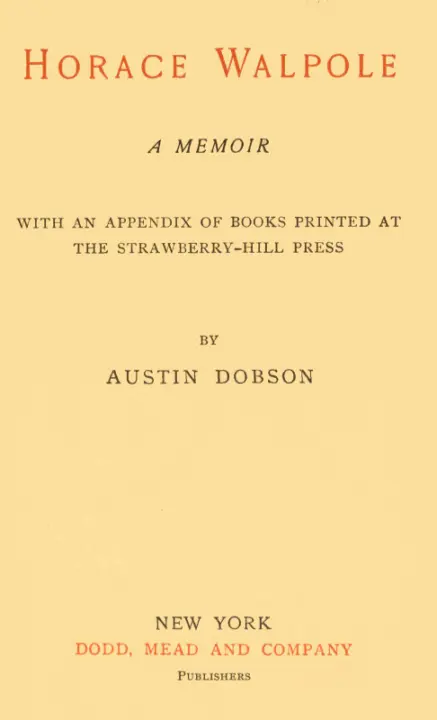
Horace Walpole: A memoir With an appendix of books printed at the Strawberry Hill Press
Austin Dobson
THE CLASSIC COLLECTION · 1895
"Collected Poems in Two Volumes, Vol. II" by Austin Dobson is a collection of poetry written in the late 19th century. This volume showcases a variety of lyrical poems that explore themes such as love, nostalgia, nature, and the passage of time, reflecting a keen observation of the world and a rich emotional landscape. The verses include ballads and more structured forms, often characterized by a light, playful tone mixed with deeper philosophical reflections. The opening of the collection presents a distinctly whimsical tone, beginning with the poem "At the Sign of the Lyre," where the poet welcomes readers to enjoy a selection of songs and ballads, promising pleasure and engagement with the lyrical form. The subsequent pieces, starting with "The Ladies of St. James's," juxtapose the charm of rustic beauty, embodied in the character Phyllida, with the artificiality of high society. Using vivid imagery and accessible language, the poems invite readers into scenes that are both relatable and richly decorated with emotional depth, setting the stage for the diverse themes and styles that Dobson employs throughout the volume.
Introduction adapted from the source catalogue; source summaries may be automatically generated.
Free to read · English · 30,546 words · No account needed
MAKE TIME FOR A GOOD BOOK
On by default. Untick to stop anonymous reading totals. Each page counts after 10 seconds in view. How this works.
Anonymous counting is on unless you have switched it off.
Nurses, no doubt, might name her "somewhat wild;" And pedants, possibly, pronounce her "slow;" Or corset-makers add, that for a child, She needed "cultivation;"--all I know Is that whene'er she spoke, or laughed, or romped, you Felt in each act the beauty of impromptu.
The Lady was a nullity--a pale,
Nerveless and pulseless quasi-invalid,
Who, lest the ozone should in aught avail,
Remained religiously indoors to read;
So that, in wandering at her will, the Child
Did, in reality, run "somewhat wild."
At first but peering at the sanded floor
And great shark jaw-bone in the cosy bar;
Then watching idly from the dusky door,
The noisy advent of a coach or car;
Then stealing out to wonder at the fate
Of blistered Ajax by the garden gate,--
Some old ship's figure-head--until at last,
Straying with each excursion more and more,
She reached the limits of the road, and passed,
Plucking the pansies, downward to the shore,
And so, as you, respected Reader, showed,
Came to the smith's "desirable abode."
There by the cave the occupant she found,
Weaving a crate; and, with a gladsome cry,
The dog frisked out, although the Cyclops frowned
With all the terrors of his single eye;
Then from a mound came running, too, the goat,
Uttering her plaintive, desultory note.
The Child stood wondering at the silent man,
Doubtful to go or stay, when presently
She felt a plucking, for the goat began
To crop the trail of twining briony
She held behind her; so that, laughing, she
Turned her light steps, retreating, to the sea.
But the goat followed her on eager feet,
And therewithal an air so grave and mild,
Coupled with such a deprecatory bleat
Of injured confidence, that soon the Child
Filled the lone shore with louder merriment,
And e'en the Cyclops' heavy brow unbent.
Thus grew acquaintanceship between the pair, The girl and goat;--for thenceforth, day by day, The Child would bring her four-foot friend such fare As might be gathered on the downward way:-- Foxglove, or broom, and "yellow cytisus," Dear to all goats since Greek Theocritus.
But, for the Cyclops, that misogynist
Having, by stress of circumstances, smiled,
Felt it at least incumbent to resist
Further encroachment, and as one beguiled
By adverse fortune, with the half-door shut,
Dwelt in the dim seclusion of his hut.
And yet not less from thence he still must see
That daily coming, and must hear the goat
Bleating her welcome; then, towards the sea,
The happy voices of the playmates float;
Until, at last, enduring it no more,
He took his wonted station by the door.
Your reading position is saved on this browser. Take it to another device with a library code. Reading pages adapt to text, rather than matching a printed edition.
Austin Dobson
Austin Dobson
Austin Dobson
Austin Dobson
BEHIND THE BOOK
This eBook is for the use of anyone anywhere in the United States and most other parts of the world at no cost and with almost no restrictions whatsoever. You may copy it, give it away or re-use it under the terms of the Project Gutenberg License included with this eBook or online at www.gutenberg.org. If you are not located in the United States, you will have to check the laws of the country where you are located before using this eBook. Read the source licence.
The original source file, including credits and licence, is retained by this library. Request an original-format copy at no charge. Please include the book title and Project Gutenberg identifier #24334.
KEEP YOUR CURIOSITY GOING

Eric Mackay
Edmund Gosse
Sophia Margaretta Hensley
Gilbert Parker
George MacDonald

Elizabeth Bibesco