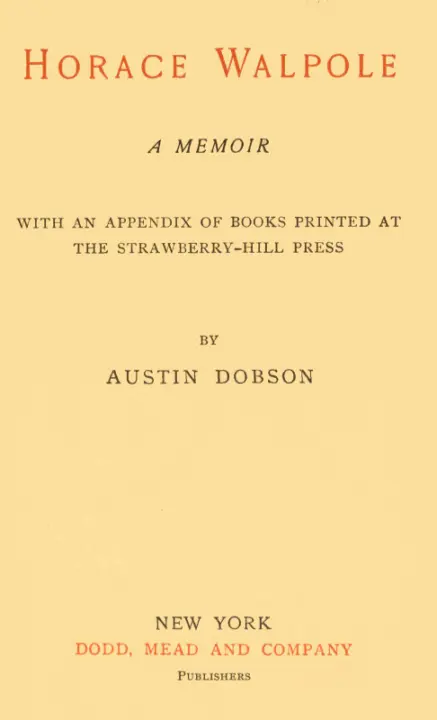
Horace Walpole: A memoir With an appendix of books printed at the Strawberry Hill Press
Austin Dobson
THE CLASSIC COLLECTION · 1895
"Collected Poems in Two Volumes, Vol. II" by Austin Dobson is a collection of poetry written in the late 19th century. This volume showcases a variety of lyrical poems that explore themes such as love, nostalgia, nature, and the passage of time, reflecting a keen observation of the world and a rich emotional landscape. The verses include ballads and more structured forms, often characterized by a light, playful tone mixed with deeper philosophical reflections. The opening of the collection presents a distinctly whimsical tone, beginning with the poem "At the Sign of the Lyre," where the poet welcomes readers to enjoy a selection of songs and ballads, promising pleasure and engagement with the lyrical form. The subsequent pieces, starting with "The Ladies of St. James's," juxtapose the charm of rustic beauty, embodied in the character Phyllida, with the artificiality of high society. Using vivid imagery and accessible language, the poems invite readers into scenes that are both relatable and richly decorated with emotional depth, setting the stage for the diverse themes and styles that Dobson employs throughout the volume.
Introduction adapted from the source catalogue; source summaries may be automatically generated.
Free to read · English · 30,546 words · No account needed
MAKE TIME FOR A GOOD BOOK
On by default. Untick to stop anonymous reading totals. Each page counts after 10 seconds in view. How this works.
Anonymous counting is on unless you have switched it off.
Once--'twas in good Queen ANNA'S Time--
While yet in this benighted Clime
The GENIUS of the ARTS (now known
On mouldy Pediments alone)
Protected all the Men of Mark,
Two Painters met Her in the Park.
Whether She wore the Robe of Air
Portrayed by VERRIO and LAGUERRE;
Or, like BELINDA, trod this Earth,
Equipped with Hoop of monstrous Girth,
And armed at every Point for Slaughter
With Essences and Orange-water,
I know not: but it seems that then,
After some talk of Brush and Pen,--
Some chat of Art both High and Low,
Of VAN'S "Goose-Pie" and KNELLER'S "Mot,"--
The Lady, as a Goddess should,
Bade Them ask of Her what They would.
"Then, Madam, my request," says BRISK,
Giving his Ramillie a whisk,
"Is that your Majesty will crown
My humble Efforts with Renown.
Let me, I beg it--Thanks to You--
Be praised for Everything I do,
Whether I paint a Man of Note,
Or only plan a Petticoat."
"Nay," quoth the other, "I confess"
(This One was plainer in his Dress,
And even poorly clad), "for me,
I scorn Your Popularity.
Why should I care to catch at once
The Point of View of every Dunce?
Let me do well, indeed, but find
The Fancy first, the Work behind;
Nor wholly touch the thing I wanted...."
The Goddess both Petitions granted.
Each in his Way, achieved Success;
But One grew Great. And which One? Guess.
Too oft we hide our Frailties' Blame
Beneath some simple-sounding Name!
So Folks, who in gilt Coaches ride,
Will call Display but Proper Pride;
So Spendthrifts, who their Acres lose,
Curse not their Folly but the Jews;
So Madam, when her Roses faint,
Resorts to ... anything but Paint.
An honest Uncle, who had plied
His Trade of Mercer in Cheapside,
Until his Name on 'Change was found
Good for some Thirty Thousand Pound,
Was burdened with an Heir inclined
To thoughts of quite a different Kind.
His Nephew dreamed of Naught but Verse
From Morn to Night, and, what was worse,
He quitted all at length to follow
That "sneaking, whey-faced God, APOLLO."
In plainer Words, he ran up Bills
At Child's, at Batson's and at Will's;
Discussed the Claims of rival Bards
At Midnight,--with a Pack of Cards;
Or made excuse for "t'other Bottle"
Over a point in ARISTOTLE.
This could not last, and like his Betters
He found, too soon, the Cost of Letters.
Back to his Uncle's House he flew,
Confessing that he'd not a Sou.
'Tis true, his Reasons, if sincere,
Were more poetical than clear:
"Alas!" he said, "I name no Names:
The Muse, dear Sir, the Muse has claims."
His Uncle, who, behind his Till,
Knew less of Pindus than Snow-Hill,
Looked grave, but thinking (as Men say)
That Youth but once can have its Day,
Equipped anew his Pride and Hope
To frisk it on Parnassus Slope.
In one short Month he sought the Door
More shorn and ragged than before.
This Time he showed but small Contrition,
And gloried in his mean Condition.
"The greatest of our Race," he said,
"Through Asian Cities begged his Bread.
The Muse--the Muse delights to see
Not Broadcloth but Philosophy!
Who doubts of this her Honour shames,
But (as you know) she has her Claims...."
"Friend," quoth his Uncle then, "I doubt
This scurvy Craft that you're about
Will lead your philosophic Feet
Either to Bedlam or the Fleet.
Still, as I would not have you lack,
Go get some Broadcloth to your Back,
And--if it please this precious Muse--
'Twere well to purchase decent Shoes.
Though harkye, Sir...." The Youth was gone,
Before the good Man could go on.
Your reading position is saved on this browser. Take it to another device with a library code. Reading pages adapt to text, rather than matching a printed edition.
Austin Dobson
Austin Dobson
Austin Dobson
Austin Dobson
BEHIND THE BOOK
This eBook is for the use of anyone anywhere in the United States and most other parts of the world at no cost and with almost no restrictions whatsoever. You may copy it, give it away or re-use it under the terms of the Project Gutenberg License included with this eBook or online at www.gutenberg.org. If you are not located in the United States, you will have to check the laws of the country where you are located before using this eBook. Read the source licence.
The original source file, including credits and licence, is retained by this library. Request an original-format copy at no charge. Please include the book title and Project Gutenberg identifier #24334.
KEEP YOUR CURIOSITY GOING

Eric Mackay
Edmund Gosse
Sophia Margaretta Hensley
Gilbert Parker
George MacDonald

Elizabeth Bibesco