THE CLASSIC COLLECTION✦A dead man’s diaryCLASSIC FREE BOOKS
A dead man’s diary
Coulson Kernahan
THE CLASSIC COLLECTION · 1889
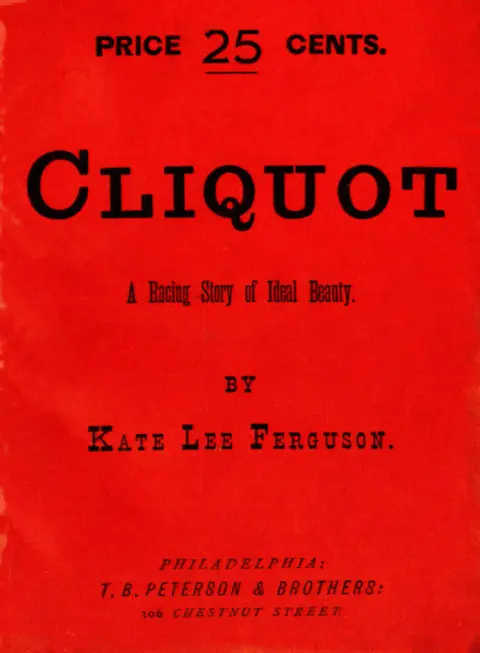
"Cliquot: A Racing Story of Ideal Beauty" by Kate Lee Ferguson is a romance novel likely written in the late 19th century. The story revolves around Neil Emory, a man with a troubled past, and his deep affections for Gwendoline Gwinn, juxtaposed against the backdrop of horse racing and a particularly dangerous stallion named Cliquot. As the plot unfolds, themes of love, ambition, and societal expectations are woven into a tapestry that includes elements of both personal struggle and the thrill of the racetrack. The opening of "Cliquot" introduces a riveting incident on the racetrack, where another jockey has been killed due to the violent behavior of the powerful stallion, Cliquot. Neil Emory, the horse's owner, grapples with the implications of this tragedy as he contemplates finding a new rider amidst a chaotic environment. The scene vividly depicts the tension and excitement of the racing world, while also hinting at Neil's complex emotions regarding his past and his feelings for Gwendoline. He is determined to win the upcoming race, not just for the financial stakes but also for personal redemption. The introduction sets the tone for a narrative rich in passionate love, fierce ambition, and the dangers of the sporting life.
Introduction adapted from the source catalogue; source summaries may be automatically generated.
Free to read · English · 37,818 words · No account needed
MAKE TIME FOR A GOOD BOOK
On by default. Untick to stop anonymous reading totals. Each page counts after 10 seconds in view. How this works.
Anonymous counting is on unless you have switched it off.
When the gayest month of the winter--February--came, it brought with it Gray and Maury, who thought the smiles upon her lips were just as sweet, though fraught with a sadness they had not known before. Young Maury pressed his suit, but in vain; and, at last, he, too, went home, a “sadder if not a wiser man.” I do not think I have ever led you to suppose that Reginald Gray had cared for her in a lover-like way. His place in these pages has only been that of Neil Emory’s friend--perhaps, one of Gwendoline’s, too--and the would-be lover of that gloriously seductive creature, Cassandra Clovis.
“Ah, me!” he thought, “I didn’t want the embers of a heart, burned in the furnace of her love for my friend,” and he heaved a sigh,--a rather uncommon sound, as coming from so light a breast.
Let us trust that he will find on earth a fitting mate, one who will give unto him the first sweet love of her girlhood and lavish on those bright features the purest and best of caresses. We bless you, Reginald, and offer for you this prayer, knowing as we do the purity of your heart, and so bid you a last farewell.
One cold, raw evening, Gwendoline, returning from a reception, entered her apartments through the sitting-room. She found it dark, and, hearing Alice in the bed-chamber, passed on, and, giving her wraps into her hands, returned to the sitting-room. She was shivering from the cold, and, going to the fire, stirred it to a blaze. The brightness illuminated floor and ceiling, chairs and table, falling on the black marble of the last-mentioned article of furniture, and upon the whiteness of a visiting card that lay like a snowflake before her, as she stood with her back to the chimney. Leaning over, she took it up, and turned it to the light behind her.
She was rolling it now softly, now fiercely, between her fingers, when her maid spoke to her, asking some questions about her wardrobe; then, finding herself unanswered, she went again to her work of folding and unfolding her mistress’ tumbled dresses. Presently, Gwendoline moved and, darting into the other room, said:
“When did this come?” and she held out the card, adding: “And did you
see him?”
“It came some hours ago,” replied the girl; “and, yes, Miss, I did see him for a few moments.”
“And you never told me!”
“How could I? I have not seen you since,” and Alice went on hanging and putting away the dresses.
The mistress walked in a restless manner about the room, then, stopping in front of the girl, asked:
Your reading position is saved on this browser. Take it to another device with a library code. Reading pages adapt to text, rather than matching a printed edition.
BEHIND THE BOOK
This eBook is for the use of anyone anywhere in the United States and most other parts of the world at no cost and with almost no restrictions whatsoever. You may copy it, give it away or re-use it under the terms of the Project Gutenberg License included with this eBook or online at www.gutenberg.org. If you are not located in the United States, you will have to check the laws of the country where you are located before using this eBook. Read the source licence.
The original source file, including credits and licence, is retained by this library. Request an original-format copy at no charge. Please include the book title and Project Gutenberg identifier #66587.
KEEP YOUR CURIOSITY GOING
Coulson Kernahan

Maurice Baring
Frances Wright
Cécile Tormay

Frederic Jesup Stimson

W. H. P. (William Henry Pope) Jarvis