THE CLASSIC COLLECTION✦My diaries, being a personal narrative of events 1888-1914, Part 2 (1900-1914)CLASSIC FREE BOOKS
My diaries, being a personal narrative of events 1888-1914, Part 2 (1900-1914)
Wilfrid Scawen Blunt
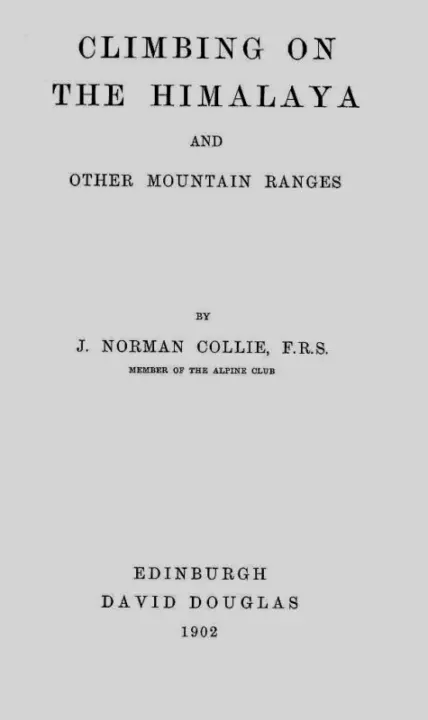
THE CLASSIC COLLECTION · 1902
"Climbing on the Himalaya and Other Mountain Ranges" by J. Norman Collie is a mountaineering narrative written in the early 20th century. This work blends personal adventure with the history of mountaineering, particularly focusing on the exploration of the Himalayan peaks and other mountain ranges. The book delves into Collie's experiences and the challenges faced by climbers as they venture into these majestic terrains. The opening of the book provides a historical overview of mountaineering in the Himalaya, highlighting its allure and the many untrodden paths that remain. Collie reflects on the challenges and dangers inherent in Himalayan exploration, stressing the unique satisfaction derived from conquering these formidable heights. He introduces his own motivation as a climber and the mental and physical qualities necessary for such journeys, setting the stage for his subsequent expeditions, including his experiences leading up to the ascent of Nanga Parbat.
Introduction adapted from the source catalogue; source summaries may be automatically generated.
Free to read · English · 69,591 words · No account needed
MAKE TIME FOR A GOOD BOOK
On by default. Untick to stop anonymous reading totals. Each page counts after 10 seconds in view. How this works.
Anonymous counting is on unless you have switched it off.
Curiously, however, I have found that sometimes those who most loudly complain of the Alps being played out are quite unacquainted with, or at least have never attempted, most of those ascents which it was my good fortune to make with Mummery. Certainly they were mostly made in the Mont Blanc range, a part which does not seem to commend itself so much to mountaineers of the present day as the eastern portion of the Alps. Yet where can be found anywhere else, in the whole range, rock pinnacles that are finer than the Aiguille Noire de Pétéret. Few people know that its west face is a sheer precipice of several thousand feet. In 1899 I was camping for a couple of days with Major Bruce and Harkabir Thapa, just opposite to it on the ridge between the Brouillard and Fresnay glaciers. It was then I watched a slab of rock fall from about twenty feet below the summit. It was a mass weighing perhaps fifty or a hundred tons. For over 1000 feet it touched nothing, then striking on a ledge it burst into a thousand fragments with a noise like thunder, and hardly one of the fragments touched rock again, but descended straight to the snows of the Fresnay glacier beneath.
We were investigating the south-west corner of Mont Blanc, intending if possible to make the ascent by the continuation of the Brouillard ridge. With this prospect in view, we ascended the Brouillard glacier to near the top of the Aiguille l'Innominata, but went no further. The Brouillard is a glacier that to try and descend on a hot summer afternoon would be foolish, to say the least of it. For, set at a very high angle, and broken up in the wildest fashion, although presenting a magnificent spectacle, it does not lend itself to safe mountaineering. Harkabir was much disappointed that we refused to go on, for he thought he could see his way up the rock escarpment at the head of the glacier, and, were that possible, probably no more difficulty would be met with from there to the summit. But in spite of the climber of the party being confident we could proceed, I as conductor insisted on turning back, being only a 'mere mountaineer.' One thing at least I was certain of: Bertolini lived at Courmayeur, not Chamonix, and forty-year old Barolo, together with countless other delicacies, was to be obtained from him alone. To return, however, from the excellences of the cuisine at Bertolini's to those of the range of Mont Blanc, should the jaded climber of 'degraded' mountains want more rock peaks, the ascent of the lesser Dru, in my opinion, can be repeated profitably. Not even amongst the Dolomites can one get the sensation of dizzy height and appalling depth to the same extent as on this mountain; moreover, there is a most sporting though small glacier to cross before one begins the rock ascent. Then the Charmoz and the Grépon are not to be despised. For a most varied climb, requiring every kind of mountain craft, the traverse of the Aiguille du Plan is to be recommended, from the Glacier des Pèlerins over the summit, down the Glacier du Plan, and back by the Glacier du Géant. Again, without doubt, the finest snow and ice climb in the Alps, surrounded the whole time by superb scenery, is from the Montanvert to the hut behind the Aiguille du Midi, thence over Mont Blanc du Tacul and the Mont Maudit to the summit of Mont Blanc, and down to the Grands-Mulets. Of course, I know that to recommend any one to climb Mont Blanc will certainly be regarded as a bold suggestion by those who have noticed a taint of staleness in the great mountains. For of all the peaks that have been overwhelmed by the waters of oblivion, surely Mont Blanc outrivals both the Jungfraus and the Finsteraarhorns of the happy childhood of the Alps. Personally, however, I am a staunch adherent of the 'ancient monarch of the mountains.' But as Leslie Stephen says, the 'coarse flattery of the guide-books has done much to surround him with vulgarising associations.' Surely, though, Mont Blanc is far too magnificent, far too splendid to be much affected by such associations, and as if to shake them off every now and then, after he has been patted on the back by those of every nationality who swarm over his sides, he arises in his anger, hangs out his danger signal above his summit, and sweeps his glaciers and snows clear of the invading crowd. The Föhn wind and the angry clouds envelop him, his snow-fields glare with a ghastly dead white colour, and whirlwinds of clouds, snow, and gloom descend. But the storm passes, and once more he emerges clean and glistening in all his beauty.
Your reading position is saved on this browser. Take it to another device with a library code. Reading pages adapt to text, rather than matching a printed edition.
BEHIND THE BOOK
This eBook is for the use of anyone anywhere in the United States and most other parts of the world at no cost and with almost no restrictions whatsoever. You may copy it, give it away or re-use it under the terms of the Project Gutenberg License included with this eBook or online at www.gutenberg.org. If you are not located in the United States, you will have to check the laws of the country where you are located before using this eBook. Read the source licence.
The original source file, including credits and licence, is retained by this library. Request an original-format copy at no charge. Please include the book title and Project Gutenberg identifier #45747.
KEEP YOUR CURIOSITY GOING
Wilfrid Scawen Blunt
Wilfrid Scawen Blunt

E. W. (Edgar Watson) Howe
Cécile Tormay

Moritz Busch
John L. Ransom