THE CLASSIC COLLECTION✦South Australia and Western AustraliaCLASSIC FREE BOOKS
South Australia and Western Australia
Anthony Trollope
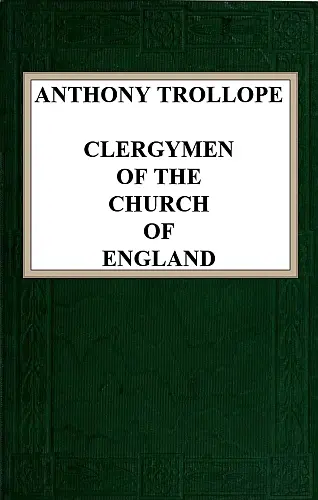
THE CLASSIC COLLECTION · 1866
"Clergymen of the Church of England" by Anthony Trollope is a collection of essays written in the mid-19th century. The work explores the various roles and responsibilities of clergymen within the Church of England, highlighting the changes in their societal position and duties over time. Trollope examines figures such as the archbishop, bishops, and parish clergymen, reflecting on how their identities and functions have evolved in response to broader societal shifts. The opening of the book provides a detailed examination of the modern English archbishop, contrasting their historical status with the more humble role they occupy in the present. Trollope articulates how formerly grand archbishops, once considered princes of the realm, have lost much of their status and influence, as temporal power wanes and societal attitudes shift towards a more egalitarian view. Through a combination of historical context and personal anecdote, he sets the stage for a deeper exploration of the clergy's contemporary identity and their evolving duties within the framework of British society.
Introduction adapted from the source catalogue; source summaries may be automatically generated.
Free to read · English · 25,793 words · No account needed
MAKE TIME FOR A GOOD BOOK
On by default. Untick to stop anonymous reading totals. Each page counts after 10 seconds in view. How this works.
Anonymous counting is on unless you have switched it off.
But, above all things, an archdeacon should be a man of the world. He should know well, not only how many shillings there are in a pound, but how many shillings also there are in a clerical pound,--for in these matters there is a difference. Five hundred a year is much more in the hands of a country parson than it is in the hands of a country gentleman who is not a parson,--all which the efficient archdeacon understands and has at his fingers’ ends to the last shilling of the calculation. He should understand, too, after what fashion his brother rectors and vicars live around him,--should know something of their habits, something also of their means, and should have an eye open to their welfare, their pursuits, and their amusements. Of all these things the really stirring archdeacon does in fact know very much.
The archdeacon is, in fact, a bishop in little, and as such is often much more of a bishop in fact than is the bishop himself. To define,--or rather to make intelligible by any definition,--an archdeacon’s power and duties, would be very difficult; as also it is very difficult, or I may say impossible, to do so with reference to a bishop’s functions. The archdeacon holds a court, and makes visitations. These visitations may be made pretty much at his pleasure. He must, I believe, make them once in three years, but may make them every year if he thinks fit. He inquires as to the administration of the services, seeing that the canons are maintained, but has no power to alter aught; and as there seems to be much difficulty in knowing when and by what the canons are maintained, and when and by what they are not maintained, we may imagine that the inquiries of a discreet archdeacon into the practices of a respectable and efficient parson will not be too close or searching in this matter of the canons. It is, however, easier to see whether the windows of a church are in repair, and whether the roof keeps out the rain, than it is to be intelligibly and efficiently explicit on the subject of canons, and, therefore, the outward structure of the parish church gives very safe employment to an archdeacon. The little difficulty as to church rates which sometimes follows upon an order for repairs is not uncongenial to the archdeacon’s mind. It hinges upon politics, and upon a vexed political question in which the archdeacon, as a strong local Conservative, has hitherto had his victories. There remain so very few subjects which are still grateful to him in the same way, that church rates, with all their little impediments and embargoes, naturally present themselves to him as pleasant matters. And then the archdeacons receive reports from the churchwardens, if churchwardens have anything to report,--any scandal of which to tell, or evil practices on the parson’s side of which complaint has unfortunately become necessary according to the judgment of those churchwardens! By the word “scandal” let not the uninitiated reader be led to think that undignified tittle-tattle with his neighbour’s churchwardens is the duty or the employment of an archdeacon. Open moral misconduct in a clergyman’s life is supposed to be matter of justifiable public scandal--the scandal arising with the clerical sinner, and not with those who tell of the sin--and, as such, is, by the constitution of our Church, an especial subject for the care of our archdeacons, and indeed, under them, of our churchwardens. But in such matters archdeacons are liberal, and much prefer to wink an eye than to see too much. We may imagine that a churchwarden, misunderstanding his mission with regard to scandal, and taking upon himself too promptly the duty of watching the moral conduct of his parson, would not receive much comfort from a visiting archdeacon. No one knows better than an archdeacon--no one knows so well as an archdeacon--that it is needless and absurd to look for a St. Paul in every parsonage. He would, indeed, be very little at his own ease with a local St. Paul, much preferring a comfortable rector, who can take his glass of wine after dinner and talk pleasantly of old college days. St. Pauls, however, do not trouble him; nor is he troubled much by the scandals of his clerical neighbours; but he must be troubled sorely, I should think, by the increasing number and increasing influence around him of those “literate” clergymen who--from want of better, as we must in sorrow confess,--are flocking to us from Islington, Birkenhead, and such like fountains of pastoral care. The man who won’t drink his glass of wine, and talk of his college, and put off for a few happy hours the sacred stiffnesses of the profession and become simply an English gentleman,--he is the clergyman whom in his heart the archdeacon does not love.
Your reading position is saved on this browser. Take it to another device with a library code. Reading pages adapt to text, rather than matching a printed edition.
Anthony Trollope

Anthony Trollope

Anthony Trollope

Anthony Trollope
BEHIND THE BOOK
This eBook is for the use of anyone anywhere in the United States and most other parts of the world at no cost and with almost no restrictions whatsoever. You may copy it, give it away or re-use it under the terms of the Project Gutenberg License included with this eBook or online at www.gutenberg.org. If you are not located in the United States, you will have to check the laws of the country where you are located before using this eBook. Read the source licence.
The original source file, including credits and licence, is retained by this library. Request an original-format copy at no charge. Please include the book title and Project Gutenberg identifier #55665.
KEEP YOUR CURIOSITY GOING

David Patterson (Spirit) Hatch

David Patterson (Spirit) Hatch

David Patterson (Spirit) Hatch
Cécile Tormay

Moritz Busch
John L. Ransom