THE CLASSIC COLLECTION✦The Early Life of Mark Rutherford (W. Hale White)CLASSIC FREE BOOKS
The Early Life of Mark Rutherford (W. Hale White)
William Hale White
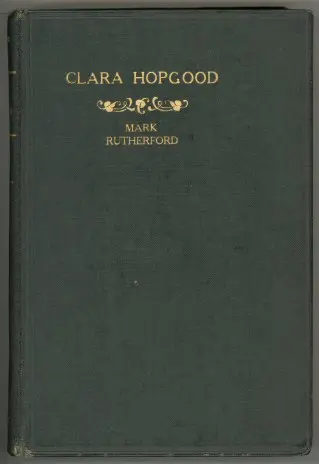
THE CLASSIC COLLECTION · 1896
"Clara Hopgood" by Mark Rutherford is a novel written in the late 19th century. The story centers around the lives of the Hopgood sisters, Clara and Madge, as they navigate their upbringing in the provincial town of Fenmarket, shaped by both the constraints of society and their intellectual aspirations. The novel explores themes of love, duty, and the pursuit of personal freedom within a society that often devalues women’s education and autonomy. The opening of the novel introduces us to Fenmarket, a mundane and somewhat oppressive locale, and contrasts it with the more vibrant and intellectually stimulating experiences of Clara and Madge during their formative years. Clara is depicted as the more reserved and introspective of the two sisters, while Madge has a more outgoing personality but struggles with societal expectations. Their relationships, particularly with their father, who encourages their education, and with Mr. Frank Palmer, who becomes a significant suitor for Madge, set the stage for conflicts between personal desires and societal norms. The sisters’ contrasting personalities and their interactions with the people of Fenmarket provide a rich backdrop for their journeys of self-discovery and the challenges they face in a society that seeks to define their roles as women.
Introduction adapted from the source catalogue; source summaries may be automatically generated.
Free to read · English · 49,490 words · No account needed
MAKE TIME FOR A GOOD BOOK
On by default. Untick to stop anonymous reading totals. Each page counts after 10 seconds in view. How this works.
Anonymous counting is on unless you have switched it off.
‘There are three of us,’ she said, ‘as knows you—Miss Madge, Miss Clara and myself—and, as far as you are concerned, we are dead and buried. I can’t say as I was altogether of Miss Madge’s way of looking at it at first, and I thought it ought to have been different, though I believe now as she’s right, but,’ and the old woman suddenly fired up as if some bolt from heaven had kindled her, ‘I pity you, sir—you, sir, I say—more nor I do her. You little know what you’ve lost, the blessedest, sweetest, ah, and the cleverest creature, too, as ever I set eyes on.’
‘But, Mrs Caffyn,’ said Frank, with much emotion, ‘it was not I who left her, you know it was not, and, and even—’
The word ‘now’ was coming, but it did not come.
‘Ah,’ said Mrs Caffyn, with something like scorn, ‘I know, yes, I do know. It was she, you needn’t tell me that, but, God-a-mighty in heaven, if I’d been you, I’d have laid myself on the ground afore her, I’d have tore my heart out for her, and I’d have said, “No other woman in this world but you”—but there, what a fool I am! Goodbye, Mr Palmer.’
She marched away, leaving Frank very miserable, and, as he imagined, unsettled, but he was not so. The fit lasted all day, but when he was walking home that evening, he met a poor friend whose wife was dying.
‘I am so grieved,’ said Frank ‘to hear of your trouble—no hope?’
‘None, I am afraid.’
‘It is very dreadful.’
‘Yes, it is hard to bear, but to what is inevitable we must submit.’
This new phrase struck Frank very much, and it seemed very philosophic to him, a maxim, for guidance through life. It did not strike him that it was generally either a platitude or an excuse for weakness, and that a nobler duty is to find out what is inevitable and what is not, to declare boldly that what the world oftentimes affirms to be inevitable is really evitable, and heroically to set about making it so. Even if revolt be perfectly useless, we are not particularly drawn to a man who prostrates himself too soon and is incapable of a little cursing.
As it was impossible to provide for Madge and the child now, Frank considered whether he could not do something for them in the will which he had to make before his marriage. He might help his daughter if he could not help the mother.
Your reading position is saved on this browser. Take it to another device with a library code. Reading pages adapt to text, rather than matching a printed edition.
William Hale White
William Hale White
William Hale White
BEHIND THE BOOK
This eBook is for the use of anyone anywhere in the United States and most other parts of the world at no cost and with almost no restrictions whatsoever. You may copy it, give it away or re-use it under the terms of the Project Gutenberg License included with this eBook or online at www.gutenberg.org. If you are not located in the United States, you will have to check the laws of the country where you are located before using this eBook. Read the source licence.
The original source file, including credits and licence, is retained by this library. Request an original-format copy at no charge. Please include the book title and Project Gutenberg identifier #5986.
KEEP YOUR CURIOSITY GOING
Coulson Kernahan

Maurice Baring
Frances Wright
Cécile Tormay

Frederic Jesup Stimson

W. H. P. (William Henry Pope) Jarvis