THE CLASSIC COLLECTION✦The Early Life of Mark Rutherford (W. Hale White)CLASSIC FREE BOOKS
The Early Life of Mark Rutherford (W. Hale White)
William Hale White
THE CLASSIC COLLECTION · 1896
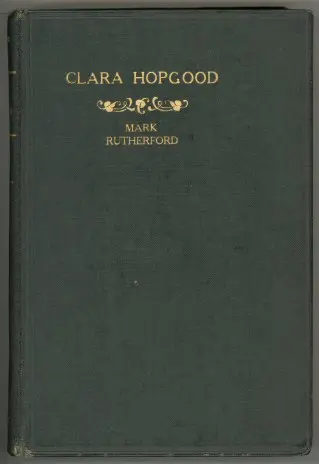
"Clara Hopgood" by Mark Rutherford is a novel written in the late 19th century. The story centers around the lives of the Hopgood sisters, Clara and Madge, as they navigate their upbringing in the provincial town of Fenmarket, shaped by both the constraints of society and their intellectual aspirations. The novel explores themes of love, duty, and the pursuit of personal freedom within a society that often devalues women’s education and autonomy. The opening of the novel introduces us to Fenmarket, a mundane and somewhat oppressive locale, and contrasts it with the more vibrant and intellectually stimulating experiences of Clara and Madge during their formative years. Clara is depicted as the more reserved and introspective of the two sisters, while Madge has a more outgoing personality but struggles with societal expectations. Their relationships, particularly with their father, who encourages their education, and with Mr. Frank Palmer, who becomes a significant suitor for Madge, set the stage for conflicts between personal desires and societal norms. The sisters’ contrasting personalities and their interactions with the people of Fenmarket provide a rich backdrop for their journeys of self-discovery and the challenges they face in a society that seeks to define their roles as women.
Introduction adapted from the source catalogue; source summaries may be automatically generated.
Free to read · English · 49,490 words · No account needed
MAKE TIME FOR A GOOD BOOK
On by default. Untick to stop anonymous reading totals. Each page counts after 10 seconds in view. How this works.
Anonymous counting is on unless you have switched it off.
‘I knew a case in which a man had to encounter three successive trials of all the courage and inventive faculty in him. Failure in one would have been ruin. The odds against him in each trial were desperate, and against ultimate victory were overwhelming. Nevertheless, he made the attempt, and was triumphant, by the narrowest margin, in every struggle. That which is of most value to us is often obtained in defiance of the laws of probability.’
‘What is precious in Quakerism is not so much the doctrine of the Divine voice as that of the preliminary stillness, the closure against other voices and the reduction of the mind to a condition in which it can listen, in which it can discern the merest whisper, inaudible when the world, or interest, or passion, are permitted to speak.’
‘The acutest syllogiser can never develop the actual consequences of any system of policy, or, indeed, of any change in human relationship, man being so infinitely complex, and the interaction of human forces so incalculable.’
‘Many of our speculative difficulties arise from the unauthorised conception of an omnipotent God, a conception entirely of our own creation, and one which, if we look at it closely, has no meaning. It is because God could have done otherwise, and did not, that we are confounded. It may be distressing to think that God cannot do any better, but it is not so distressing as to believe that He might have done better had He so willed.’
Although these passages were disconnected, each of them seemed to Clara to be written in a measure for herself, and her curiosity was excited about the author. Perhaps the man who called would say something about him.
Baruch Cohen was now a little over forty. He was half a Jew, for his father was a Jew and his mother a Gentile. The father had broken with Judaism, but had not been converted to any Christian church or sect. He was a diamond-cutter, originally from Holland, came over to England and married the daughter of a mathematical instrument maker, at whose house he lodged in Clerkenwell. The son was apprenticed to his maternal grandfather’s trade, became very skilful at it, worked at it himself, employed a man and a boy, and supplied London shops, which sold his instruments at about three times the price he obtained for them. Baruch, when he was very young, married Marshall’s elder sister, but she died at the birth of her first child and he had been a widower now for nineteen years. He had often thought of taking another wife, and had seen, during these nineteen years, two or three women with whom he had imagined himself to be really in love, and to whom he had been on the verge of making proposals, but in each case he had hung back, and when he found that a second and a third had awakened the same ardour for a time as the first, he distrusted its genuineness. He was now, too, at a time of life when a man has to make the unpleasant discovery that he is beginning to lose the right to expect what he still eagerly desires, and that he must beware of being ridiculous. It is indeed a very unpleasant discovery. If he has done anything well which was worth doing, or has made himself a name, he may be treated by women with respect or adulation, but any passable boy of twenty is really more interesting to them, and, unhappily, there is perhaps so much of the man left in him that he would rather see the eyes of a girl melt when she looked at him than be adored by all the drawing-rooms in London as the author of the greatest poem since Paradise Lost, or as the conqueror of half a continent. Baruch’s life during the last nineteen years had been such that he was still young, and he desired more than ever, because not so blindly as he desired it when he was a youth, the tender, intimate sympathy of a woman’s love. It was singular that, during all those nineteen years, he should not once have been overcome. It seemed to him as if he had been held back, not by himself, but by some external power, which refused to give any reasons for so doing. There was now less chance of yielding than ever; he was reserved and self-respectful, and his manner towards women distinctly announced to them that he knew what he was and that he had no claims whatever upon them. He was something of a philosopher, too; he accepted, therefore, as well as he could, without complaint, the inevitable order of nature, and he tried to acquire, although often he failed, that blessed art of taking up lightly and even with a smile whatever he was compelled to handle. ‘It is possible,’ he said once, ‘to consider death too seriously.’ He was naturally more than half a Jew; his features were Jewish, his thinking was Jewish, and he believed after a fashion in the Jewish sacred books, or, at anyrate, read them continuously, although he had added to his armoury defensive weapons of another type. In nothing was he more Jewish than in a tendency to dwell upon the One, or what he called God, clinging still to the expression of his forefathers although departing so widely from them. In his ethics and system of life, as well as in his religion, there was the same intolerance of a multiplicity which was not reducible to unity. He seldom explained his theory, but everybody who knew him recognised the difference which it wrought between him and other men. There was a certain concord in everything he said and did, as if it were directed by some enthroned but secret principle.
Your reading position is saved on this browser. Take it to another device with a library code. Reading pages adapt to text, rather than matching a printed edition.
William Hale White
William Hale White
William Hale White
BEHIND THE BOOK
This eBook is for the use of anyone anywhere in the United States and most other parts of the world at no cost and with almost no restrictions whatsoever. You may copy it, give it away or re-use it under the terms of the Project Gutenberg License included with this eBook or online at www.gutenberg.org. If you are not located in the United States, you will have to check the laws of the country where you are located before using this eBook. Read the source licence.
The original source file, including credits and licence, is retained by this library. Request an original-format copy at no charge. Please include the book title and Project Gutenberg identifier #5986.
KEEP YOUR CURIOSITY GOING
Coulson Kernahan

Maurice Baring
Frances Wright
Cécile Tormay

Frederic Jesup Stimson

W. H. P. (William Henry Pope) Jarvis