THE CLASSIC COLLECTION✦The Early Life of Mark Rutherford (W. Hale White)CLASSIC FREE BOOKS
The Early Life of Mark Rutherford (W. Hale White)
William Hale White
THE CLASSIC COLLECTION · 1896
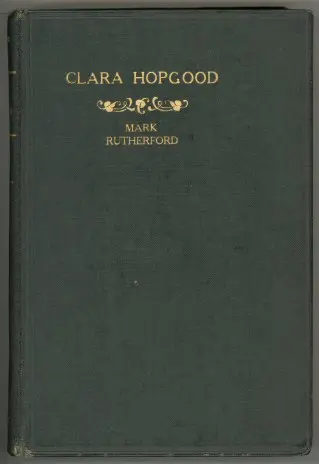
"Clara Hopgood" by Mark Rutherford is a novel written in the late 19th century. The story centers around the lives of the Hopgood sisters, Clara and Madge, as they navigate their upbringing in the provincial town of Fenmarket, shaped by both the constraints of society and their intellectual aspirations. The novel explores themes of love, duty, and the pursuit of personal freedom within a society that often devalues women’s education and autonomy. The opening of the novel introduces us to Fenmarket, a mundane and somewhat oppressive locale, and contrasts it with the more vibrant and intellectually stimulating experiences of Clara and Madge during their formative years. Clara is depicted as the more reserved and introspective of the two sisters, while Madge has a more outgoing personality but struggles with societal expectations. Their relationships, particularly with their father, who encourages their education, and with Mr. Frank Palmer, who becomes a significant suitor for Madge, set the stage for conflicts between personal desires and societal norms. The sisters’ contrasting personalities and their interactions with the people of Fenmarket provide a rich backdrop for their journeys of self-discovery and the challenges they face in a society that seeks to define their roles as women.
Introduction adapted from the source catalogue; source summaries may be automatically generated.
Free to read · English · 49,490 words · No account needed
MAKE TIME FOR A GOOD BOOK
On by default. Untick to stop anonymous reading totals. Each page counts after 10 seconds in view. How this works.
Anonymous counting is on unless you have switched it off.
‘What on earth can be found in “St Paul” which can be put to music?’ said Madge. ‘Fancy a chapter in the Epistle to the Romans turned into a duet!’
‘Madge! Madge! I am ashamed of you,’ said her mother.
‘Well, mother,’ said Clara, ‘I am sure that some of the settings by your divinity, Handel, are absurd. “For as in Adam all die” may be true enough, and the harmonies are magnificent, but I am always tempted to laugh when I hear it.’
Frank hummed the familiar apostrophe ‘Be not afraid.’
‘Is that a bit of “St Paul”?’ said Mrs Hopgood.
‘Yes, it goes like this,’ and Frank went up to the little piano and sang
the song through.
‘There is no fault to be found with that,’ said Madge, ‘so far as the coincidence of sense and melody is concerned, but I do not care much for oratorios. Better subjects can be obtained outside the Bible, and the main reason for selecting the Bible is that what is called religious music may be provided for good people. An oratorio, to me, is never quite natural. Jewish history is not a musical subject, and, besides, you cannot have proper love songs in an oratorio, and in them music is at its best.’
Mrs Hopgood was accustomed to her daughter’s extravagance, but she was, nevertheless, a little uncomfortable.
‘Ah!’ said Frank, who had not moved from the piano, and he struck the first two bars of ‘Adelaide.’
‘Oh, please,’ said Madge, ‘go on, go on,’ but Frank could not quite
finish it.
She was sitting on the little sofa, and she put her feet up, lay and listened with her eyes shut. There was a vibration in Mr Palmer’s voice not perceptible during his vision of the crown of life and of fidelity to death.
‘Are you going to stay over Sunday?’ inquired Mrs Hopgood.
‘I am not quite sure; I ought to be back on Sunday evening. My father likes me to be at home on that day.’
‘Is there not a Mr Maurice who is a friend of your father?’
‘Oh, yes, a great friend.’
‘He is not High Church nor Low Church?’
‘No, not exactly.’
‘What is he, then? What does he believe?’
‘Well, I can hardly say; he does not believe that anybody will be burnt in a brimstone lake for ever.’
‘That is what he does not believe,’ interposed Clara.
‘He believes that Socrates and the great Greeks and Romans who acted up to the light that was within them were not sent to hell. I think that is glorious, don’t you?’
Your reading position is saved on this browser. Take it to another device with a library code. Reading pages adapt to text, rather than matching a printed edition.
William Hale White
William Hale White
William Hale White
BEHIND THE BOOK
This eBook is for the use of anyone anywhere in the United States and most other parts of the world at no cost and with almost no restrictions whatsoever. You may copy it, give it away or re-use it under the terms of the Project Gutenberg License included with this eBook or online at www.gutenberg.org. If you are not located in the United States, you will have to check the laws of the country where you are located before using this eBook. Read the source licence.
The original source file, including credits and licence, is retained by this library. Request an original-format copy at no charge. Please include the book title and Project Gutenberg identifier #5986.
KEEP YOUR CURIOSITY GOING
Coulson Kernahan

Maurice Baring
Frances Wright
Cécile Tormay

Frederic Jesup Stimson

W. H. P. (William Henry Pope) Jarvis