THE CLASSIC COLLECTION✦The Early Life of Mark Rutherford (W. Hale White)CLASSIC FREE BOOKS
The Early Life of Mark Rutherford (W. Hale White)
William Hale White
THE CLASSIC COLLECTION · 1896
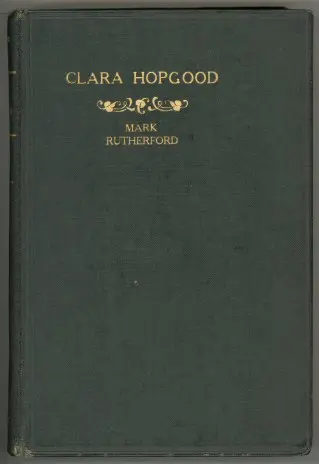
"Clara Hopgood" by Mark Rutherford is a novel written in the late 19th century. The story centers around the lives of the Hopgood sisters, Clara and Madge, as they navigate their upbringing in the provincial town of Fenmarket, shaped by both the constraints of society and their intellectual aspirations. The novel explores themes of love, duty, and the pursuit of personal freedom within a society that often devalues women’s education and autonomy. The opening of the novel introduces us to Fenmarket, a mundane and somewhat oppressive locale, and contrasts it with the more vibrant and intellectually stimulating experiences of Clara and Madge during their formative years. Clara is depicted as the more reserved and introspective of the two sisters, while Madge has a more outgoing personality but struggles with societal expectations. Their relationships, particularly with their father, who encourages their education, and with Mr. Frank Palmer, who becomes a significant suitor for Madge, set the stage for conflicts between personal desires and societal norms. The sisters’ contrasting personalities and their interactions with the people of Fenmarket provide a rich backdrop for their journeys of self-discovery and the challenges they face in a society that seeks to define their roles as women.
Introduction adapted from the source catalogue; source summaries may be automatically generated.
Free to read · English · 49,490 words · No account needed
MAKE TIME FOR A GOOD BOOK
On by default. Untick to stop anonymous reading totals. Each page counts after 10 seconds in view. How this works.
Anonymous counting is on unless you have switched it off.
‘Pardon me, that is just where you and I differ. Whenever any real good is done it is by a crusade; that is to say, the cross must be raised and appeal be made to something above the people. No system based on rights will stand. Never will society be permanent till it is founded on duty. If we consider our rights exclusively, we extend them over the rights of our neighbours. If the oppressed classes had the power to obtain their rights to-morrow, and with the rights came no deeper sense of duty, the new order, for the simple reason that the oppressed are no better than their oppressors, would be just as unstable as that which preceded it.’
‘To put it in my own language,’ said Madge, ‘you believe in God.’
Mazzini leaned forward and looked earnestly at her.
‘My dear young friend, without that belief I should have no other.’
‘I should like, though,’ said Marshall, ‘to see the church which would acknowledge you and Miss Madge, or would admit your God to be theirs.’
‘What is essential,’ replied Madge, ‘in a belief in God is absolute loyalty to a principle we know to have authority.’
‘It may, perhaps,’ said Mazzini, ‘be more to me, but you are right, it is a belief in the supremacy and ultimate victory of the conscience.’
‘The victory seems distant in Italy now,’ said Baruch. ‘I do not mean the millennial victory of which you speak, but an approximation to it by the overthrow of tyranny there.’
‘You are mistaken; it is far nearer than you imagine.’
‘Do you obtain,’ said Clara, ‘any real help from people here? Do you not find that they merely talk and express what they call their sympathy?’
‘I must not say what help I have received; more than words, though, from
many.’
‘You expect, then,’ said Baruch, ‘that the Italians will answer your
appeal?’
‘If I had no faith in the people, I do not see what faith could survive.’
‘The people are the persons you meet in the street.’
‘A people is not a mere assemblage of uninteresting units, but it is not a phantom. A spirit lives in each nation which is superior to any individual in it. It is this which is the true reality, the nation’s purpose and destiny, it is this for which the patriot lives and dies.’
‘I suppose,’ said Clara, ‘you have no difficulty in obtaining volunteers for any dangerous enterprise?’
‘None. You would be amazed if I were to tell you how many men and women at this very moment would go to meet certain death if I were to ask them.’
‘Women?’
Your reading position is saved on this browser. Take it to another device with a library code. Reading pages adapt to text, rather than matching a printed edition.
William Hale White
William Hale White
William Hale White
BEHIND THE BOOK
This eBook is for the use of anyone anywhere in the United States and most other parts of the world at no cost and with almost no restrictions whatsoever. You may copy it, give it away or re-use it under the terms of the Project Gutenberg License included with this eBook or online at www.gutenberg.org. If you are not located in the United States, you will have to check the laws of the country where you are located before using this eBook. Read the source licence.
The original source file, including credits and licence, is retained by this library. Request an original-format copy at no charge. Please include the book title and Project Gutenberg identifier #5986.
KEEP YOUR CURIOSITY GOING
Coulson Kernahan

Maurice Baring
Frances Wright
Cécile Tormay

Frederic Jesup Stimson

W. H. P. (William Henry Pope) Jarvis