THE CLASSIC COLLECTION✦The Early Life of Mark Rutherford (W. Hale White)CLASSIC FREE BOOKS
The Early Life of Mark Rutherford (W. Hale White)
William Hale White
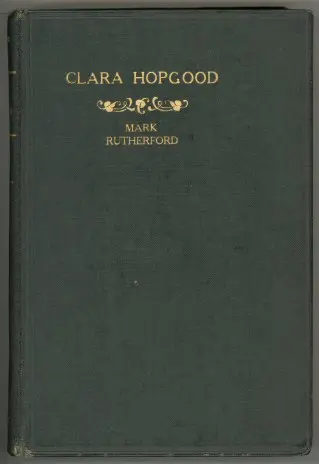
THE CLASSIC COLLECTION · 1896
"Clara Hopgood" by Mark Rutherford is a novel written in the late 19th century. The story centers around the lives of the Hopgood sisters, Clara and Madge, as they navigate their upbringing in the provincial town of Fenmarket, shaped by both the constraints of society and their intellectual aspirations. The novel explores themes of love, duty, and the pursuit of personal freedom within a society that often devalues women’s education and autonomy. The opening of the novel introduces us to Fenmarket, a mundane and somewhat oppressive locale, and contrasts it with the more vibrant and intellectually stimulating experiences of Clara and Madge during their formative years. Clara is depicted as the more reserved and introspective of the two sisters, while Madge has a more outgoing personality but struggles with societal expectations. Their relationships, particularly with their father, who encourages their education, and with Mr. Frank Palmer, who becomes a significant suitor for Madge, set the stage for conflicts between personal desires and societal norms. The sisters’ contrasting personalities and their interactions with the people of Fenmarket provide a rich backdrop for their journeys of self-discovery and the challenges they face in a society that seeks to define their roles as women.
Introduction adapted from the source catalogue; source summaries may be automatically generated.
Free to read · English · 49,490 words · No account needed
MAKE TIME FOR A GOOD BOOK
On by default. Untick to stop anonymous reading totals. Each page counts after 10 seconds in view. How this works.
Anonymous counting is on unless you have switched it off.
Madge turned and fixed her eyes, unobserved, on Baruch. He was looking straight at the bookshelves. There was not, and, indeed, how could there be, any reference to herself.
‘I should put it in this way,’ she said, ‘that he thought he was justified in sacrificing a woman for the sake of an impulse. Call this a defect or a crime—whichever you like—it is repellent to me. It makes no difference to me to know that he believed the impulse to be divine.’
‘I wish,’ interrupted Clara, ‘you two would choose less exciting subjects of conversation; my totals will not come right.’
They were silent, and Baruch, affecting to study a Rollin’s Ancient History, wondered, especially when he called to mind Mrs Caffyn’s report, what this girl’s history could have been. He presently recovered himself, and it occurred to him that he ought to give some reason why he had called. Before, however, he was able to offer any excuse, Clara closed her book.
‘Now, it is right,’ she said, ‘and I am ready.’
Just at that moment Barnes appeared, hot with hurrying.
‘Very sorry, Miss Hopgood, to ask you to stay for a few minutes. I recollected after I left that the doctor particularly wanted those books sent off to-night. I should not like to disappoint him. I have been to the booking-office, and the van will be here in about twenty minutes. If you will make out the invoice and check me, I will pack them.’
‘I will be off,’ said Madge. ‘The shop will be shut if I do not make
haste.’
‘You are not going alone, are you?’ said Baruch. ‘May I not go with you, and cannot we both come back for your sister?’
‘It is very kind of you.’
Clara looked up from her desk, watched them as they went out at the door and, for a moment, seemed lost. Barnes turned round.
‘Now, Miss Hopgood.’ She started.
‘Yes, sir.’
‘Fabricius, J. A. Bibliotheca Ecclesiastica in qua continentur.’
‘I need not put in the last three words.’
‘Yes, yes.’ Barnes never liked to be corrected in a title. ‘There’s another Fabricius Bibliotheca or Bibliographia. Go on—Basili opera ad MSS. codices, 3 vols.’
Clara silently made the entries a little more scholarly. In a quarter of an hour the parcel was ready and Cohen returned.
‘Your sister would not allow me to wait. She met Mrs Marshall; they said they should have something to carry, and that it was not worth while to bring it here. I will walk with you, if you will allow me. We may as well avoid Holborn.’
Your reading position is saved on this browser. Take it to another device with a library code. Reading pages adapt to text, rather than matching a printed edition.
William Hale White
William Hale White
William Hale White
BEHIND THE BOOK
This eBook is for the use of anyone anywhere in the United States and most other parts of the world at no cost and with almost no restrictions whatsoever. You may copy it, give it away or re-use it under the terms of the Project Gutenberg License included with this eBook or online at www.gutenberg.org. If you are not located in the United States, you will have to check the laws of the country where you are located before using this eBook. Read the source licence.
The original source file, including credits and licence, is retained by this library. Request an original-format copy at no charge. Please include the book title and Project Gutenberg identifier #5986.
KEEP YOUR CURIOSITY GOING
Coulson Kernahan

Maurice Baring
Frances Wright
Cécile Tormay

Frederic Jesup Stimson

W. H. P. (William Henry Pope) Jarvis