THE CLASSIC COLLECTION✦Towards democracyCLASSIC FREE BOOKS
Towards democracy
Edward Carpenter
THE CLASSIC COLLECTION · 1889
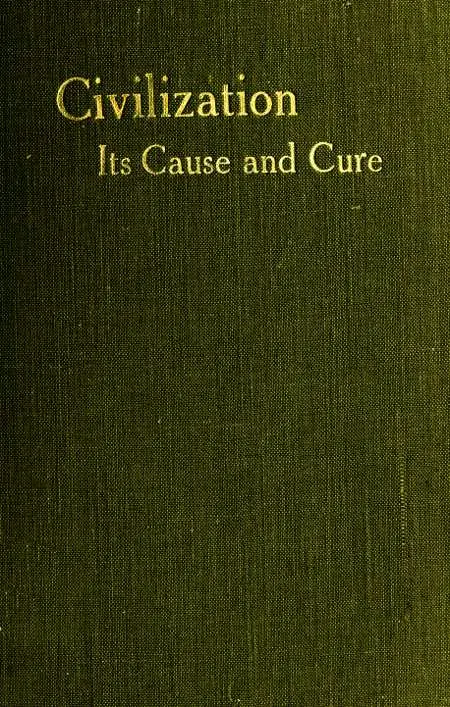
"Civilisation: Its Cause and Cure; and Other Essays" by Edward Carpenter is a critical examination of societal constructs written in the late 19th century. The work reflects on the state of civilization, suggesting it may be a disease that humanity must traverse, positing that civilizations have historically succumbed to various ailments and that true health may be rediscovered by returning to more primitive ways of living. Through essays that explore the nature of society, science, and morality, Carpenter argues for a new understanding of what constitutes human well-being. The opening of the volume presents a thought-provoking preface where Carpenter recalls the reception of his initial work, "Civilisation," which was delivered as a lecture to the Fabian Society. He suggests that civilization, once viewed as an ideal condition, has instead shown itself to be fraught with disease-like symptoms, including social discord and individualism, which detracts from the unity of human nature. Carpenter poignantly asserts that the physical and mental struggles of modern society indicate a need for re-evaluation and a potential reversion back to a state more closely aligned with nature, advocating for a deeper examination of personal and collective health as humanity moves forward.
Introduction adapted from the source catalogue; source summaries may be automatically generated.
Free to read · English · 75,964 words · No account needed
MAKE TIME FOR A GOOD BOOK
On by default. Untick to stop anonymous reading totals. Each page counts after 10 seconds in view. How this works.
Anonymous counting is on unless you have switched it off.
I propose, therefore, in these few pages to consider especially this inner force producing modification in man and animals--to try and find out of what nature it is, what is the law, and what are the limits of its action--premising always, as already suggested, that this distinction between "inner" and "outer," which is convenient and easy to handle on certain planes of thought, may ultimately, and in the last resort, prove very difficult or even impossible to maintain.
It is often said by Biologists that function precedes organisation--that is, man fights with his fellows before he makes weapons to fight with; the rudimentary animal digests food (as in the case of the amoeba) before it acquires a stomach or organ of digestion; it sees or is sensitive to light before it grows an eye; in society letters are carried by private hands before an organised postal system is created. Such facts properly considered are of vital importance. They show us, as it were by a sign-post, the direction of creation. They show how any new thing or modification of an old thing may come into being. They may be supplemented by a second statement--namely that desire precedes function. That is, man desires to injure his fellow before he actually fights with him; he experiences the wish to communicate with distant friends before ever he thinks of sending such a thing as a letter; the amoeba craves for food first, and circumvents its prey afterwards. Desire, or inward change, comes first, action follows, and organisation or outward structure is the result.
In man this "order of creation," if it may so be called, i.e., from within outwards, is very marked. Whenever a man creates anything new he pursues it; when he builds a house, for instance, or composes a poem or piece of music, or designs an Alpine tunnel, or whatever it may be. The order seems to be: first, a feeling--a dim want or desire; then the feeling becomes conscious of itself, takes shape in thought; the thought becomes more defined and issues in a distinct plan; the plan is committed to paper, models are made, etc.; and finally the actual work is begun and completed. The process appears as a movement from within outwards--the earliest and most authentic discernible source of the movement being a feeling--(though there may lie something behind that). Even in ordinary action the same order is manifest; for, though of course every action is not preceded by desire--since we know that actions soon become habitual and more or less unconscious--still a vast number of them are immediately so preceded; and in the case of any action that is new, either to the individual or to the race, its inception is generally accompanied by effort so painful that it would not be exerted unless the desire were very strong. The difficulty which a man experiences in learning any new art, and the records of the many failures, struggles, oppositions, persecutions, etc., which have attended every new invention or innovation of any kind in human history, afford plenty of evidence of this last point. Certainly the effort that accompanies a new action is not always faced so much from sheer desire of the new thing itself as from fear perhaps of something else--as it may be contended that monkeys did not take to climbing trees because they loved trees, but because they feared the beasts below, or that the giraffe did not stretch its neck because it particularly desired to feed on leaves, as because it could not get food any other way--but still, even in these cases the desire may be said to exist, though it is secondary--being founded upon another and more elementary desire--the desire namely of escaping pain or obtaining food. In either case a desire of some kind is a precedent condition of the new action. And so as we know of no case of a new action coming into play without being preceded by desire, we seem to be justified in supposing that all our actions when they were first initiated (in our forefathers, if not in ourselves) were so preceded. If this is so, then, since function is always preceded by desire, and organisation is preceded by function, organisation must necessarily be preceded by desire. And if this is the order of creation in man, should we not reasonably look in this direction for the key to the variation of animals and the order of creation in general?[39]
Your reading position is saved on this browser. Take it to another device with a library code. Reading pages adapt to text, rather than matching a printed edition.
Edward Carpenter
Edward Carpenter
Edward Carpenter
Edward Carpenter
BEHIND THE BOOK
This eBook is for the use of anyone anywhere in the United States and most other parts of the world at no cost and with almost no restrictions whatsoever. You may copy it, give it away or re-use it under the terms of the Project Gutenberg License included with this eBook or online at www.gutenberg.org. If you are not located in the United States, you will have to check the laws of the country where you are located before using this eBook. Read the source licence.
The original source file, including credits and licence, is retained by this library. Request an original-format copy at no charge. Please include the book title and Project Gutenberg identifier #44094.
KEEP YOUR CURIOSITY GOING

David Patterson (Spirit) Hatch

David Patterson (Spirit) Hatch

David Patterson (Spirit) Hatch
Coulson Kernahan

Ralph Waldo Emerson

Maurice Baring