THE CLASSIC COLLECTION✦An outlaw’s diary: the CommuneCLASSIC FREE BOOKS
An outlaw’s diary: the Commune
Cécile Tormay
THE CLASSIC COLLECTION · 1919
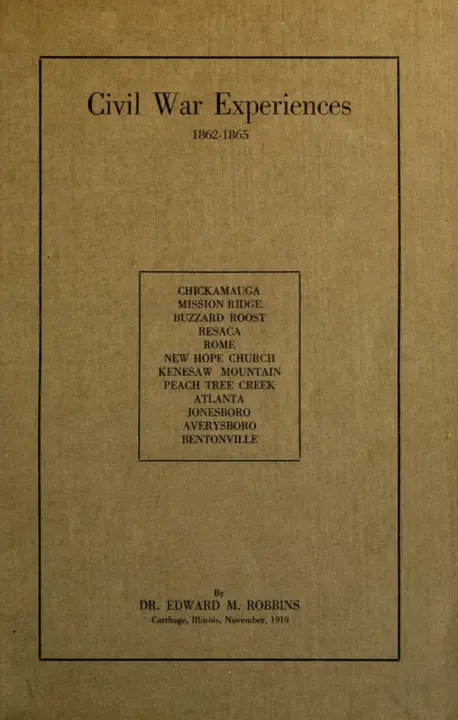
"Civil War Experiences, 1862-1865" by Edward Mott Robbins is a historical account written in the early 20th century. The book details the author's personal experiences as a soldier in the 78th Illinois Volunteer Infantry during the American Civil War. Robbins provides a firsthand narrative of battles and military campaigns, as well as insights into camp life and the challenges faced by soldiers. In this detailed memoir, Robbins recounts various significant engagements, including battles at Chickamauga, Mission Ridge, and Atlanta, among others. His narrative includes vivid descriptions of the brutal realities of war, the camaraderie among soldiers, and moments of humanity even amidst conflict, such as his interaction with wounded Confederate soldiers. Robbins reflects on the hardships endured, the complexities of camp life, and the bittersweet nature of military camaraderie, providing readers with a personal lens through which to understand the experiences of ordinary soldiers during this tumultuous period in American history.
Introduction adapted from the source catalogue; source summaries may be automatically generated.
Free to read · English · 9,169 words · No account needed
MAKE TIME FOR A GOOD BOOK
On by default. Untick to stop anonymous reading totals. Each page counts after 10 seconds in view. How this works.
Anonymous counting is on unless you have switched it off.
On the morning of the 22nd of July the battle of Atlanta was fought which was a peculiar and unfortunate affair for both armies as nothing was accomplished by either army that benefited them in the least. It was brought about by a strategic movement on the part of the Rebel forces. They evacuated their works in the night, deceiving the Federal forces, causing them to think that they had evacuated Atlanta, which was not the case, as the Confederates marched east around the left flank of the Federal forces and attacked the Federal forces in the rear. When skirmishing first commenced Major General McPherson, with his staff rode back in the direction of the firing and rode into an ambush of Confederates which arose as one man and demanded him to surrender, which he refused to do, and was shot off his horse; his staff were taken prisoners, but in twenty minutes we retook the staff and put their captors under guard. Four 20-lb. Parot guns with muzzles planted in the ground, mark the spot where General McPherson fell.
July 28th the command was ordered to assist Gen. Howard and we kept moving to the right round Atlanta, skirmishing, fighting and building works until August 25th. Aug. 23rd our colonel, Carter Van Vleck, died from wounds received in front of Atlanta. He was much beloved by us all. Aug. 26th, abandoned the works in front of Atlanta and struck south, skirmishing as usual. On Sept. 1st, assaulted the enemy's works at Jonesboro, Georgia, and after a desperate resistance, mounted their works, capturing men, cannon and battle flags, performing a feat that was not often equalled on either side during the war. The regiment did not lose more men than at Kennesaw but the result was far more gratifying.
I must not pass without mentioning some circumstances which occurred during this battle. Soon after we crossed the fence and entered the open field, Capt. Black of Co. D of the 78th, was shot and instantly killed. Capt. Black was from Carthage, Ill. Lieutenant John B. Worrell took command of the company and was afterwards promoted to captain. He was father of Bertha Worrell, now Mrs. Bertha Seger, and was as brave a man as ever faced the enemy, and was loved by his men and all who knew him. With him it was never go, but come on, boys. He was wounded at Chickamauga. When we had charged about half way across the field, the officers saw that owing to the enemy's line of works, the charging line would not all get to the enemy's line at the same time, so a halt was ordered, guides thrown out and the charging line ordered to dress on the guides. This movement was executed under a galling fire from the Rebel line. The coolness with which this maneuver was executed, I have heard commented on, many times since the war. But I think it was the most trying ordeal I ever experienced during my three years of service. When the battle line was properly dressed, the command forward came and we went forward with a yell that sent terror to our opponents and we carried the line, taking a battery of six guns and many prisoners, among whom was a general and staff officers, taken by Thos. Brodes of Co. I. After he had relieved them of their arms he addressed the general and said, "General, I took a good many chances on your arrest with your staff." The general said, "I don't know, why do you say that?" "Because my gun was empty. I fired my last shot as I entered your works." This private, Tom Brodes, was the son of Major Wm. L. Brodes, who was killed at Chickamauga, almost a year before. Among the killed was a young man who belonged to Co. K, Perry Lashore. His death was a willing and willful sacrifice for his country. He was visiting friends in Quincy when he enlisted and he being the only son of aged parents, they at once set about to get him discharged. He enlisted in June, 1862, and the battle of Jonesboro was fought the first of September, 1864. His discharge came in the morning and was handed to him by his captain, and he said, "Captain, what would you do if you were in my place, go into this fight or not?" The captain's reply was, "You don't have to go, you have always been a good soldier, and we all know the circumstances under which your discharge was obtained, and it is for your father's and mother's sake. This will undoubtedly be a hard battle, and were I in your place I would turn in my musket and take no chances." The members of his company by this time had gathered around him and all urged him not to take the chance. But his answer was, "I have been lucky for two years, never had a wound, and I believe I will be now, and I am going with you." Which he did, but never reached the enemy's works.
Your reading position is saved on this browser. Take it to another device with a library code. Reading pages adapt to text, rather than matching a printed edition.
BEHIND THE BOOK
This eBook is for the use of anyone anywhere in the United States and most other parts of the world at no cost and with almost no restrictions whatsoever. You may copy it, give it away or re-use it under the terms of the Project Gutenberg License included with this eBook or online at www.gutenberg.org. If you are not located in the United States, you will have to check the laws of the country where you are located before using this eBook. Read the source licence.
The original source file, including credits and licence, is retained by this library. Request an original-format copy at no charge. Please include the book title and Project Gutenberg identifier #38859.
KEEP YOUR CURIOSITY GOING
Cécile Tormay

Moritz Busch
John L. Ransom
Frances Wright
Cécile Tormay

Mabel Potter Daggett