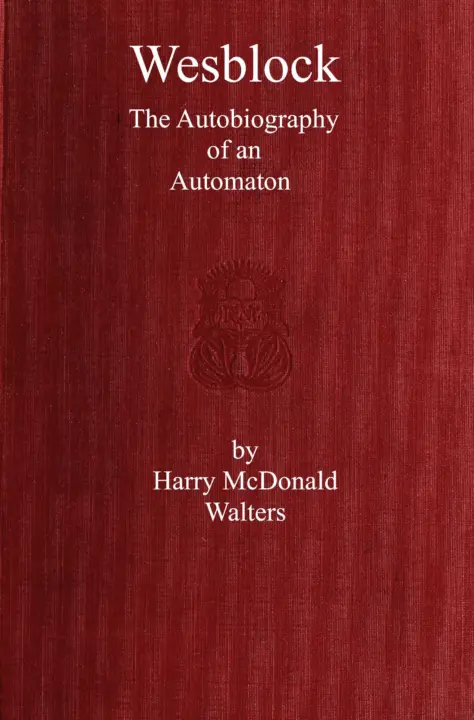
Wesblock, the autobiography of an automaton
Harry McDonald Walters
THE CLASSIC COLLECTION · 1911
"Civil Service Jingles and Other Things" by "Harry McDonald Walters" is a collection of humorous poetic sketches and satirical anecdotes written in the early 20th century. This work explores the everyday experiences, perceptions, and comical aspects of life in the civil service, embodying both wit and a critical perspective on bureaucracy. The opening hints at the author's sharp commentary on the civil service's structures and characters, likely presenting various figures that typify the profession. At the start of the collection, readers are introduced to a variety of quirky narratives through playful rhymes and anecdotes. One poem, “The Song of the Extra Clerk,” reflects on the unseen contributions of temporary clerks in a humorous light, emphasizing their lack of recognition compared to their permanent counterparts. In another piece, “The Parable of Gastonio,” a tale unfolds about a clever character trying to navigate the pitfalls of corruption and bureaucracy with resourcefulness and cunning. The opening portion establishes a tone that is both entertaining and insightful, drawing readers into a world where the intricacies of civil service become a source of both amusement and reflection.
Introduction adapted from the source catalogue; source summaries may be automatically generated.
Free to read · English · 24,581 words · No account needed
MAKE TIME FOR A GOOD BOOK
On by default. Untick to stop anonymous reading totals. Each page counts after 10 seconds in view. How this works.
Anonymous counting is on unless you have switched it off.
“Oh, Jack, you do not understand,” said Mrs. Johns. “But I do understand,” replied Johns. “I understand very plainly, indeed, that we could never be happy in the way we were going. I could not be happy in one continued round of obeying orders, so like a private in a regiment of soldiers; and you could not be happy with a man you had to worry over and fuss about all the time as if he were a child. In that way we would worry each other out of all comfort in life, as I see many couples foolishly do. Let us be different from other couples.”
Mrs. Johns was thinking: “Where have you been, Jack, the last eight
nights?” she asked.
“Why, I do not remember, dear, exactly;” answered Johns, “to the club mostly, and down town and around.”
“There, I knew it,” cried Mrs. Johns, “I knew you had been around, and you know how I hate men who go around.”
“But don’t be hasty, dear,” said Johns. “Where have you been? Have you not been around during the past eight days?”
“Yes, I have, Jack, but you know a woman’s around, and a man’s around, are not alike,” sobbed Mrs. Johns.
“No; no more than their clothes are alike, thank heaven,” said Johns.
“And where is the maid?” asked Mrs. Johns.
“Fired,” replied Johns.
“Discharged!” exclaimed Mrs. Johns. “Oh, Jack, you are dreadful. Where will I get another? You are turning out so different to what you used to be; so different to what I expected. I don’t believe I love you any more.”
“Try a little,” said Johns, kissing her without her offering much resistance. “Try,” kisses, “try again,” more kisses. Oh, it was disgusting the way she gave in.
“You are different too, dear;” continued Johns, “so different from the pliable, unsophisticated young thing of twenty I courted. At twenty-three you are quite old and domineering, and it does not become you a bit to become domineering. It makes lines on your face to be domineering. Will we go down to the cafe for dinner?”
“I don’t know, John.” “Well, I know,” said Johns. “Go and get your things on and we will take dinner at the Place Viger, anyway, without conditions; perhaps people have begun to talk already about your being away.”
“Jack,” said Mrs. Johns, with arms about his neck, “you are a horrid, practical beast, and I love you. I’ll be back in a minute,” and she ran upstairs to dress for dinner at the Place Viger. She was a dear woman, and Johns knew it.
Your reading position is saved on this browser. Take it to another device with a library code. Reading pages adapt to text, rather than matching a printed edition.
Harry McDonald Walters
BEHIND THE BOOK
This eBook is for the use of anyone anywhere in the United States and most other parts of the world at no cost and with almost no restrictions whatsoever. You may copy it, give it away or re-use it under the terms of the Project Gutenberg License included with this eBook or online at www.gutenberg.org. If you are not located in the United States, you will have to check the laws of the country where you are located before using this eBook. Read the source licence.
The original source file, including credits and licence, is retained by this library. Request an original-format copy at no charge. Please include the book title and Project Gutenberg identifier #74982.
KEEP YOUR CURIOSITY GOING

Eric Mackay
Edmund Gosse
Sophia Margaretta Hensley
Gilbert Parker
George MacDonald

Elizabeth Bibesco