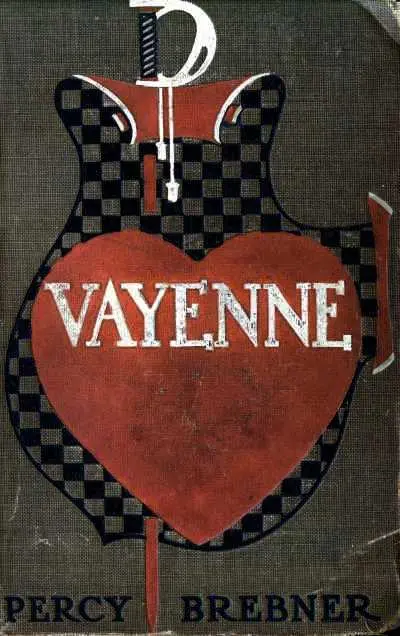
Vayenne
Percy James Brebner
THE CLASSIC COLLECTION · 1914
"Christopher Quarles: College Professor and Master Detective" by Percy James Brebner is a detective novel written in the early 20th century. The story revolves around the titular character, Professor Christopher Quarles, who, despite being a professor of philosophy, is also an adept detective. The narrative focuses on his involvement in solving intricate cases, starting with the mysterious death of a man named Mr. Ratcliffe, showcasing Quarles’s unique methods and his relationship with the young detective, Wigan. At the start of the novel, we are introduced to Wigan, who arrives at Blenheim Square to investigate the death of Mr. Ratcliffe, found dead in his study under suspicious circumstances. The narrative describes the peculiar details surrounding Ratcliffe's death: a sapphire stone positioned on his desk and a set of ivory boxes. Quarles enters the scene through his chance encounter with Wigan, and despite their initial differences, he expresses a keen interest in unraveling the mystery. The chapter vividly portrays Quarles's analytical thinking, as he begins to piece together clues and formulate theories about the circumstances leading to Ratcliffe's demise, setting the stage for a captivating blend of intellectual exploration and thrilling detective work.
Introduction adapted from the source catalogue; source summaries may be automatically generated.
Free to read · English · 83,527 words · No account needed
MAKE TIME FOR A GOOD BOOK
On by default. Untick to stop anonymous reading totals. Each page counts after 10 seconds in view. How this works.
Anonymous counting is on unless you have switched it off.
My suggestion that Christopher Quarles should be associated with me in the inquiry met with some opposition. The officials of the bank seemed a little nervous of too much publicity. The fact of the robbery, quite apart from the actual loss, had injured the bank considerably. However, all objections were overruled.
When Quarles and I went to the bank, we were requested to walk in and see Mr. Wickstead, who was one of the three general managers, and he very graciously apologized to the professor for the difficulties which had been raised.
"I need not tell you that this is a very serious business for us," he said. "The loss, large as it is, constitutes the least part of the damage. Clients, naturally enough, are anxious about the security of their own property, and already some nervous persons have removed their deed boxes."
"I can quite see the necessity of precaution," said Quarles. "You may rely on my discretion. May I ask whether the full amount of the loss has yet been ascertained?"
"Yes, I think we have now got to the bottom of it."
"The securities--deeds, bonds, and such-like--have they been tampered
with?"
"No."
"The gang must have possessed wonderful knowledge," said Quarles.
"Marvelous."
"May I take it, Mr. Wickstead, that there is no suspicion of collusion with officials in the bank?"
"You may. Of course, you are aware that we had to dismiss a clerk
recently?"
"Yes, who cannot be found. I understand that he would be in a position to give the necessary information if he chose to do so?"
"That is true. He was in a position of some importance."
"With regard to this gold reserve, how often is it examined?" asked
Quarles.
"At intervals, not regular intervals. The unexpected inspection is generally considered the best. We have a staff of inspectors for this purpose."
"My point is this," said Quarles; "might the robbery of this gold extend over a period of time, several weeks, let us say--a bag taken to-day, for instance, replaced by a dummy one, perhaps, and another bag taken in three days' time, and so on?"
Mr. Wickstead smiled.
"This reserve is kept in an inner strong-room. Three keys are necessary to open the door, and these three keys are kept by three different persons. I have one. Three of us have to go together to open that inner room."
"Ewing would never be there alone, then?"
"Certainly not," Wickstead answered. "For my part, I do not believe Frederick Ewing had anything to do with the affair at all. The circumstances of his dismissal naturally make him suspect, but I think that offense was the beginning and end of his dishonesty."
Your reading position is saved on this browser. Take it to another device with a library code. Reading pages adapt to text, rather than matching a printed edition.
Percy James Brebner
Percy James Brebner
Percy James Brebner
Percy James Brebner
BEHIND THE BOOK
This eBook is for the use of anyone anywhere in the United States and most other parts of the world at no cost and with almost no restrictions whatsoever. You may copy it, give it away or re-use it under the terms of the Project Gutenberg License included with this eBook or online at www.gutenberg.org. If you are not located in the United States, you will have to check the laws of the country where you are located before using this eBook. Read the source licence.
The original source file, including credits and licence, is retained by this library. Request an original-format copy at no charge. Please include the book title and Project Gutenberg identifier #34468.
KEEP YOUR CURIOSITY GOING
Coulson Kernahan

Maurice Baring
Frances Wright
Cécile Tormay

Frederic Jesup Stimson

W. H. P. (William Henry Pope) Jarvis