THE CLASSIC COLLECTION✦My diaries, being a personal narrative of events 1888-1914, Part 2 (1900-1914)CLASSIC FREE BOOKS
My diaries, being a personal narrative of events 1888-1914, Part 2 (1900-1914)
Wilfrid Scawen Blunt
THE CLASSIC COLLECTION · 1891
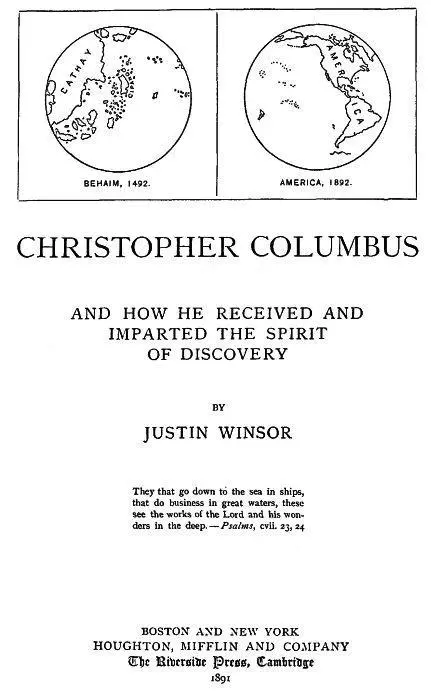
"Christopher Columbus and How He Received and Imparted the Spirit of Discovery" by Justin Winsor is a historical account written in the late 19th century. The work examines the life and explorations of Christopher Columbus, highlighting the various sources of information about his journeys, and the socio-political context surrounding his discoveries. It delves into how Columbus’s character and experiences contributed to the broader spirit of exploration during his time. At the start of the narrative, the author focuses on the various sources of documentation related to Columbus's life and voyages, emphasizing the significance of Columbus's own writings. Winsor notes the challenges historians face due to the complexities and inconsistencies in Columbus's accounts, as well as the limited availability of original documents. The opening chapters introduce the reader to the extensive documentary evidence surrounding Columbus's life, including his letters and the various biographical works that have attempted to portray his legacy. Through a detailed examination of these sources, Winsor sets the stage for a deeper exploration of Columbus's impact on the spirit of discovery that characterized the Age of Exploration.
Introduction adapted from the source catalogue; source summaries may be automatically generated.
Free to read · English · 211,353 words · No account needed
MAKE TIME FOR A GOOD BOOK
On by default. Untick to stop anonymous reading totals. Each page counts after 10 seconds in view. How this works.
Anonymous counting is on unless you have switched it off.
It had also been the aim of Vancouver in 1790-95 "to ascertain the existence of any navigable communication between the North Pacific and the North Atlantic Oceans," and the correspondence of the British government leading to this expedition has only been lately printed in the Report of the Dominion archivist, Douglas Brymner, for 1889.
[Sidenote: Arctic explorers.]
[Sidenote: 1850. McClure finds the northwest passage.]
The names of Barrow, Ross, Parry, and Franklin, not to mention others of a later period, make the story of the final severance of the continent in the arctic seas one of conspicuous interest in the history of maritime exploration. Captain Robert L. McClure, in the "Investigator," late in 1850 passed into Bering's Straits, and before September closed his ship was bound in the ice. In October McClure made a sledge journey easterly over a frozen channel and reached the open sea, which thirty years before Parry had passed into from the Atlantic side. The northwest passage was at last discovered.
We have seen that within thirty years from the death of Columbus the outline of South America was defined, while it had taken nearly two centuries and a quarter to free the coast lines of the New World from an entanglement in men's minds with the outlines of eastern Asia, and another century and a quarter were required to complete the arctic contour of America, so that the New World at last should stand a wholly revealed and separate continent.
Nor had all this labor been done by governments alone. The private merchant and the individual adventurer, equipping ships and sailing without national help, had done no small part of it. Dr. Kohl strikingly says, "The extreme northern limit of America, the desolate peninsula Boothia, is named after the English merchant who fitted out the arctic expedition of Sir John Ross; and the southernmost strait, beyond Patagonia, preserves the name of Le Maire, the merchant at whose charge it was disclosed to the world!"
Acklin Island, 215.
Adam of Bremen, 147.
Adda, G. d', 12.
Admiral's map, 534, 546, 581. See Waldseemüller.
Africa, circumnavigations of, 91;
discoveries along its coast, 91, 151;
early maps, 133;
Ptolemy's map of its southern part, 335.
Agnese Baptista, his maps, 595, 597.
Aguado, Juan, sent to Española, 317;
his conduct, 319.
Ailly, Pierre d', De Imagine Mundi, 7, 8, 121, 180, 497;
his map (1410), 601.
Albertus Magnus, 497; portrait, 120.
Aleutian Islands, 652, 658.
Alexander VI., letter to, from Columbus, 9;
pope, 252;
his bull of demarcation, 252;
his bust, 253.
Alfonso V. (Portugal), 108.
Aliacus. See Ailly.
Allefonsce, 614.
Allegetto degli Allegetti, Ephemerides, 32.
Almagro, 565.
Alto Velo, 390.
Alva, Duke of, 514, 515.
Amazons, 235, 237.
Your reading position is saved on this browser. Take it to another device with a library code. Reading pages adapt to text, rather than matching a printed edition.
BEHIND THE BOOK
This eBook is for the use of anyone anywhere in the United States and most other parts of the world at no cost and with almost no restrictions whatsoever. You may copy it, give it away or re-use it under the terms of the Project Gutenberg License included with this eBook or online at www.gutenberg.org. If you are not located in the United States, you will have to check the laws of the country where you are located before using this eBook. Read the source licence.
The original source file, including credits and licence, is retained by this library. Request an original-format copy at no charge. Please include the book title and Project Gutenberg identifier #42059.
KEEP YOUR CURIOSITY GOING
Wilfrid Scawen Blunt
Wilfrid Scawen Blunt

E. W. (Edgar Watson) Howe
Cécile Tormay

Moritz Busch
John L. Ransom