THE CLASSIC COLLECTION✦My diaries, being a personal narrative of events 1888-1914, Part 2 (1900-1914)CLASSIC FREE BOOKS
My diaries, being a personal narrative of events 1888-1914, Part 2 (1900-1914)
Wilfrid Scawen Blunt
THE CLASSIC COLLECTION · 1891
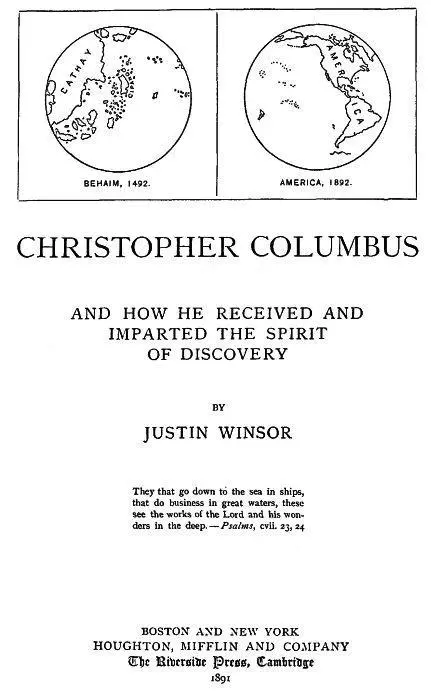
"Christopher Columbus and How He Received and Imparted the Spirit of Discovery" by Justin Winsor is a historical account written in the late 19th century. The work examines the life and explorations of Christopher Columbus, highlighting the various sources of information about his journeys, and the socio-political context surrounding his discoveries. It delves into how Columbus’s character and experiences contributed to the broader spirit of exploration during his time. At the start of the narrative, the author focuses on the various sources of documentation related to Columbus's life and voyages, emphasizing the significance of Columbus's own writings. Winsor notes the challenges historians face due to the complexities and inconsistencies in Columbus's accounts, as well as the limited availability of original documents. The opening chapters introduce the reader to the extensive documentary evidence surrounding Columbus's life, including his letters and the various biographical works that have attempted to portray his legacy. Through a detailed examination of these sources, Winsor sets the stage for a deeper exploration of Columbus's impact on the spirit of discovery that characterized the Age of Exploration.
Introduction adapted from the source catalogue; source summaries may be automatically generated.
Free to read · English · 211,353 words · No account needed
MAKE TIME FOR A GOOD BOOK
On by default. Untick to stop anonymous reading totals. Each page counts after 10 seconds in view. How this works.
Anonymous counting is on unless you have switched it off.
The sixth was Maria de la Cueva, daughter of Juana, sister of Luis, who died before December, 1600, while her daughter died in 1605, leaving Carlos Pacheco a claimant, whose rights were disallowed.
The seventh was Balthazar Colombo, a descendant of a Domenico Colombo, who was, according to the claim, the same Domenico who was the father of Columbus. His genealogical record was not accepted.
The eighth was Bernardo Colombo, who claimed to be a descendant of Bartholomew Columbus, the Adelantado, a claim not made good.
These last two contestants rested their title in part on the fact that their ancestors had always borne the name of Colombo, and this was required by Columbus to belong to the inheritors of his honors. The lineal ancestors of the other claimants had borne the names of Cardona, Portogallo, or Avila.
[Sidenote: Nuño de Portogallo succeeds, and the line later changes.]
From Nuño de Portogallo the titles descended to his son Alvaro Jacinto, and then to the latter's son, Pedro Nuño. His rights were contested by Luis de Avila (grandson of Cristoval, brother of Luis Colon), who tried in 1620 to reverse the verdict of 1608, and it was not till 1664 that Pedro Nuño defeated his adversaries. He was succeeded by his son, Pedro Manuel, and he by his son, Pedro Nuño, who died in 1733, when this male line became extinct.
The titles were now illegally assumed by Pedro Nuño's sister, Catarina Ventura, who by marriage gave them to her husband, James Fitz-James Stuart, son of the famous Duke of Berwick, and by inheritance in his own right, Duke of Liria. When he died, in 1738, the titles passed to his son, Jacobo Eduardo; thence to the latter's son, Carlos Fernando, who transmitted them to his son, Jacobo Filipe. This last was obliged, by a verdict in 1790, which reversed the decree of 1664, to yield the titles to the line of Francesca, sister of Diego, the fourth holder of them. This Francesca married Diego Ortegon, and their grandchild, Josefa, married Martin Larreategui, whose great-great-grandson, Mariano (by decrees 1790-96), became Duke of Veragua, from whom the title descended to his son, Pedro, and then to his grandson, Cristoval, the present Duke, born in 1837, whose heir, the next Duke, was born in 1878. The value of the titles is said to-day to represent about eight or ten thousand dollars, and this income is chargeable upon the revenues of Cuba and Porto Rico.
Your reading position is saved on this browser. Take it to another device with a library code. Reading pages adapt to text, rather than matching a printed edition.
BEHIND THE BOOK
This eBook is for the use of anyone anywhere in the United States and most other parts of the world at no cost and with almost no restrictions whatsoever. You may copy it, give it away or re-use it under the terms of the Project Gutenberg License included with this eBook or online at www.gutenberg.org. If you are not located in the United States, you will have to check the laws of the country where you are located before using this eBook. Read the source licence.
The original source file, including credits and licence, is retained by this library. Request an original-format copy at no charge. Please include the book title and Project Gutenberg identifier #42059.
KEEP YOUR CURIOSITY GOING
Wilfrid Scawen Blunt
Wilfrid Scawen Blunt

E. W. (Edgar Watson) Howe
Cécile Tormay

Moritz Busch
John L. Ransom