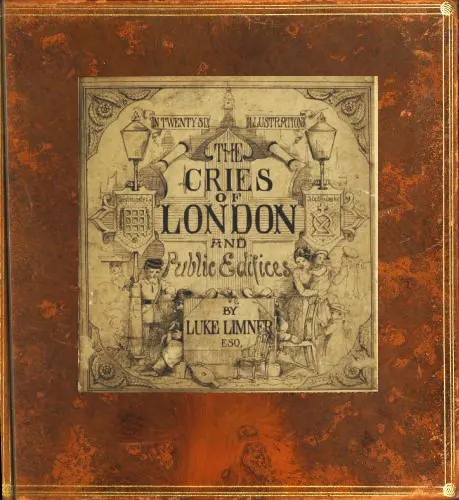
London Cries & Public Edifices
John Leighton
THE CLASSIC COLLECTION · 1850
"Christmas Comes but Once a Year" by John Leighton is a comedic narrative likely written in the late 19th century. The story follows the life of Mr. John Brown, a prosperous citizen of London, as he navigates the festive chaos of the Christmas season alongside his family and various quirky neighbors. The tale captures the humorous mishaps and social absurdities typical of Victorian holiday celebrations. The opening of the book sets the scene during a bleak Christmas season, introducing the Browns—Mr. Brown, his wife, and their two daughters, among other notable characters like the pompous Captain de Camp. The narrative paints a vivid picture of the Christmas preparations, complete with whimsical details about the family's home, social aspirations, and interactions with their neighbors. Mr. Brown is characterized as a well-meaning but bumbling figure, attempting to fulfill both familial and social obligations as absurdity reigns around him. The fun-infused prose hints at delightful humor and a critical look at society's quirks during the festive period while laying the groundwork for a story filled with mishaps and endearing moments.
Introduction adapted from the source catalogue; source summaries may be automatically generated.
Free to read · English · 23,671 words · No account needed
MAKE TIME FOR A GOOD BOOK
On by default. Untick to stop anonymous reading totals. Each page counts after 10 seconds in view. How this works.
Anonymous counting is on unless you have switched it off.
The chandelier, the treacherous culprit, that would not swing or hang in chains, is being borne away, clanking along the lower hall; the broken glass has been picked out of the pastry, and the oily odour overcome with esprit de bouquet--presenting, withal, a very effective coup-d'oeil:--though, we could fancy the tipsy-cake, in the form of a leaning-tower, if anything, a little more groggy; and that the composite Corinthian temple looked as if it had suffered from an earthquake--but there it was, for all the intense remorse of the cook, who thought the exhibition of so mutilated a work of art would injure his reputation for ever--but it did not!--Neither did any one notice the loss of the frail effeminate brigand, that formerly tenanted the rotunda of barley-sugar; nor was it known that a treadmill had given place to a locomotive and tender--in sweets.
The first portion of this banquet disappears merrily; there being no lack of the usual conserves, pasties, and geometrical bread-envelopes--supposed to contain something, but consumed without the slightest knowledge of their contents.
After the ladies have supped and withdrawn, the gentlemen lay to, with immense energy, as if to make up for the time they have been kept in suspense, creating great havoc amongst ruined fowls, or anything they can lay hands upon--in the excitement, particularity having given place to mirth. One gentleman has planted a spoon in his button-hole, after the fashion of a flower; and, of course, for his pains, got called a "Spooney," by an unknown voice behind Mr. Potts, the tame apothecary, who is pouring, or rather measuring out, some champagne, himself, catching the final drop on the edge of the glass, as if it were castor-oil:--the "Spooney," thinking it Potts' voice, must make a joke in return; so begins with the rather hackney'd, but, as he thought, appropriate one, of champagne being better than real pain or quinine wine; and, upon Mr. P.'s essaying to answer, our "Spoon" diverted to some tongue he was consuming, saying he liked it better than Potted tongue--an observation that made the apothecary's face flush, and the "Spoon" liken it to an article before them, a claret-mug. At this last allusion the "Pott" got red-hot, and there is no knowing what would have been the consequences, had not the "Spoon" terrified the "Pott" by proclaiming "silence!"--in a stentorian voice;--and a gentleman risen, Dr. Portbin, the author of that elaborate essay on "Dribbling Babies," in one thick volume, royal octavo--a work that nobody read, but everybody thought a great deal of, for it gained its author a vast infantine practice:--so, when the M.D. rose, the "Pott" trembled--feeling greatly relieved to find the doctor only did so to propose the "ladies"--"health and long life to Mrs. Brown and the ladies!"--a toast that was drunk with great enthusiasm, Mr. Lark vociferously applauding; at the same time stating, in an under tone--"the doctor meant a long life of ills and bills." Dr. Portbin's sentiment is echoed by Mr. Brown, who returns thanks in a stereotype-speech, almost as original as a royal one; to which, in some points, it bore slight resemblance, the ideas being very much generalized--there was an "alliance with foreign powers," "acquisition of territory," and "friendly relations:"--altogether a prosperous allegory, which causes Captain de Camp to be "called upon;" and, in that style of speech usually denominated "neat," give very visible vent to his inexpressible feelings--sketching several scenes, commencing at Victoria Villa and ending at St. Stephen's,--with a verse, intended to look as if composed for the nonce; but, in reality, a work of much study:--it was delivered with great emphasis--a composition for which we had to blush, though, as faithful chroniclers, feel bound to insert--it ran as follows:--
Your reading position is saved on this browser. Take it to another device with a library code. Reading pages adapt to text, rather than matching a printed edition.
John Leighton
John Leighton
BEHIND THE BOOK
This eBook is for the use of anyone anywhere in the United States and most other parts of the world at no cost and with almost no restrictions whatsoever. You may copy it, give it away or re-use it under the terms of the Project Gutenberg License included with this eBook or online at www.gutenberg.org. If you are not located in the United States, you will have to check the laws of the country where you are located before using this eBook. Read the source licence.
The original source file, including credits and licence, is retained by this library. Request an original-format copy at no charge. Please include the book title and Project Gutenberg identifier #20251.
KEEP YOUR CURIOSITY GOING
Coulson Kernahan

Maurice Baring
Frances Wright
Cécile Tormay

Frederic Jesup Stimson

W. H. P. (William Henry Pope) Jarvis