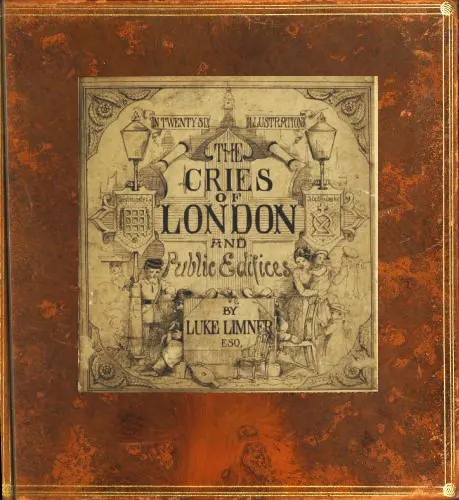
London Cries & Public Edifices
John Leighton
THE CLASSIC COLLECTION · 1850
"Christmas Comes but Once a Year" by John Leighton is a comedic narrative likely written in the late 19th century. The story follows the life of Mr. John Brown, a prosperous citizen of London, as he navigates the festive chaos of the Christmas season alongside his family and various quirky neighbors. The tale captures the humorous mishaps and social absurdities typical of Victorian holiday celebrations. The opening of the book sets the scene during a bleak Christmas season, introducing the Browns—Mr. Brown, his wife, and their two daughters, among other notable characters like the pompous Captain de Camp. The narrative paints a vivid picture of the Christmas preparations, complete with whimsical details about the family's home, social aspirations, and interactions with their neighbors. Mr. Brown is characterized as a well-meaning but bumbling figure, attempting to fulfill both familial and social obligations as absurdity reigns around him. The fun-infused prose hints at delightful humor and a critical look at society's quirks during the festive period while laying the groundwork for a story filled with mishaps and endearing moments.
Introduction adapted from the source catalogue; source summaries may be automatically generated.
Free to read · English · 23,671 words · No account needed
MAKE TIME FOR A GOOD BOOK
On by default. Untick to stop anonymous reading totals. Each page counts after 10 seconds in view. How this works.
Anonymous counting is on unless you have switched it off.
No sooner did the orchestra commence--barely having finished the first eight bars of "the Martyrs",--than the guests came rushing up from the coffee-room, like sheep through a hedge, one bolder than the rest leading the way, causing Mrs. Brown to desert her partner in l'ete--a figure the gentleman feels bound to execute twice, though he would much rather have been excused either performance; and upon Mrs. Brown's presenting a substitute he became so beside himself as to forget the figure--a mishap rendered none the clearer by a wag's performing la pastorale, when he ought to have done trenise, and moreover, not have done it in such a facetious manner, as to render it a matter of doubt if he himself could have recognized it; the audacity being accompanied by a certain amount of shyness, that had to be hidden, altogether sadly deranging our amiable youth's comprehension, he being led by his partner, instead of leading her--to be left, alone, in a mental pillory, a specimen of blushing mortification more diverting to behold than to experience;--but, upon being kindly treated by his gentle partner, he recovers, in the galop finale, feeling truly grateful to the guardian spirit that has conducted him through the purgatory. Ladies, be gentle with youthful bashfulness--it often arises from pure feelings, modest diffidence, or unselfishness;--such, unlike many proficient dancers, carry their brains in their hats, and not in their boots:--weigh your "fantastic-toes" against them, and see which are the most empty.
Somehow, the first quadrille is always unfortunate!--In the back room they succeeded no better than in the front:--here, Miss Charmer was top of the dance, as she always is, if it can be obtained; especially in the Lancers or Caledonians (which, we dare say, are pleasant quadrilles to those who know them, and the Charmer does). Well, she is top, with young Hoy (heir to Sir Hobbedy), for a partner, a brave youth at quoits, cricket, boxing, or boating--his hands, horny as a tortoise and large as Polyphemus', over which he split three right-hand gloves:--a glance will suffice to show how much he is out of his, and she in her, element--Miss Charmer looking, Lark said, as if she would prefer performing the "first set" (or sit) upon a vacant seat, beside Arthur Beau, who has just arrived, and by whom, we know, she disliked to be quizzed;--so, upon the completion of the first eight bars, the Charmer flounced, bringing the flounces of her dress into contact with the bars of the grate, causing the smoke to come out, and Arthur to come round, that he might lean upon the shelf, engage himself for the next dance, and stand behind the fair partner, a fire-guard of honour, unable to keep from smiling at Mr. Hoy, who dances upon his heels, as though enamoured of his large feet, and afraid of knocking his head against the chandelier. Their vis-a-vis is a lively lady, apparently taking stock of a bouquet, but, in reality, joking an absent gentleman, opposite:--it is Miss Gay, whom Lark (her partner) is making laugh, by observing--the gentleman is not so absent as he ought to be; causing that lady to forget herself--making many mistakes and false starts; which, being those of a person who knew better, were very diverting. Miss Gay is voluble as volatile, no subject coming amiss--she is now speculating as to how far the gentlemen will permit the buttons to travel down their backs, or their skirts to be curtailed; and Mr. Lark, unable to find a reason, must get up a contrary supposition--imagining some middle-aged ladies to resemble a cork-screw, as they have at different periods shifted the waist from the armpits downward;--waists making us think of the short lady (in this set) with a very long one--Miss Price, only child of Alderman Price, chandler and dry-salter, of Candlewick ward--daughter and hair, as Mr. Lark jocosely observed, in allusion to the luxuriant red tresses of that lady;--saying her papa was the great crony of Sir Rich. Big, the free vintner, late of Portsoken ward, who was found, or rather not found--having evaporated of spontaneous combustion, before he could get to the civic chair,--leaving all his money to Price; who has retired, with his fat and the gout, to Bayswater. Miss Price is a lovely dancer, appearing hollow (a thing Miss Gay did not doubt), like an India rubber ball in flounces; she is said to have a beautiful hand, so small as to require only No. 6. gloves--as if a pigmy hand could not be a deformity. She is invited, in a hope that young Brown may make her a partner, for the dance of life; and is said to be worth L150,000--not by the pound weight, as the envious Miss Gay hinted.--No! No! naughty Miss Gay, be satisfied with Nature's gifts, and do not covet lucre.
Your reading position is saved on this browser. Take it to another device with a library code. Reading pages adapt to text, rather than matching a printed edition.
John Leighton
John Leighton
BEHIND THE BOOK
This eBook is for the use of anyone anywhere in the United States and most other parts of the world at no cost and with almost no restrictions whatsoever. You may copy it, give it away or re-use it under the terms of the Project Gutenberg License included with this eBook or online at www.gutenberg.org. If you are not located in the United States, you will have to check the laws of the country where you are located before using this eBook. Read the source licence.
The original source file, including credits and licence, is retained by this library. Request an original-format copy at no charge. Please include the book title and Project Gutenberg identifier #20251.
KEEP YOUR CURIOSITY GOING
Coulson Kernahan

Maurice Baring
Frances Wright
Cécile Tormay

Frederic Jesup Stimson

W. H. P. (William Henry Pope) Jarvis