
The Pacific Coast scenic tour
Henry T. Finck
THE CLASSIC COLLECTION · 1889
"Chopin and Other Musical Essays" by Henry T. Finck is a collection of musical essays written in the late 19th century. The book primarily focuses on the life and works of Frédéric Chopin, delving into his genius as a pianist and composer while also exploring the perceptions of his music in the context of his time. Finck provides in-depth analysis and criticisms of Chopin's contributions to piano music and advocates for his recognition as one of the greatest composers alongside renowned figures such as Wagner and Beethoven. The opening of the work begins with an examination of Chopin's unparalleled impact on piano music, emphasizing his popularity and the misconceptions about his genius during his lifetime. Finck argues that despite Chopin’s immense talent and profound influence on the Romantic music landscape, he faced significant misunderstanding and underappreciation primarily due to his delicate and introspective nature. The essay highlights several misconceptions about Chopin's style and the gradual acknowledgment of his revolutionary contributions to music, setting the stage for a deeper exploration of his compositional techniques and innovations in the following sections.
Introduction adapted from the source catalogue; source summaries may be automatically generated.
Free to read · English · 60,531 words · No account needed
MAKE TIME FOR A GOOD BOOK
On by default. Untick to stop anonymous reading totals. Each page counts after 10 seconds in view. How this works.
Anonymous counting is on unless you have switched it off.
Scaria, unfortunately, was never heard in opera in this country. But we have had Materna and Niemann and Brandt and Fischer, and Alvary and Lehmann, who have given us correct ideas of the German vocal style. Surely no one can say, on listening to Lehmann's Bruennhilde, or Fischer's Hans Sachs, or Alvary's Siegfried, that the vocal part is inferior in beauty or importance to the orchestral. When Alvary sang Siegfried for the first time in New York, he presented a creditable but uneven impersonation, not having sufficiently mastered the details of the acting to feel quite at ease, and not being able to husband his vocal resources for the grand duo at the close. But at the end of the season, at the eleventh performance, he had become a full-fledged Siegfried, acting the part as by instinct, while his voice was as fresh at the close of the opera as at the beginning: thus affording a striking proof of Wagner's assertion, that the greatest vocal difficulties of his roles can be readily mastered if the singer will only take the pains to enter thoroughly into the spirit of the text and the dramatic situations. Alvary spent a whole year in learning this role, availing himself of the hints given him by Herr Seidl, who has the Wagnerian traditions by heart; and to-day he might, if he felt so inclined, amass wealth and win honor by travelling about Europe and singing nothing but this one role. Vienna and Brussels made strenuous efforts to entice him away from New York after his great success as Siegfried.
This success is the more gratifying and encouraging because, previously, he had been only a second-rate singer. It was his conscientious and prolonged study of the German vocal style that enabled him to win his present lucrative and honorable position. If there were a few more young singers like him the operatic problem might be considered solved, for it is the rarity of well-trained singers that causes all the financial embarrassment in our opera-houses. They are so scarce, that as soon as one is discovered he is hurried on the stage, after a year's hasty preparation, and if his untrained voice soon gives out--as it must under the circumstances--the blame is laid on Wagner's shoulders. But, as Mme. Lucca remarks, "neither Wagner nor any other composer spoils the voice of any one who knows how to sing." She thinks that at least six years of faithful study are necessary to develop the voice in accordance with artistic principles. Herr Hey is somewhat more lenient, three years of thorough training sufficing, in his opinion, as a preparation for the stage. Much, of course, depends on individuals, and the number of hours given to study every day. In the old Italian vocal schools, two centuries ago, the pupils were kept busy six or eight hours a day, devoting one hour to difficult passages, another to trills and to accuracy of intonation, others to expression, to counterpoint, composition and accompaniment, etc. They often practised before a mirror in order to study the position of the soft parts in the mouth, and to avoid grimaces; and sometimes they sang at places where there was a good echo, so as to hear their own faults, as if some one else were singing. Yet, as we have seen, the main stress was laid on agility of technical execution, whereas the modern German method, without in the least neglecting technique, calls upon pupils to devote more attention to the principles of soulful expression and dramatic accentuation. A singer who wishes to appear to advantage as Euryanthe or Lohengrin or Tristan must not only be entirely familiar with his own vocal parts but he ought to be as familiar with the orchestral score as the conductor himself: for, only then, can he acquire that ease which is necessary for producing a deep impression. As he has not the conductor's advantage of looking on the printed score while singing, he must therefore have an excellent memory. As Dr. Hanslick remarks, "the artists who sing 'Tristan and Isolde' by heart, if they do nothing more than sing the notes correctly, deserve our most sincere admiration. That they can do to-day what seemed almost impossible twenty years ago is indeed Wagner's achievement, an achievement which has hardly been noted hitherto." Let me add that in modern German music, everything is difficult to the singer--the consonants of the language, the unusual intervals and accents, the necessity of being actor and singer at the same time, etc. Hence we ought to be charitable and condone an occasional slip. But the average opera-goer in this country is anything but charitable. If one of these dramatic singers, thus hampered by difficulties, makes the slightest lapse from tonal beauty (which may be even called for) he is judged as unmercifully as if he were a representative of the bel canto, whose art consists in a mere voice without emotion--vox et praeterea nihil. This is as unfair as it is to judge Wagner's dramas by the music alone, and is, indeed a consequence of this attitude.
Your reading position is saved on this browser. Take it to another device with a library code. Reading pages adapt to text, rather than matching a printed edition.
Henry T. Finck
Henry T. Finck
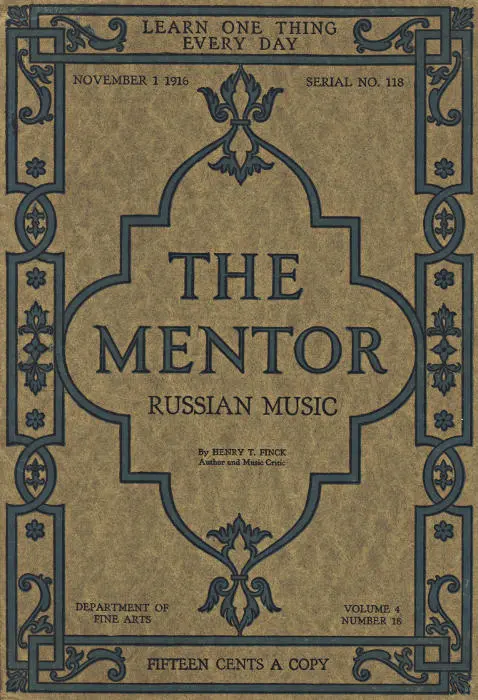
Henry T. Finck
Henry T. Finck
BEHIND THE BOOK
This eBook is for the use of anyone anywhere in the United States and most other parts of the world at no cost and with almost no restrictions whatsoever. You may copy it, give it away or re-use it under the terms of the Project Gutenberg License included with this eBook or online at www.gutenberg.org. If you are not located in the United States, you will have to check the laws of the country where you are located before using this eBook. Read the source licence.
The original source file, including credits and licence, is retained by this library. Request an original-format copy at no charge. Please include the book title and Project Gutenberg identifier #18560.
KEEP YOUR CURIOSITY GOING

David Patterson (Spirit) Hatch

David Patterson (Spirit) Hatch

David Patterson (Spirit) Hatch
Cécile Tormay

Moritz Busch
John L. Ransom