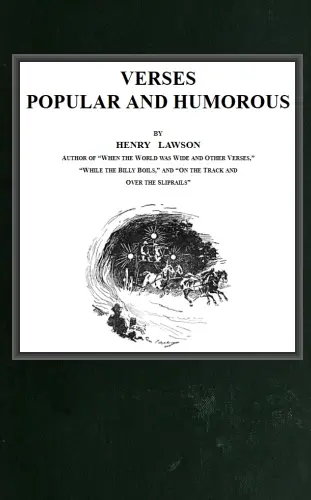
Verses popular and humorous
Henry Lawson
THE CLASSIC COLLECTION · 1902
"Children of the Bush" by Henry Lawson is a collection of short stories written during the late 19th century. The narratives explore the lives of bushmen in the Australian outback, delving into themes of mateship, kindness, and the struggles of rural life. Central to these tales is the character “The Giraffe,” a tall, good-natured man who embodies the spirit of camaraderie and selflessness in his community, often taking on the role of a caretaker for those facing hardship. The opening of "Children of the Bush" introduces us to the Giraffe as he goes about a morning in a shearers' shanty, where a sick jackaroo is to be sent to the hospital. The narrative captures the lively dynamics of the shanty, with its colorful characters sharing banter while they pass around a hat to collect funds for their ailing companion. Through various interactions and humorous exchanges, we see the Giraffe’s unwavering goodwill and his tendency to help others in distress, setting the tone for the stories that celebrate the resilience and generosity of those living in the bush. The Giraffe's commitment to community and humanity despite personal challenges hints at the broader social themes present throughout Lawson's work.
Introduction adapted from the source catalogue; source summaries may be automatically generated.
Free to read · English · 89,033 words · No account needed
MAKE TIME FOR A GOOD BOOK
On by default. Untick to stop anonymous reading totals. Each page counts after 10 seconds in view. How this works.
Anonymous counting is on unless you have switched it off.
We turned out of Pitt Street into Hunter Street, and across George Street, where a double line of fast electric tramway was running, into Margaret Street and had a drink at Pfahlert’s Hotel, where a counter lunch—as good as many dinners you get for a shilling—was included with a sixpenny drink. “Get a quiet corner,” said Mitchell, “I like to bear myself cackle.” So we took our beer out in the fernery and got a cool place at a little table in a quiet corner amongst the fern boxes.
“Well, One-eyed Bogan was a hard case, Mitchell,” I said. “Wasn’t he?”
“Yes,” said Mitchell, putting down his “long-beer” glass, “he was.”
“Rather a bad egg?”
“Yes, a regular bad egg,” said Mitchell, decidedly.
“I heard he got caught cheating at cards,” I said.
“Did you?” said Mitchell. “Well, I believe he did. Ah, well,” he added reflectively, after another long pull, “One-eyed Bogan won’t cheat at cards any more.”
“Why?” I said. “Is he dead then?”
“No,” said Mitchell, “he’s blind.”
“Good God!” I said, “how did that happen?”
“He lost the other eye,” said Mitchell, and he took another drink. “Ah, well, he won’t cheat at cards any more—unless there’s cards invented for the blind.”
“How did it happen?” I asked.
“Well,” said Mitchell, “you see, Harry, it was this way. Bogan went pretty free in Bourke after the shearing before last, and in the end he got mixed up in a very ugly-looking business: he was accused of doing two new-chum jackaroos out of their stuff by some sort of confidence trick.”
“Confidence trick,” I said. “I’d never have thought that One-eyed Bogan had the brains to go in for that sort of thing.”
“Well, it seems he had, or else he used somebody else’s brains; there’s plenty of broken-down English gentlemen sharpers knocking about out back, you know, and Bogan might have been taking lessons from one. I don’t know the rights of the case, it was hushed up, as you’ll see presently; but, anyway, the jackaroos swore that Bogan had done ’em out of ten quid. They were both Cockneys and I suppose they reckoned themselves smart, but bushmen have more time to think. Besides, Bogan’s one eye was in his favour. You see he always kept his one eye fixed strictly on whatever business he had in hand; if he’d had another eye to rove round and distract his attention and look at things on the outside, the chances are he would never have got into trouble.”
Your reading position is saved on this browser. Take it to another device with a library code. Reading pages adapt to text, rather than matching a printed edition.
Henry Lawson
Henry Lawson
Henry Lawson
Henry Lawson
BEHIND THE BOOK
This eBook is for the use of anyone anywhere in the United States and most other parts of the world at no cost and with almost no restrictions whatsoever. You may copy it, give it away or re-use it under the terms of the Project Gutenberg License included with this eBook or online at www.gutenberg.org. If you are not located in the United States, you will have to check the laws of the country where you are located before using this eBook. Read the source licence.
The original source file, including credits and licence, is retained by this library. Request an original-format copy at no charge. Please include the book title and Project Gutenberg identifier #7065.
KEEP YOUR CURIOSITY GOING
Coulson Kernahan

Maurice Baring
Frances Wright
Cécile Tormay

Frederic Jesup Stimson

W. H. P. (William Henry Pope) Jarvis