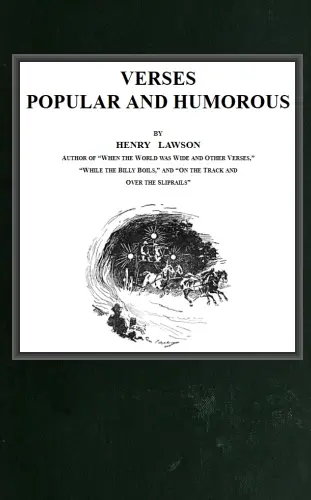
Verses popular and humorous
Henry Lawson
THE CLASSIC COLLECTION · 1902
"Children of the Bush" by Henry Lawson is a collection of short stories written during the late 19th century. The narratives explore the lives of bushmen in the Australian outback, delving into themes of mateship, kindness, and the struggles of rural life. Central to these tales is the character “The Giraffe,” a tall, good-natured man who embodies the spirit of camaraderie and selflessness in his community, often taking on the role of a caretaker for those facing hardship. The opening of "Children of the Bush" introduces us to the Giraffe as he goes about a morning in a shearers' shanty, where a sick jackaroo is to be sent to the hospital. The narrative captures the lively dynamics of the shanty, with its colorful characters sharing banter while they pass around a hat to collect funds for their ailing companion. Through various interactions and humorous exchanges, we see the Giraffe’s unwavering goodwill and his tendency to help others in distress, setting the tone for the stories that celebrate the resilience and generosity of those living in the bush. The Giraffe's commitment to community and humanity despite personal challenges hints at the broader social themes present throughout Lawson's work.
Introduction adapted from the source catalogue; source summaries may be automatically generated.
Free to read · English · 89,033 words · No account needed
MAKE TIME FOR A GOOD BOOK
On by default. Untick to stop anonymous reading totals. Each page counts after 10 seconds in view. How this works.
Anonymous counting is on unless you have switched it off.
Peter sat leaning forward, his elbows resting on his knees and his hands fingering his cold pipe nervously. His sad eyes had grown haggard and haunted. It is in the hearts of exiles in new lands that the old songs are felt.
“Take no thought of the morrow, Mitchell,” said Peter, abstractedly. “I beg your pardon, Mitchell. I mean——”
“That’s all right, Peter,” said Mitchell. “You’re right; to-morrow is the past, as far as I’m concerned.”
Peter blinked down at him as if he were a new species.
“You’re an odd young man, Mitchell,” he said. “You’ll have to take care of that head of yours or you’ll be found hanging by a saddle-strap to a leaning tree on a lonely track, or find yourself in a lunatic asylum before you’re forty-five.”
“Or else I’ll be a great man,” said Mitchell. “But—ah, well!”
Peter turned his eyes to the fire and smiled sadly. “Not enjoyment and not sorrow, is our destined end or way,” he repeated to the fire.
“But we get there just the same,” said Mitchell, “destined or not.”
But to live, that each to-morrow,
Finds us further than to-day!
“Why, that just fits my life, Peter,” said Mitchell. “I might have to tramp two or three hundred miles before I get a cut[3] or a job, and if to-morrow didn’t find me nearer than to-day I’d starve or die of thirst on a dry stretch.”
[3] Cut—a pen or “stand” in a shearing shed.
“Why don’t you get married and settle down, Mitchell?” asked Peter, a little tired. “You’re a teetotaller.”
“If I got married I couldn’t settle down,” said Mitchell. “I reckon I’d be the loneliest man in Australia.” Peter gave him a swift glance. “I reckon I’d be single no matter how much married I might be. I couldn’t get the girl I wanted, and—ah, well!”
Mitchell’s expression was still quaintly humorous round the lower part of his face, but there was a sad light in his eyes. The strange light as of the old dead days, and he was still young.
The cornet had started in the surveyors’ camp.
“Their blooming tunes seem to fit in just as if they knew what we were talking about,” remarked Mitchell.
The cornet:
You’ll break my heart, you little bird,
That sings upon the flowering thorn
Thou mind’st me of departed joys,
Departed never to return.
Your reading position is saved on this browser. Take it to another device with a library code. Reading pages adapt to text, rather than matching a printed edition.
Henry Lawson
Henry Lawson
Henry Lawson
Henry Lawson
BEHIND THE BOOK
This eBook is for the use of anyone anywhere in the United States and most other parts of the world at no cost and with almost no restrictions whatsoever. You may copy it, give it away or re-use it under the terms of the Project Gutenberg License included with this eBook or online at www.gutenberg.org. If you are not located in the United States, you will have to check the laws of the country where you are located before using this eBook. Read the source licence.
The original source file, including credits and licence, is retained by this library. Request an original-format copy at no charge. Please include the book title and Project Gutenberg identifier #7065.
KEEP YOUR CURIOSITY GOING
Coulson Kernahan

Maurice Baring
Frances Wright
Cécile Tormay

Frederic Jesup Stimson

W. H. P. (William Henry Pope) Jarvis