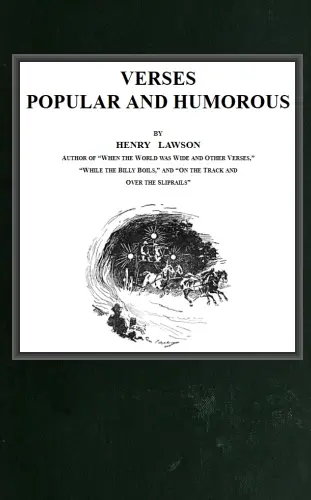
Verses popular and humorous
Henry Lawson
THE CLASSIC COLLECTION · 1902
"Children of the Bush" by Henry Lawson is a collection of short stories written during the late 19th century. The narratives explore the lives of bushmen in the Australian outback, delving into themes of mateship, kindness, and the struggles of rural life. Central to these tales is the character “The Giraffe,” a tall, good-natured man who embodies the spirit of camaraderie and selflessness in his community, often taking on the role of a caretaker for those facing hardship. The opening of "Children of the Bush" introduces us to the Giraffe as he goes about a morning in a shearers' shanty, where a sick jackaroo is to be sent to the hospital. The narrative captures the lively dynamics of the shanty, with its colorful characters sharing banter while they pass around a hat to collect funds for their ailing companion. Through various interactions and humorous exchanges, we see the Giraffe’s unwavering goodwill and his tendency to help others in distress, setting the tone for the stories that celebrate the resilience and generosity of those living in the bush. The Giraffe's commitment to community and humanity despite personal challenges hints at the broader social themes present throughout Lawson's work.
Introduction adapted from the source catalogue; source summaries may be automatically generated.
Free to read · English · 89,033 words · No account needed
MAKE TIME FOR A GOOD BOOK
On by default. Untick to stop anonymous reading totals. Each page counts after 10 seconds in view. How this works.
Anonymous counting is on unless you have switched it off.
“There’s an empty bedroom at the end of the store in the yard,” she said when she came back. “They can camp there for to-night if they behave themselves. You’d better tell ’em, Bob.”
“Thank yer, Alice,” said the Giraffe.
Next day, after work, the Giraffe and I drifted together and down by the river in the cool of the evening, and sat on the edge of the steep, drought-parched bank.
“I heard you saw your lady friends off this morning, Bob,” I said, and was sorry I said it, even before he answered.
“Oh, they ain’t no friends of mine,” he said. “Only four’ poor devils of women. I thought they mightn’t like to stand waitin’ with the crowd on the platform, so I jest offered to get their tickets an’ told ’em to wait round at the back of the station till the bell rung.... An’ what do yer think they did, Harry?” he went on, with an exasperatingly unintelligent grin. “Why, they wanted to kiss me.”
“Did they?”
“Yes. An’ they would have done it, too, if I hadn’t been so long.... Why, I’m blessed if they didn’t kiss me hands.”
“You don’t say so.”
“God’s truth. Somehow I didn’t like to go on the platform with them after that; besides, they was cryin’, and I can’t stand women cryin’. But some of the chaps put them into an empty carriage.” He thought a moment. Then:
“There’s some terrible good-hearted fellers in the world,” he
reflected.
I thought so too. “Bob,” I said, “you’re a single man. Why don’t you get married and settle down?”
“Well,” he said, “I ain’t got no wife an’ kids, that’s a fact. But it ain’t my fault.”
He may have been right about the wife. But I thought of the look that Alice had given him, and—
“Girls seem to like me right enough,” he said, “but it don’t go no further than that. The trouble is that I’m so long, and I always seem to get shook after little girls. At least there was one little girl in Bendigo that I was properly gone on.”
“And wouldn’t she have you?”
“Well, it seems not.”
“Did you ask her?”
“Oh, yes, I asked her right enough.”
“Well, and what did she say?”
“She said it would be redicilus for her to be seen trottin’ alongside of a chimbley like me.”
“Perhaps she didn’t mean that. There are any amount of little women who
like tall men.”
Your reading position is saved on this browser. Take it to another device with a library code. Reading pages adapt to text, rather than matching a printed edition.
Henry Lawson
Henry Lawson
Henry Lawson
Henry Lawson
BEHIND THE BOOK
This eBook is for the use of anyone anywhere in the United States and most other parts of the world at no cost and with almost no restrictions whatsoever. You may copy it, give it away or re-use it under the terms of the Project Gutenberg License included with this eBook or online at www.gutenberg.org. If you are not located in the United States, you will have to check the laws of the country where you are located before using this eBook. Read the source licence.
The original source file, including credits and licence, is retained by this library. Request an original-format copy at no charge. Please include the book title and Project Gutenberg identifier #7065.
KEEP YOUR CURIOSITY GOING
Coulson Kernahan

Maurice Baring
Frances Wright
Cécile Tormay

Frederic Jesup Stimson

W. H. P. (William Henry Pope) Jarvis