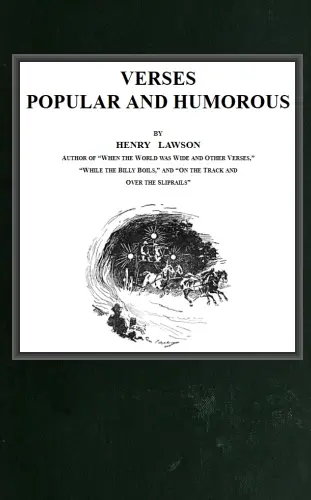
Verses popular and humorous
Henry Lawson
THE CLASSIC COLLECTION · 1902
"Children of the Bush" by Henry Lawson is a collection of short stories written during the late 19th century. The narratives explore the lives of bushmen in the Australian outback, delving into themes of mateship, kindness, and the struggles of rural life. Central to these tales is the character “The Giraffe,” a tall, good-natured man who embodies the spirit of camaraderie and selflessness in his community, often taking on the role of a caretaker for those facing hardship. The opening of "Children of the Bush" introduces us to the Giraffe as he goes about a morning in a shearers' shanty, where a sick jackaroo is to be sent to the hospital. The narrative captures the lively dynamics of the shanty, with its colorful characters sharing banter while they pass around a hat to collect funds for their ailing companion. Through various interactions and humorous exchanges, we see the Giraffe’s unwavering goodwill and his tendency to help others in distress, setting the tone for the stories that celebrate the resilience and generosity of those living in the bush. The Giraffe's commitment to community and humanity despite personal challenges hints at the broader social themes present throughout Lawson's work.
Introduction adapted from the source catalogue; source summaries may be automatically generated.
Free to read · English · 89,033 words · No account needed
MAKE TIME FOR A GOOD BOOK
On by default. Untick to stop anonymous reading totals. Each page counts after 10 seconds in view. How this works.
Anonymous counting is on unless you have switched it off.
“And, Tommy, I seen Harry Dale give young Tommy Carey a lick with a strap the day before New Year’s Eve for throwing his sister’s cat into the dam,” said Aunt Emma, coming to poor Mary’s rescue. “Never mind, Mary, my dear, he said goodbye to you last.”
“No, he didn’t!” roared Uncle Abel.
They were used to Uncle Abel’s sudden bellowing, but it startled them
this time.
“Why, Uncle Abel,” cried both Aunt Emma and Mrs Carey, “whatever do you
mean?”
“What I means is that I ain’t a-goin’ to have the feelin’s of a niece of mine trifled with. What I means is that I seen Harry Dale with Bertha Buckolt on New Year’s night after he left here. That’s what I means—”
“Don’t speak so loud, Abel, we’re not deaf,” interrupted Carey, as Mary started up white-faced. “What do you want to always shout for?”
“I speak loud because I want people to hear me!” roared Uncle Abel,
turning on him.
“Go on, Uncle Abel,” said Mary, “tell me what you mean.”
“I mean,” said Uncle Abel, lowering his voice a little, “that I seen Harry Dale and Bertha Buckolt at Buckolts’ Gate that night—I seen it all—”
“At Buckolts’ Gate!” cried Mary.
“Yes! at Buckolts’ Gate! Ain’t I speakin’ loud enough?”
“And where were you?”
“Never mind wheers I was. I was comin’ home along the ridges, and I seen them. I seen them say good-bye; I seen them hug an’ kiss—”
“Uncle Abel!” exclaimed Aunt Emma.
“It’s no use Uncle Abelin’ me. What I sez I sez. I ain’t a-goin’ to have a niece of mine bungfoodled—”
“Uncle Abel,” cried Mary, staring at him wild-eyed, “do be careful what you say. You must have made a mistake. Are you sure it was Bertha and Harry?”
“Am I sure my head’s on me neck?” roared Uncle Abel. “Would I see ’em if I didn’t see ’em? I tell you—”
“Now wait a moment, Uncle Abel,” interrupted Mary, with dangerous calmness. “Listen to me. Harry Dale and I are engaged to be married, and—”
“Have you got the writings!” shouted Uncle Abel.
“The what?” said Mary.
“The writings.”
“No, of course not.”
“Then that’s where you are,” said Uncle Abel, triumphantly. “If you had the writings you could sue him for breach of contract.”
Uncle Abel, who couldn’t read, had no faith whatever in verbal agreements (he wouldn’t sign one, he said), all others he referred to as “writings.”
Your reading position is saved on this browser. Take it to another device with a library code. Reading pages adapt to text, rather than matching a printed edition.
Henry Lawson
Henry Lawson
Henry Lawson
Henry Lawson
BEHIND THE BOOK
This eBook is for the use of anyone anywhere in the United States and most other parts of the world at no cost and with almost no restrictions whatsoever. You may copy it, give it away or re-use it under the terms of the Project Gutenberg License included with this eBook or online at www.gutenberg.org. If you are not located in the United States, you will have to check the laws of the country where you are located before using this eBook. Read the source licence.
The original source file, including credits and licence, is retained by this library. Request an original-format copy at no charge. Please include the book title and Project Gutenberg identifier #7065.
KEEP YOUR CURIOSITY GOING
Coulson Kernahan

Maurice Baring
Frances Wright
Cécile Tormay

Frederic Jesup Stimson

W. H. P. (William Henry Pope) Jarvis