THE CLASSIC COLLECTION✦An outlaw’s diary: the CommuneCLASSIC FREE BOOKS
An outlaw’s diary: the Commune
Cécile Tormay
THE CLASSIC COLLECTION · 1912
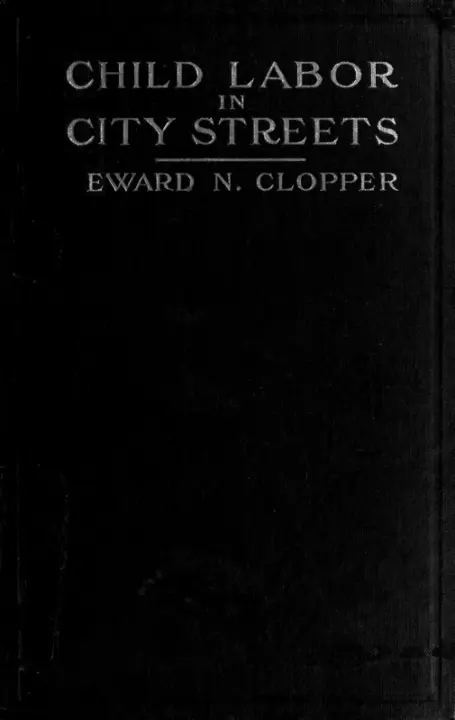
"Child Labor in City Streets" by Edward N. Clopper is a historical account written in the early 20th century. The book explores the often-overlooked issue of child labor in urban environments, focusing particularly on children engaged in street occupations such as selling newspapers, bootblacking, and peddling. Clopper argues that these children, far from being considered independent merchants, are often subjected to harsh working conditions that negatively impact their health and education, while public indifference continues to allow their exploitation. At the start of the work, Clopper establishes the context of child labor in the United States, highlighting how previous reform efforts have primarily concentrated on factory and mine workers, thus neglecting children in street occupations. He discusses how street workers are frequently seen through a naive lens, romanticizing their roles while failing to recognize the detrimental effects that such labor has on their well-being. The opening chapters outline the extent of street child labor, categorize various street work activities, and indicate the urgent need for legislative attention and societal reform to protect these vulnerable children.
Introduction adapted from the source catalogue; source summaries may be automatically generated.
Free to read · English · 52,258 words · No account needed
MAKE TIME FOR A GOOD BOOK
On by default. Untick to stop anonymous reading totals. Each page counts after 10 seconds in view. How this works.
Anonymous counting is on unless you have switched it off.
The fifteen-year-old messenger of another office showed the agent the list of about one hundred calls sent in the previous night, nearly every one of which came from the "red light" district.
After weighing such evidence we can readily comprehend the justice of the opinion rendered by Dr. Charles P. Neill in the following words: "The newsboys' service is demoralizing, but the messenger service is debauching.... And, saddest of all, this service appeals strongly to the children. The prurient curiosity of the developing boy would itself incline him to like these calls to houses of prostitution, but they quickly learn also that women who live in these sections are more generous with their earnings in the way of tips than are the people in the more respectable sections of the city.... It can be said that all the boys who go into the messenger service do not go to the bad, but it can be said with equal truth that it ruins children by the dozens, and that if any boy comes out of this service without having suffered moral shipwreck he can thank the mercy of God for it, and not the protecting arm of the community that stands idly by and makes no attempt to save him from temptation."[73]
In 1908 Congress passed a child labor law for the District of Columbia which provided, among other restrictions, that no messenger boy under sixteen years should be employed between 7 P.M. and 6 A.M.,--sixteen years, the beginning of the period of adolescence, when boys have the greatest need of protection from the vices running riot in cities!
The Chicago Vice Commission devotes several pages of its report to a recital of the experiences of messenger boys in connection with their work in the segregated districts. One of the telegraph companies maintains a branch office close to one of these districts, where eight boys from fifteen to eighteen years of age are employed as messengers. These boys are called upon to work at all hours of the day and night, their tasks being the same as those of the messengers in other cities. A number of specific instances of the wretched environment into which these boys are thrown, are given. One of them who works from midnight until 10 A.M. was sent by a prostitute to a drug store for a package of cocaine hydrochloride, for which he paid $5.78, receiving $1 from the prostitute as a tip for the service. Another messenger was sent out on a similar errand by another prostitute two weeks later and purchased for her a hypodermic needle for a syringe; he was charged $2 for this needle, the cost to the druggist being 19 cents. A few days later a boy was called by another prostitute who confided to him that she had discontinued the use of messenger boys for purchasing "dope" because she found that they talked too much and could not be trusted, adding that she now had a newsboy, who sold papers at a near-by corner, buy the cocaine for her. A woman who lives in an apartment house and is the owner and proprietor of houses of prostitution in the restricted district, is in the habit of sending in an order for cocaine to a druggist, who calls a messenger boy to deliver it to her residence. This messenger opened one of the packages and, suspecting that it was cocaine, sniffed a little of it himself. He confessed that he had done this quite often since, and it appeared that he had derived a good deal of pleasure from it. The same messenger is sent about three times monthly by a certain man to a Chinaman, from whom he buys a package of opium for $4. On returning from one of these trips he watched the man open the package, take a quantity of the stuff, roll it and heat it, but at this point the messenger was told to leave the room. Another messenger boy has been employed at this particular branch office for more than three years, although he is now only seventeen years old; his earnings average about $10 per week, including tips. He is of small stature, not mentally bright and at present is afflicted with syphilis of three months' duration. Another messenger is a boy of foreign parentage, only fifteen years of age, who said he had recently been called quite often to a certain house of prostitution where an inmate gave him a box with a note to a druggist; the contents cost $1.75, but upon returning to the woman he would declare that he had paid $2.50, thus obtaining 75 cents on false pretenses, and in addition a tip of half a dollar. On one of his trips for this prostitute he had opened the note and found that it was a requisition for cocaine; on returning he placed some of the contents upon his tongue, but did not like the sensation and never repeated it. He is in the habit of picking up discarded cigarettes and smoking them. In spite of his age, he knows the name of nearly every prostitute in this district and can recognize these women at sight; he stated that whenever he entered a house of prostitution they would nearly always kiss him, and at different times he had had sores on his lips.
Your reading position is saved on this browser. Take it to another device with a library code. Reading pages adapt to text, rather than matching a printed edition.
BEHIND THE BOOK
This eBook is for the use of anyone anywhere in the United States and most other parts of the world at no cost and with almost no restrictions whatsoever. You may copy it, give it away or re-use it under the terms of the Project Gutenberg License included with this eBook or online at www.gutenberg.org. If you are not located in the United States, you will have to check the laws of the country where you are located before using this eBook. Read the source licence.
The original source file, including credits and licence, is retained by this library. Request an original-format copy at no charge. Please include the book title and Project Gutenberg identifier #44396.
KEEP YOUR CURIOSITY GOING
Cécile Tormay

Moritz Busch
John L. Ransom
Frances Wright
Cécile Tormay

Mabel Potter Daggett