THE CLASSIC COLLECTION✦An outlaw’s diary: the CommuneCLASSIC FREE BOOKS
An outlaw’s diary: the Commune
Cécile Tormay
THE CLASSIC COLLECTION · 1912
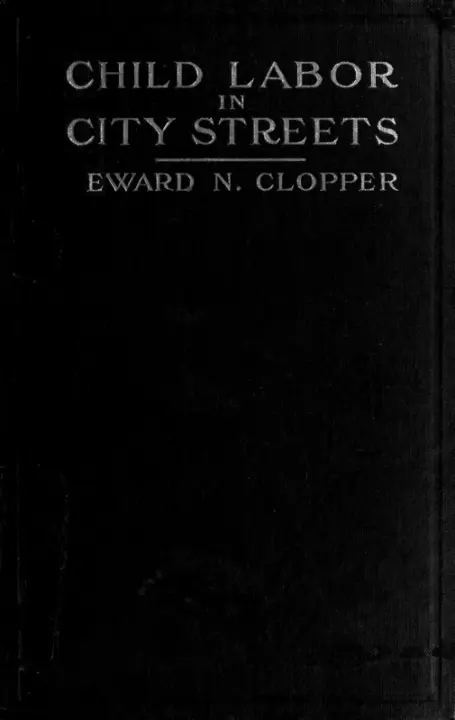
"Child Labor in City Streets" by Edward N. Clopper is a historical account written in the early 20th century. The book explores the often-overlooked issue of child labor in urban environments, focusing particularly on children engaged in street occupations such as selling newspapers, bootblacking, and peddling. Clopper argues that these children, far from being considered independent merchants, are often subjected to harsh working conditions that negatively impact their health and education, while public indifference continues to allow their exploitation. At the start of the work, Clopper establishes the context of child labor in the United States, highlighting how previous reform efforts have primarily concentrated on factory and mine workers, thus neglecting children in street occupations. He discusses how street workers are frequently seen through a naive lens, romanticizing their roles while failing to recognize the detrimental effects that such labor has on their well-being. The opening chapters outline the extent of street child labor, categorize various street work activities, and indicate the urgent need for legislative attention and societal reform to protect these vulnerable children.
Introduction adapted from the source catalogue; source summaries may be automatically generated.
Free to read · English · 52,258 words · No account needed
MAKE TIME FOR A GOOD BOOK
On by default. Untick to stop anonymous reading totals. Each page counts after 10 seconds in view. How this works.
Anonymous counting is on unless you have switched it off.
Inquiries extending over almost the whole German Empire were accordingly made by the different states from January to April, 1898. It was found that 544,283 children under fourteen years were employed in labor other than factory labor, agricultural employment and domestic service. This was 6.53 per cent of the total number of children of school age (8,334,919).
With regard to the effects of such work, this German report says: "As the children who carry around small wares, sell flowers, etc., go from one inn to another, they are exposed to evil influences, and are liable to contract at an early age, bad habits of smoking, lying, drinking.... The delivery of newspapers is a particularly great strain on the children, as it occupies them both before and after school hours."
Seven divisions of these children were made according to occupation, four of them relating to street work. Under the heading Handel were included children in many kinds of work, among them hawking fruit, milk, bread, brooms, flowers, newspapers, etc.; under Austragedienste were included only the delivery and carrying around of bread, milk, vegetables, beer, papers, books, advertisements, circulars, bills, coals, wood, boots and shoes, washing, clothes, etc.; under Gewöhnliche Laufdienste were included only errand boys and messengers; under Sonstige gewerbliche Thätigkeit were included, among other occupations, blacking boots, leading the blind, street singers and players, etc.
========================+========+========+=========+=========+============ | | | SEX NOT | | | BOYS | GIRLS | STATED | TOTAL | PERCENTAGE ------------------------+--------+--------+---------+---------+------------ Handel (retail trade) | 7,507 | 4,540 | 5,576 | 17,623 | 3.31 | | | | | Austragedienste | | | | | (delivery service) | 67,188 | 36,966 | 31,676 | 135,830 | 25.52 | | | | | Gewöhnliche Laufdienste | | | | | (general messenger | | | | | service) | 23,321 | 2,134 | 10,454 | 35,909 | 6.75 | | | | | Sonstige gewerbliche | | | | | Thätigkeit (other forms | | | | | of labor) | 6,281 | 2,387 | 3,119 | 11,787 | 2.21 ========================+========+========+=========+=========+============
Conditions in Austria
The Austrian Ministry of Commerce began an investigation of actual conditions in Austria late in 1907 in response to the agitation for a new law that would regulate child labor not only in factories, but also in home industries, in commerce, and even in agriculture. In his Report on Child Labor Legislation in Europe, Mr. C. W. A. Veditz refers to the findings of this investigation in a number of the provinces. In Bohemia, of 676 children in trade and transportation, but still attending school, 169 were engaged in peddling and huckstering; in delivering goods and going errands 1554 children were employed, being generally hired to deliver bread, milk, meats, groceries, newspapers, books, telegrams, circulars--in fact, all manner of goods.[39] In the province of Upper Austria children are paid from two to seven crowns (40.6 cents to $1.42) a month for delivering newspapers daily, while in the duchy of Salzburg the pay varies from twenty to fifty hellers (4 to 10 cents) a day for delivering bread or newspapers.
Your reading position is saved on this browser. Take it to another device with a library code. Reading pages adapt to text, rather than matching a printed edition.
BEHIND THE BOOK
This eBook is for the use of anyone anywhere in the United States and most other parts of the world at no cost and with almost no restrictions whatsoever. You may copy it, give it away or re-use it under the terms of the Project Gutenberg License included with this eBook or online at www.gutenberg.org. If you are not located in the United States, you will have to check the laws of the country where you are located before using this eBook. Read the source licence.
The original source file, including credits and licence, is retained by this library. Request an original-format copy at no charge. Please include the book title and Project Gutenberg identifier #44396.
KEEP YOUR CURIOSITY GOING
Cécile Tormay

Moritz Busch
John L. Ransom
Frances Wright
Cécile Tormay

Mabel Potter Daggett