Chats on Old Silver
Arthur Hayden
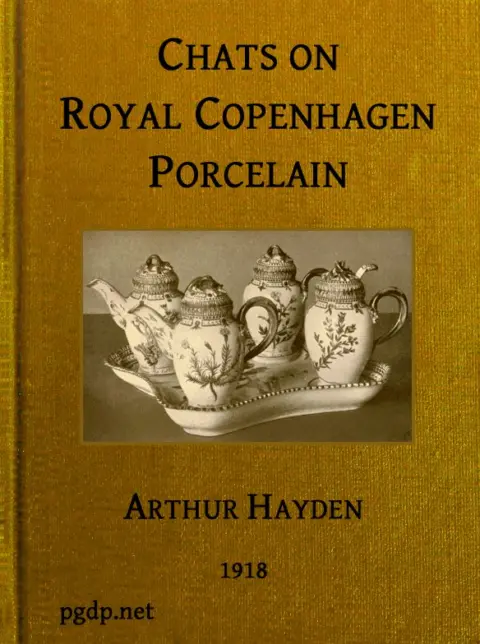
THE CLASSIC COLLECTION · 1918
"Chats on Royal Copenhagen Porcelain" by Arthur Hayden is a historical account written in the early 20th century. The book explores the rich history and artistic significance of the Royal Copenhagen Porcelain Factory, drawing attention to its development and the key figures involved in its creation. Focused on the artistry and craftsmanship of porcelain, it seeks to enrich the reader's understanding of what makes this factory renowned in the field of ceramics. The opening of the book sets the stage by discussing the context and conditions of porcelain manufacturing in 18th century Denmark, particularly the efforts to establish a porcelain factory under King Frederik V. It introduces the challenges faced, such as the elusive nature of creating true porcelain and the influence of existing European factories. Hayden highlights notable periods, including the Fournier period, and provides insights into the artistic journey of Danish porcelain, which eventually culminated in the establishment of a national identity in its ceramics craftsmanship. This initial exploration reveals a deliberate effort to both honor historical significance and present a visual representation of the porcelain through illustrations, marking the beginning of a detailed examination of the Royal Copenhagen Porcelain Factory's legacy.
Introduction adapted from the source catalogue; source summaries may be automatically generated.
Free to read · English · 45,988 words · No account needed
MAKE TIME FOR A GOOD BOOK
On by default. Untick to stop anonymous reading totals. Each page counts after 10 seconds in view. How this works.
Anonymous counting is on unless you have switched it off.
=Classification of Figure Subjects.=--The figure subjects under examination in this chapter may be divided into the following groups:--
Portrait Busts and Statuettes and Classic figures, in biscuit--
such as those of Queen Juliane Marie and the Hereditary Prince Frederik, and the statuette of A Hero at the National Museum, Stockholm (illustrated, p. 115)
Ornamental subjects, in white--
such as the centre-piece with the supporting Cupids at the Dansk Folke Museum, Copenhagen, and the remarkably fine vases, 4 feet high, at Frederiksborg, having powerfully modelled groups of female classic figures.
Classic figures and subjects, decorated in colours, overglaze--
such as the group Flora and Minerva by Jacob Schmidt and Sea Horses at the National Museum, Stockholm (illustrated, p. 119).
Romantic subjects in costume, decorated in colours, overglaze--
such as Lovers with Cupid and Garlands (illustrated, p. 123), and small figures of women and children in fanciful costume.
There is at Frederiksborg Castle a group--Chinese Woman and Chinaman, who is offering her a basket of fruit. This Oriental subject is very rare. Marked with three lines underglaze in blue, but the yellow overglaze pigment on base has turned the blue into three green lines.
Figure subjects in correct contemporary costume--practically a ceramic gallery faithfully reflecting the social character of the period--
such as the Flute Player, the Lady and Gentleman dancing, the Beggar, and an especially fine series of peasant types in old costume, engaged at their various vocations--e.g. two groups of Norwegian Miners, with black costume and green caps, with C7 in gold (at Frederiksborg Castle). The Woman with Hens, in Norwegian costume, a Market Woman with Fowls, a Lobster-seller, Woman selling Fruit, Woman milking Cow. Figures in naval and military uniform, and many others.
=Old Copenhagen Figures--their National Character.=--In regard to the series of figures in contemporary costume, there is an air about them which stamps them at once as being the work of the old Copenhagen factory. They are practically portrait studies, with that added touch of poetic charm which fits them for their place among the gods of the china cabinet.
They challenge comparison with the work of other European factories. Kändler, the modeller at Meissen, in what is styled the Krinolinengruppen period in mid eighteenth-century days, produced figures of lovers and ladies in rich costumes. They belong to that impossible world of the china-shelf, of shepherds and shepherdesses and bending cavaliers and gay ladies, conjured up in the fertile brain of the potter. They invaded France and they conquered England in the glorious days of Derby and Chelsea. But with a few notable exceptions they did not penetrate to Copenhagen.
Your reading position is saved on this browser. Take it to another device with a library code. Reading pages adapt to text, rather than matching a printed edition.
Arthur Hayden
Arthur Hayden
Arthur Hayden
Arthur Hayden
BEHIND THE BOOK
This eBook is for the use of anyone anywhere in the United States and most other parts of the world at no cost and with almost no restrictions whatsoever. You may copy it, give it away or re-use it under the terms of the Project Gutenberg License included with this eBook or online at www.gutenberg.org. If you are not located in the United States, you will have to check the laws of the country where you are located before using this eBook. Read the source licence.
The original source file, including credits and licence, is retained by this library. Request an original-format copy at no charge. Please include the book title and Project Gutenberg identifier #48391.
KEEP YOUR CURIOSITY GOING
Cécile Tormay

Moritz Busch
John L. Ransom
Frances Wright
Cécile Tormay

Mabel Potter Daggett