Chats on Old Silver
Arthur Hayden
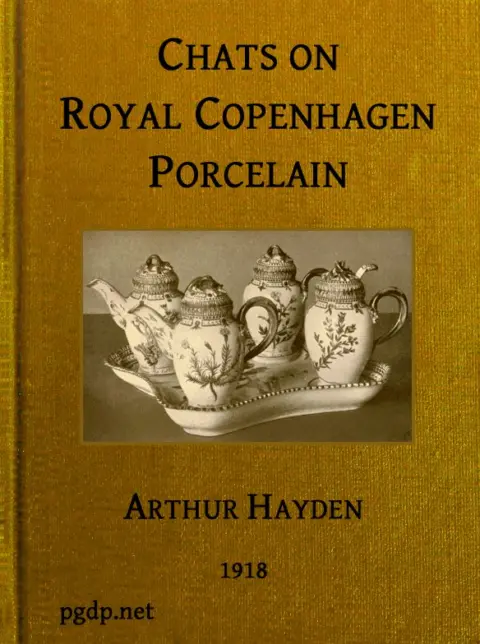
THE CLASSIC COLLECTION · 1918
"Chats on Royal Copenhagen Porcelain" by Arthur Hayden is a historical account written in the early 20th century. The book explores the rich history and artistic significance of the Royal Copenhagen Porcelain Factory, drawing attention to its development and the key figures involved in its creation. Focused on the artistry and craftsmanship of porcelain, it seeks to enrich the reader's understanding of what makes this factory renowned in the field of ceramics. The opening of the book sets the stage by discussing the context and conditions of porcelain manufacturing in 18th century Denmark, particularly the efforts to establish a porcelain factory under King Frederik V. It introduces the challenges faced, such as the elusive nature of creating true porcelain and the influence of existing European factories. Hayden highlights notable periods, including the Fournier period, and provides insights into the artistic journey of Danish porcelain, which eventually culminated in the establishment of a national identity in its ceramics craftsmanship. This initial exploration reveals a deliberate effort to both honor historical significance and present a visual representation of the porcelain through illustrations, marking the beginning of a detailed examination of the Royal Copenhagen Porcelain Factory's legacy.
Introduction adapted from the source catalogue; source summaries may be automatically generated.
Free to read · English · 45,988 words · No account needed
MAKE TIME FOR A GOOD BOOK
On by default. Untick to stop anonymous reading totals. Each page counts after 10 seconds in view. How this works.
Anonymous counting is on unless you have switched it off.
At Copenhagen, therefore, the manufacture of faience at a porcelain factory was a leap into the unknown. Not only were different kilns to be employed, but a different technique and especial conditions governed the manufacture. The theories which had been skilfully put into practice and the ideals which had been reached in the art of porcelain were alien to the new departure in the field of faience. To have welded together the two arts and the two techniques would have ruined the enterprise at its commencement. The two streams were allowed to run apart, and the result is an artistic achievement no less noteworthy than the Renaissance of the Royal Copenhagen porcelain. The mantle of Philip Schou has descended on his son-in-law, Frederik Dalgas, who has ably continued the traditions of his predecessor in the management of this national enterprise. The inception and development of this art faience of Copenhagen is due to Mr. Frederik Dalgas, who brought a keen and virile intuition into this new field of ceramic adventure. Whereas in the porcelain there is delicate artistry and finesse, in the faience there is breadth and vivacity of colour schemes. Never do the twain touch each other in kinship. The faience is not a poor kinsman of the porcelain. It is a new creation, a fresh and forceful note in ceramic art. It has a relationship with bygone majolica of another land. It is a transplantation of a southern stock into a northern clime. One is reminded of those labels at Kew Gardens indicating that certain rare trees from sunnier lands have been acclimatized and have become beauty spots in a far country.
=The Slow Growth of a New Art.=--It is always interesting to the student to examine specimens belonging to the experimental stage of an art. It is here that the potter struggling with his new technique betrays in his motifs suggestions as to its origin. There are very few wares in ceramic art that stand out as supremely original. In some way or another they bear relationship to earlier potters' work, as a rule. Whole schools of artistic potters have been avowedly copyist. This is a truism in regard to European ceramic art as a whole: it is admittedly derivative from Oriental prototypes. But in regard to various branches of pottery apart from porcelain, there is little doubt that it has a long lineage. It is therefore possible to compare the stages of evolution of faience in the Western countries and to realize that since Greek and Roman and Etruscan days man was a progressive potter, though even in this field derivative technique came from east of Suez. The earliest examples of the Copenhagen faience suggest that the old Italian majolica models had lingered in the memory of the potters making their essay into a new domain. Those who have carefully watched the slow but sure growth of this art faience of Copenhagen will have come to realize how surely the potter has put his foot on a new plane and established something that is characteristic and original. He has by a gradual process year by year added new forms, created dishes and beakers of sound design, and perfected the decorations in colour till they have reached something which is gay without being garish and exuberant in rich colouring without being other than surprisingly harmonious. One wonders how the Oriental rug-weaver can place his blues and his reds seemingly so disastrous to tone effect. But there they are, and, either by strong contrast or perfect harmony, the results are artistically true. It is the same question one asks of the colour effects in the Copenhagen art faience. They are perfectly luscious and strikingly original. No one else has employed these combinations of pigments, nor their wide range of colours. They appear to have been produced by magic. But to any one with a working knowledge of a great factory will come the reflection that the apparent magic is the wizardry of genius, and genius has been defined as the infinite capacity for taking pains. The strenuous work, the long vigils, the indefatigable and indomitable determination to accomplish the mastery of the technique is here evident. It is the strong and fruitful harvest of a slow growth carefully tended in an especially artistic environment by trained minds.
Your reading position is saved on this browser. Take it to another device with a library code. Reading pages adapt to text, rather than matching a printed edition.
Arthur Hayden
Arthur Hayden
Arthur Hayden
Arthur Hayden
BEHIND THE BOOK
This eBook is for the use of anyone anywhere in the United States and most other parts of the world at no cost and with almost no restrictions whatsoever. You may copy it, give it away or re-use it under the terms of the Project Gutenberg License included with this eBook or online at www.gutenberg.org. If you are not located in the United States, you will have to check the laws of the country where you are located before using this eBook. Read the source licence.
The original source file, including credits and licence, is retained by this library. Request an original-format copy at no charge. Please include the book title and Project Gutenberg identifier #48391.
KEEP YOUR CURIOSITY GOING
Cécile Tormay

Moritz Busch
John L. Ransom
Frances Wright
Cécile Tormay

Mabel Potter Daggett