Chats on Old Silver
Arthur Hayden
THE CLASSIC COLLECTION · 1905
"Chats on Old Furniture: A Practical Guide for Collectors" by Arthur Hayden is a practical guide written in the early 20th century. This informative volume explores the history and appreciation of antique furniture, focusing primarily on English styles while also touching upon French, Italian, Spanish, and Dutch influences. It serves as a resource for collectors, providing insights into the evolution of domestic furniture design and the significance of various styles. The opening of the guide sets a historical context, emphasizing the importance of understanding the characteristics and heritage of old furniture, particularly as many fine pieces cross international borders into private collections. Hayden notes the changing landscape of furniture collecting and the need for a renewed appreciation of this heritage before it is diminished by time and commerce. He outlines the book's structure, which will cover various furniture styles, and introduces the Renaissance period in Europe, discussing its impact on the development of furniture design in England and how it shaped domestic tastes and aesthetics.
Introduction adapted from the source catalogue; source summaries may be automatically generated.
Free to read · English · 34,584 words · No account needed
MAKE TIME FOR A GOOD BOOK
On by default. Untick to stop anonymous reading totals. Each page counts after 10 seconds in view. How this works.
Anonymous counting is on unless you have switched it off.
Blue delft jars and bowls, some especially made for William and Mary and bearing the Royal arms and the cypher "W. M. R." and the Nassau motto, "Je main tien-dray," still to be seen in the Queen's Gallery at Hampton Court, were introduced, and it became fashionable to collect china. Consequently the furniture in rooms had to be adapted for the arrangement of this new class of ornament, and cabinets were largely made with accommodation to receive vases and beakers and blue bowls on their shelves. The earlier form have straight sides; but later, especially in the next reign, they follow French designs, and are swollen or bombe at the sides.
With William, too, came over the plain walnut card-table. Clock cases of the style termed "Grandfather" were of Dutch origin. The seats of chairs were shaped and removable. The Dutch trade with the East Indies had brought Oriental china and lac cabinets into Holland, and these, with the coming of William, found their way into this country. Bureaux with a number of secret recesses were introduced, and another Dutch importation from the East was the now celebrated chair or table leg with claw and ball foot. This came directly from China, and as in the case of delft, which is the earthenware replica by the Dutch potter of fine blue porcelain vases, from Nankin and Canton, where the Oriental perspective and design have been slavishly copied, so with the furniture, the old Chinese symbol of a dragon's foot holding a pearl, was repeated in the furniture by Dutch cabinetmakers. Dutch marquetry made an early appearance with simple ornamentation, sometimes enriched by ivory or mother-of-pearl inlay, but later it developed into flowing floral designs with figures, vases, fruit, butterflies, and elaborate scrolls in various coloured woods, of which yellow was the predominant colour.
L s. d.
Armchair, Charles II., oak, carved with cherubs supporting crowns, and with turned column supports. Christie, November 20, 1903 15 4 6
Chairs, pair, Charles II., oak, with cane seats and oval cane panels in the backs, spirally turned legs, stretchers and rails at the back. Christie, March 4, 1904 63 0 0
Armchair, Charles II., oak, with high back carved with arabesque foliage, with lions' masks and claw legs. Christie, March 29, 1904 63 0 0
Chairs, pair, nearly similar, carved with foliage. Christie, March 29, 1904 39 18 0
Armchair, Charles II., walnut-wood, of Italian design, carved with masks, cane seat and panel in back; and cushion, covered with old Flemish tapestry. Christie, March 4, 1904 77 14 0
Chairs, three, Charles II., oak, with oval panels of canework in the backs, the borders carved with foliage, flowers, and Amorini, and surmounted by busts. Christie, April 12, 1904 42 0 0
Your reading position is saved on this browser. Take it to another device with a library code. Reading pages adapt to text, rather than matching a printed edition.
Arthur Hayden
Arthur Hayden
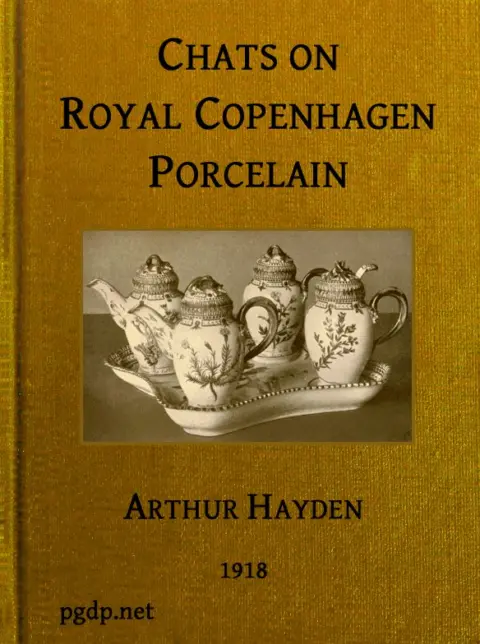
Arthur Hayden
Arthur Hayden
BEHIND THE BOOK
This eBook is for the use of anyone anywhere in the United States and most other parts of the world at no cost and with almost no restrictions whatsoever. You may copy it, give it away or re-use it under the terms of the Project Gutenberg License included with this eBook or online at www.gutenberg.org. If you are not located in the United States, you will have to check the laws of the country where you are located before using this eBook. Read the source licence.
The original source file, including credits and licence, is retained by this library. Request an original-format copy at no charge. Please include the book title and Project Gutenberg identifier #34877.
KEEP YOUR CURIOSITY GOING
Cécile Tormay

Moritz Busch
John L. Ransom
Frances Wright
Cécile Tormay

Mabel Potter Daggett