Chats on Old Silver
Arthur Hayden
THE CLASSIC COLLECTION · 1917
"Chats on Old Clocks" by Arthur Hayden is a historical account written in the early 20th century. This work explores the artistry and craftsmanship of old clocks, focusing particularly on English domestic clocks and their makers. It provides insights into the evolution of clock design and construction, the notable clockmakers of the past, and the significance of different styles and mechanisms. The opening of the book presents an introduction to the concept of timekeeping, detailing how early mechanisms were developed, particularly focusing on the pendulum's introduction, which revolutionized clockmaking. Hayden emphasizes the artistic and scientific evolution of clocks, highlighting the transformation from primitive timekeeping devices to complex machines. He also reflects on the cultural significance of clocks in domestic settings and sets the stage for further exploration of specific types and styles of clocks throughout the volume.
Introduction adapted from the source catalogue; source summaries may be automatically generated.
Free to read · English · 39,074 words · No account needed
MAKE TIME FOR A GOOD BOOK
On by default. Untick to stop anonymous reading totals. Each page counts after 10 seconds in view. How this works.
Anonymous counting is on unless you have switched it off.
Other names of Liverpool makers found on long-case clocks are William Sutton, Harrison & Son, Jas. Canson, Thomas Saxon, Jo^n Taylor (Ormskirk), W. Lassell, Toxteth Park, Liverpool, with motto, "Time shows the Way of Life's Decay," with brass face, lunar movement, and monthly dial with indicator. (This style of dial is a feature of a Shropshire clock illustrated p. 249.) Brown, Liverpool, is found on a mahogany long-case clock and also on a small long-case clock. To those who are interested the portrait in oils of Peter Litherland, the inventor of the rack lever, who died in 1804, is in the possession of the Corporation of Liverpool.
Among other Lancashire makers the following are noteworthy: T. Lees (Bury), 1795-1800; Archibald Coats (Wigan), 1780; Barr (Bolton), 1790; James Barlow (Oldham), 1775; Benjamin Barlow (Ashton-under-Lyne), 1780; and Nathaniel Brown (Manchester), 1780-1785.
In Westmorland and Cumberland the names Burton, of Kendal, and Russell, of Carlisle, are often found on grandfather clocks of local manufacture of the late eighteenth century.
In regard to a particular style of case associated with Lancashire and with Cheshire, having the door decorated with panel in Gothic style, two examples are illustrated (p. 227), one by Henry Higginbotham (Macclesfield), and the other by Heywood, Northwich, 1790 (p. 231).
=Clockmakers of the Midlands.=--As typical of the fine work produced, the bracket clock by Sam Watson, of Coventry, 1687, illustrated (p. 181), shows that the provincial maker was at that date in no way on a lower plane than his contemporary in London. Other makers are Wilson (Warwick), 1709; John Whitehurst (Derby), 1785--a fine long-case clock by this maker is in the Metropolitan Museum of Art, New York; W. Francis (Birmingham), and Thomas Wall (Birmingham), 1798. An example by this maker is illustrated (p. 233), exhibiting a pastoral scene painted in the lunette of the dial. This clock--in the possession of the author--keeps excellent time although 120 years old, and has gone for ten years without stopping.
Of Nottingham makers, the following names of early craftsmen are found on watches: Isaac Alexander, about 1760 (a watch, gold inner case, white dial; outer case of shagreen, with portrait of Charles Stuart by J. June, 1745), and Thomas Hudson, about 1790 (silver, white dial; outer case of tortoiseshell, with silver mounts). The name of Hen. Page, Upper Broughton (Notts), is found on a brass clock, and John Kirk was a maker at Epperstone and Skegby before he came to London in 1677 and was admitted as a member of the Clockmakers' Company. Among the collection of watches at Nottingham Museum, apart from the two above-mentioned, are a good many by makers of a later date, mainly of the early nineteenth century: John Lingford, A. Shepperley, William Young--all of Nottingham, and Geo. Stacey, Worksop.
Your reading position is saved on this browser. Take it to another device with a library code. Reading pages adapt to text, rather than matching a printed edition.
Arthur Hayden
Arthur Hayden
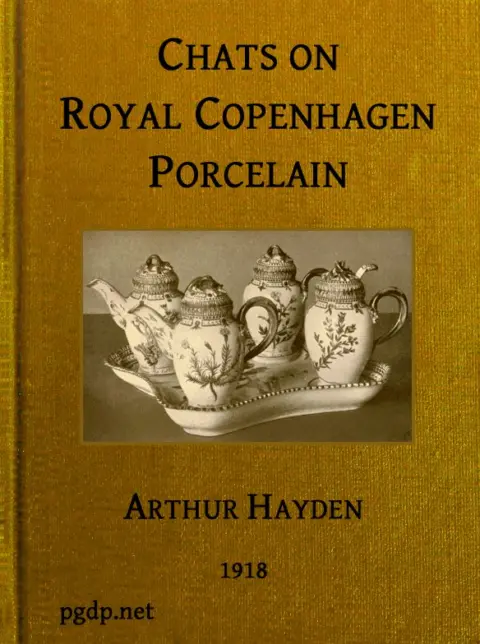
Arthur Hayden
Arthur Hayden
BEHIND THE BOOK
This eBook is for the use of anyone anywhere in the United States and most other parts of the world at no cost and with almost no restrictions whatsoever. You may copy it, give it away or re-use it under the terms of the Project Gutenberg License included with this eBook or online at www.gutenberg.org. If you are not located in the United States, you will have to check the laws of the country where you are located before using this eBook. Read the source licence.
The original source file, including credits and licence, is retained by this library. Request an original-format copy at no charge. Please include the book title and Project Gutenberg identifier #45772.
KEEP YOUR CURIOSITY GOING
Cécile Tormay

Moritz Busch
John L. Ransom
Frances Wright
Cécile Tormay

Mabel Potter Daggett