Chats on Old Silver
Arthur Hayden
THE CLASSIC COLLECTION · 1917
"Chats on Old Clocks" by Arthur Hayden is a historical account written in the early 20th century. This work explores the artistry and craftsmanship of old clocks, focusing particularly on English domestic clocks and their makers. It provides insights into the evolution of clock design and construction, the notable clockmakers of the past, and the significance of different styles and mechanisms. The opening of the book presents an introduction to the concept of timekeeping, detailing how early mechanisms were developed, particularly focusing on the pendulum's introduction, which revolutionized clockmaking. Hayden emphasizes the artistic and scientific evolution of clocks, highlighting the transformation from primitive timekeeping devices to complex machines. He also reflects on the cultural significance of clocks in domestic settings and sets the stage for further exploration of specific types and styles of clocks throughout the volume.
Introduction adapted from the source catalogue; source summaries may be automatically generated.
Free to read · English · 39,074 words · No account needed
MAKE TIME FOR A GOOD BOOK
On by default. Untick to stop anonymous reading totals. Each page counts after 10 seconds in view. How this works.
Anonymous counting is on unless you have switched it off.
No. 10 is by Kemp, London, and is decorated in Battersea enamel and shagreen. This brings us to the age of Pinchbeck, "the toyman in the Strand," and suggests the gewgaws and trifles, the enamelled heads for malacca canes, the snuff-boxes, and all the fashionable paraphernalia of a man about town. The watch in some respects had begun to lose its old character and was again a toy.
Among interesting work is that of Thomas Chamberlaine de Chelmisforde. He worked in the brightest days of Charles I, when the arts were receiving stimulation from the Court. A new era seemed as though it might be about to dawn. The picture gallery of Charles I at Hampton Court showed his catholic taste, and his Queen, Henrietta Maria, was a patron of the arts. Vandyck and other great artists flocked to this country, and highly trained craftsmen commenced to build a reputation which later iconoclasts swept aside as of Baal.
In the watch illustrated by Thomas Chamberlaine there is something delightfully simple and chaste. He was a maker whose work promised much. There is a specimen of his work signed "Chamberlain Chelmisford" at the British Museum, but in the specimen illustrated the name is chased "Thomas Chamberlaine de Chelmisforde."
The study of watches of the various periods is a fascinating one. When the collector leaves the path of clocks, with their more Gargantuan proportions, to become a student of the intricacies of the art of the watchmaker as exemplified in some of his greatest triumphs, he has been enticed on a quest which is unending. No field in collecting and connoisseurship has claimed more devotees.
"Act of Parliament" clocks, so-called, 124
Adam style, its employment in the clock-case, 147
Robert, clock-case by, illustrated, 139
Aicken, George (Cork), clock by, 277
Alarum clocks, 54
and striking clocks, early, 32
Ale-house clocks, Oliver Goldsmith quoted, 127
American clocks--
"Banjo clocks," 124
Bracket clock, by Savin and Dyer (Boston), 198
Lantern clock, with pendulum, 59
Anchor pendulum, the, 59
Arnold, John (Bodmin), 37, 212
Astronomical clock-dial, the, 28
Babylonian measurement of time, 28, 29, 30
Bacon, quoted, 53
Balance and weights prior to pendulum, 33
Barraud, clock by (1805), 203
Battersea enamel employed for watch-cases, 290
Beginners, hints for, 41
Belfast clocks and clockmakers, 272
Bewick, Thomas, engraver of clock-dials (1763-74), 215, 217
Biddell, clock by, 204
"Birdcage" clocks, 54
Böttger, his porcelain at Meissen, 109
Boulle, André Charles, and his marquetry, 72, 73, 111
Bracket clock, the, 179-204
or wall clock, the, early use of, 46, 49
Brass lantern clock, the, 45-63
Bristol clock illustrated, 149
Britten, F. J., Old Clocks and Clockmakers, full lists of
makers in, 37
Brownhill, Henry (Leeds), copper token of, 218
Cabrier, name falsely put on Dutch clocks, 36
Calendar watch illustrated, 291
Case, the, evolution of, 155
Catherine of Braganza, dowry of, 107
Centres of clock and watch making in 1797, 214
Chamber clocks an established feature in furniture, 192
Your reading position is saved on this browser. Take it to another device with a library code. Reading pages adapt to text, rather than matching a printed edition.
Arthur Hayden
Arthur Hayden
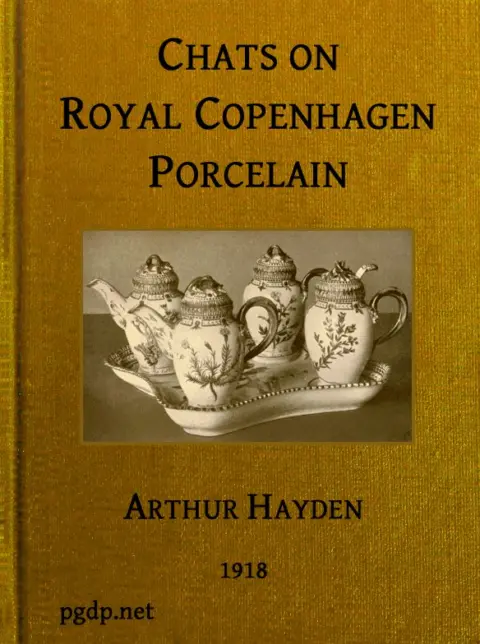
Arthur Hayden
Arthur Hayden
BEHIND THE BOOK
This eBook is for the use of anyone anywhere in the United States and most other parts of the world at no cost and with almost no restrictions whatsoever. You may copy it, give it away or re-use it under the terms of the Project Gutenberg License included with this eBook or online at www.gutenberg.org. If you are not located in the United States, you will have to check the laws of the country where you are located before using this eBook. Read the source licence.
The original source file, including credits and licence, is retained by this library. Request an original-format copy at no charge. Please include the book title and Project Gutenberg identifier #45772.
KEEP YOUR CURIOSITY GOING
Cécile Tormay

Moritz Busch
John L. Ransom
Frances Wright
Cécile Tormay

Mabel Potter Daggett