Forest Glen; or, The Mohawk’s Friendship
Elijah Kellogg
THE CLASSIC COLLECTION · 1896
"Charlie Bell, The Waif of Elm Island" by Elijah Kellogg is a novel written in the late 19th century. This work follows the journey of Charlie Bell, an English orphan with a troubled past, who finds himself taken in by a couple, Ben and Sally Rhines, on a remote island after escaping from a gang of pirates disguised as fishermen. The story explores themes of resilience, community, and personal growth as Charlie navigates his new life and seeks to contribute to his adoptive family. The opening of the novel establishes a backdrop of hardship during the Revolutionary War era, painting a vivid picture of life on Elm Island. It introduces Charlie as a mistreated boy who is saved from a dangerous situation by Ben's fierce protection of his family. After Charlie is taken in, he quickly finds a sense of purpose and belonging while assisting Ben and Sally with chores around their homestead. The bits of dialogue exchanged between the characters reveal their personalities and relationships, setting the stage for Charlie’s transformation from a frightened waif to a productive and cherished member of the household. The beginning captivates the reader by promising adventure and character development as Charlie integrates into his new life.
Introduction adapted from the source catalogue; source summaries may be automatically generated.
Free to read · English · 69,107 words · No account needed
MAKE TIME FOR A GOOD BOOK
On by default. Untick to stop anonymous reading totals. Each page counts after 10 seconds in view. How this works.
Anonymous counting is on unless you have switched it off.
But the great difficulty in the way was, he could not venture to go there in the canoe. Ben was a giant, and everything he worked with was made upon a corresponding scale. Charlie could hardly lift his axe. His canoe was twenty-five feet in length, and the blades of the oars were twice as wide as common, so that they might take stronger hold of the water. Ben made them before he went to Boston, that, if the wind came to the north-west, he might be able to exert all his strength; otherwise, in a severe blow, he would have only pulled the oars through the water without forcing the boat ahead.
Charlie could hardly move this great thing in the harbor, much less in a sea, and against the wind.
Joe Griffin now came to chop, which increased Charlie’s anxiety to catch the fish, as there were more mouths to fill, and Joe’s held a great deal. He at length broached the matter to Ben, saying, if he only had a light canoe, that he could pull, he could catch fish, for he had been used to fishing.
“I would make you one,” said Ben, “if I had time; but Joe is here, and the oxen are coming from the main, and I must chop.”
“But,” persisted Charlie, “I could dig it out; if you told me how, I think I could make the outside.”
“Well,” said Ben, pleased with the boy’s evident anxiety to be useful, “I will cut the tree, and you can be working it out, and we will help you in rainy days, and at odd times.”
“O, no, don’t,” said Charlie; “I want to cut the tree, and make it all clear from the stump.”
“Why, Charlie, it takes the largest kind of trees to make a canoe; it’s no use to cut a valuable tree to make a plaything; it ought to be as large as you can cleverly pull, or you’ll outgrow it. It will take you a week to cut down such a tree with your little axe.”
“No matter; do let me try.”
Ben picked out the tree, marked out the direction of the kerf on the bark with his axe, and left him. When Charlie came in to dinner, the perspiration stood in drops on his face, and he was as red as a turkey-cock.
“Well,” said Joe, “have you got through the bark?”
“Almost,” replied Charlie.
At night the boy showed evident signs of fatigue.
Your reading position is saved on this browser. Take it to another device with a library code. Reading pages adapt to text, rather than matching a printed edition.
Elijah Kellogg
Elijah Kellogg
Elijah Kellogg
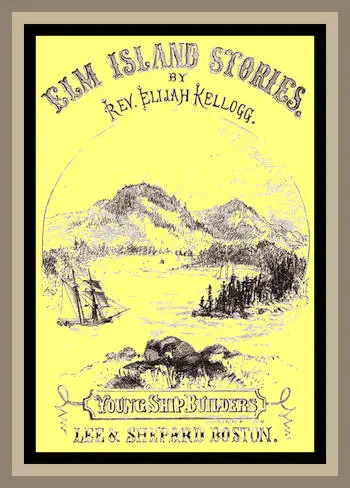
Elijah Kellogg
BEHIND THE BOOK
This eBook is for the use of anyone anywhere in the United States and most other parts of the world at no cost and with almost no restrictions whatsoever. You may copy it, give it away or re-use it under the terms of the Project Gutenberg License included with this eBook or online at www.gutenberg.org. If you are not located in the United States, you will have to check the laws of the country where you are located before using this eBook. Read the source licence.
The original source file, including credits and licence, is retained by this library. Request an original-format copy at no charge. Please include the book title and Project Gutenberg identifier #51141.
KEEP YOUR CURIOSITY GOING
Cécile Tormay

Moritz Busch
Coulson Kernahan
John L. Ransom

Maurice Baring
Frances Wright