Forest Glen; or, The Mohawk’s Friendship
Elijah Kellogg
THE CLASSIC COLLECTION · 1896
"Charlie Bell, The Waif of Elm Island" by Elijah Kellogg is a novel written in the late 19th century. This work follows the journey of Charlie Bell, an English orphan with a troubled past, who finds himself taken in by a couple, Ben and Sally Rhines, on a remote island after escaping from a gang of pirates disguised as fishermen. The story explores themes of resilience, community, and personal growth as Charlie navigates his new life and seeks to contribute to his adoptive family. The opening of the novel establishes a backdrop of hardship during the Revolutionary War era, painting a vivid picture of life on Elm Island. It introduces Charlie as a mistreated boy who is saved from a dangerous situation by Ben's fierce protection of his family. After Charlie is taken in, he quickly finds a sense of purpose and belonging while assisting Ben and Sally with chores around their homestead. The bits of dialogue exchanged between the characters reveal their personalities and relationships, setting the stage for Charlie’s transformation from a frightened waif to a productive and cherished member of the household. The beginning captivates the reader by promising adventure and character development as Charlie integrates into his new life.
Introduction adapted from the source catalogue; source summaries may be automatically generated.
Free to read · English · 69,107 words · No account needed
MAKE TIME FOR A GOOD BOOK
On by default. Untick to stop anonymous reading totals. Each page counts after 10 seconds in view. How this works.
Anonymous counting is on unless you have switched it off.
“I never disobeyed my father,” replied John, “because I never wanted to; but I’ve often done wrong, and if every boy feels as bad as I do about it, there can’t be much comfort in it.”
“I don’t believe,” said Charlie, “that boys who have nothing to do but play are as happy as we that work, for, when we get a holiday, we enjoy more in one hour than they do in a week.”
“I am glad,” continued Fred, “that I took up with Uncle Isaac’s advice, and staid at home, for, had I gone to Salem, I should probably have found other companions as bad as Pete Clash, and being away from all restraint, been worse than ever, and perhaps have come to the gallows.”
“It’s too late to do much to-night,” said Charlie, as they landed; “let’s go up to the great maple, and talk and lay plans. You’ve never seen the great maple--have you, Fred?”
“No; you know I never was on here, only in the winter, when everything was frozen up, and covered with snow.”
Going along, they came to the two great trees which were connected by a common root, making a natural bridge across the brook, which, above them, widened out into a little basin.
“What a nice place this would be to keep ducks!” said Fred; “they could swim in the cove, and, when the tide was out, come into this little basin, and go clear to the head of the brook.”
“I have often thought of it; but it takes a good deal to winter ducks, and we have to buy all our corn, both for ourselves and the hens. But we are going to plant a piece of corn in the spring, and then, perhaps, father will let me keep them.”
“I’ll give you a duck in the spring that wants to set, and eggs to put
under her.”
“Thank you, Fred.”
“I think it’s real nice to see them play in the water; and, when one gets a bug, the others swim after, and try to get it away from him, and all going one right after the other to the pond in the morning.”
Although Fred had grown up in a new country, he yet gazed with wonder upon the great maple. It was indeed a kingly tree, thirteen feet and a half in circumference at the roots, bearing its enormous coronal of leaves in that symmetry of proportions which this tree (seen nowhere in its perfection but in the North American forests) sometimes exhibits.
“What is that, Charlie, on that lower limb?” asked John.
“That’s the baby-house.”
Your reading position is saved on this browser. Take it to another device with a library code. Reading pages adapt to text, rather than matching a printed edition.
Elijah Kellogg
Elijah Kellogg
Elijah Kellogg
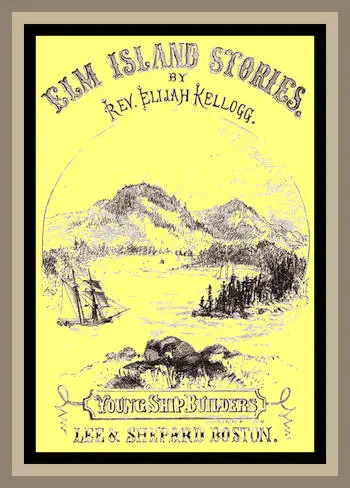
Elijah Kellogg
BEHIND THE BOOK
This eBook is for the use of anyone anywhere in the United States and most other parts of the world at no cost and with almost no restrictions whatsoever. You may copy it, give it away or re-use it under the terms of the Project Gutenberg License included with this eBook or online at www.gutenberg.org. If you are not located in the United States, you will have to check the laws of the country where you are located before using this eBook. Read the source licence.
The original source file, including credits and licence, is retained by this library. Request an original-format copy at no charge. Please include the book title and Project Gutenberg identifier #51141.
KEEP YOUR CURIOSITY GOING
Cécile Tormay

Moritz Busch
Coulson Kernahan
John L. Ransom

Maurice Baring
Frances Wright