
Charles Sumner: his complete works, volume 20 (of 20)
Charles Sumner
THE CLASSIC COLLECTION · 1880
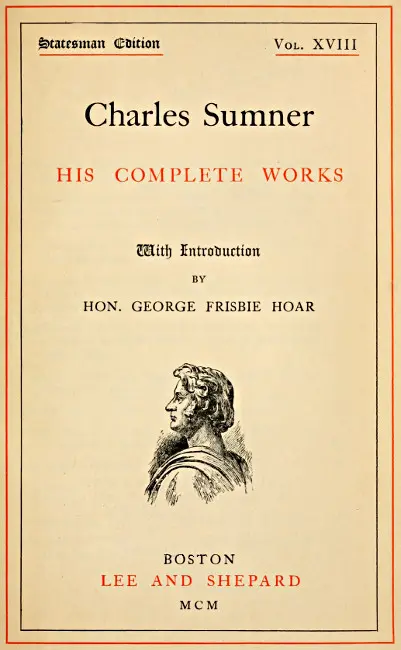
"Charles Sumner: his complete works, volume 18 (of 20)" by Charles Sumner is a collection of political speeches and writings focusing on civil rights and social justice, written in the late 19th century. The volume primarily features Sumner's powerful oratory as a U.S. Senator addressing significant issues of his time, especially surrounding the post-Civil War Reconstruction era and the rights of African Americans. Sumner’s works advocate for equality and justice, emphasizing the need for a uniform national law to protect human rights against state-level injustices. The opening of this volume sets the scene for Sumner's speeches delivered in the Senate between 1870 and 1871. He discusses critical topics such as the admission of Mississippi into Congress, the first African American senator, and the ratification of the Fifteenth Amendment. In his arguments, Sumner passionately conveys the importance of human rights over the outdated notions of state rights, arguing for civil equality and moral responsibility following the nation's recovery from the Civil War. By firmly asserting that equality is the foundation of the Republic, Sumner advocates for legislation that acknowledges and protects the rights of all citizens, thereby challenging the prevailing social and political norms of his era.
Introduction adapted from the source catalogue; source summaries may be automatically generated.
Free to read · English · 86,620 words · No account needed
MAKE TIME FOR A GOOD BOOK
On by default. Untick to stop anonymous reading totals. Each page counts after 10 seconds in view. How this works.
Anonymous counting is on unless you have switched it off.
Thus, after inquiry and debate lasting for three years, this great reform was accomplished, and the English Post-Office assumed an unprecedented character. The new system was founded on a uniform rate for uniform weight without regard to distance, and this rate the lowest unit of coin,--with prepaid stamps, and the abolition of the franking privilege. The experiment was a prodigious success, although the first results showed a falling off financially. The Post-Office authorities had predicted that it would not pay expenses; but the diminished receipts were more than enough for the expenses, while the number of letters was more than doubled.[67] There was a smaller net revenue for the National Treasury, but an infinite benefit to the people. The surplus of the first year was £500,789, against £1,633,764 of the previous year.[68] But the improvement financially was constant, so that here Rowland Hill became a prophet. He had predicted that the increase of correspondence and the economy of management would in a reasonable time afford a probable net revenue of £1,278,000.[69] In 1856 the net revenue had reached £1,207,725,--while at the same time the letters were 478,393,803 in number, with 6,178,982 money orders, against 75,907,572 letters, with 188,921 money orders, in the last year of the old system.[70]
The smallest part of the result was in the revenue,--except so far as this was advanced by the increased activity of the country, represented by the added millions of correspondence. Commerce and business were quickened infinitely, while the ties of social life were brightened and the heart was rejoiced. Here the testimony is complete. Tradesmen wrote to Rowland Hill, their benefactor, saying how their business had increased. Charles Knight, the eminent publisher, who did so much for the literature of the people, wrote that every branch of bookselling was stimulated, while the country seller was brought into almost daily communication with the London houses. The publisher of the Polyglot Bible in twenty-four languages, requiring a peculiar revision, declared that it could not have been printed but for penny postage. The Secretary of the Parker Society, composed of Church dignitaries and influential laymen, which has done so much for ecclesiastical literature by reprinting the works of the early English Reformers, stated that without penny postage the Society could not have come into existence. Secretaries of other societies, literary and benevolent, wrote how their machinery had been improved; conductors of educational establishments testified that people were everywhere learning to write for the first time, in order to enjoy the benefits of untaxed correspondence, and that night classes of adults for this purpose were springing up in all large towns. A leading advocate for the repeal of the Corn Laws gave it as his opinion that this reform must have waited but for penny postage,--that through this ally it reached its triumph two years earlier than it otherwise could have done. All this is easy to believe; for penny postage lends itself to all knowledge and to every reform. Others wrote with rapture of its operations. The accomplished naturalist, Professor Henslow, of Cambridge, rejoiced over its “importance to those who cultivate science,” and pictured the satisfaction of the humble people about his country parsonage “at the facility they enjoy of now corresponding with distant relatives,” together with what he calls “the vast domestic comfort which the penny postage has added to homes like my own, situate in retired villages.” Miss Martineau described its social benefits. Rowland Hill himself, showing how much it had done for the poor, said, “The postman has now to make long rounds through humble districts where heretofore his knock was rarely heard.”[71] And from the outlying Shetland Islands a visitor in May, 1842, reported: “The Zetlanders are delighted with penny postage. The postmaster told me that the number of letters was astonishing.”[72] But perhaps the heartfelt exultation was never better expressed than by the accomplished traveller, Mr. Laing, when, after describing the Prussian system of education, and giving the palm to penny postage as “a much wiser and more effective educational measure,” destined to be “the great historical distinction of the reign of Victoria I.,” he proceeds to say, that “every mother in the kingdom, who has children earning their bread at a distance, lays her head upon her pillow at night with a feeling of gratitude for this blessing.”[73] Such was the unbought tribute from all quarters,--alike the cottage of the lowly and the home of the professor, the counting-house of the merchant and the activities of benevolence, business in its various forms, and the commanding efforts of the political reformer, all, all confessing their debt to penny postage.[74]
Your reading position is saved on this browser. Take it to another device with a library code. Reading pages adapt to text, rather than matching a printed edition.
Charles Sumner

Charles Sumner

Charles Sumner

Charles Sumner
BEHIND THE BOOK
This eBook is for the use of anyone anywhere in the United States and most other parts of the world at no cost and with almost no restrictions whatsoever. You may copy it, give it away or re-use it under the terms of the Project Gutenberg License included with this eBook or online at www.gutenberg.org. If you are not located in the United States, you will have to check the laws of the country where you are located before using this eBook. Read the source licence.
The original source file, including credits and licence, is retained by this library. Request an original-format copy at no charge. Please include the book title and Project Gutenberg identifier #48314.
KEEP YOUR CURIOSITY GOING

David Patterson (Spirit) Hatch

David Patterson (Spirit) Hatch

David Patterson (Spirit) Hatch
Cécile Tormay

Moritz Busch
John L. Ransom