
Charles Sumner: his complete works, volume 20 (of 20)
Charles Sumner
THE CLASSIC COLLECTION · 1880
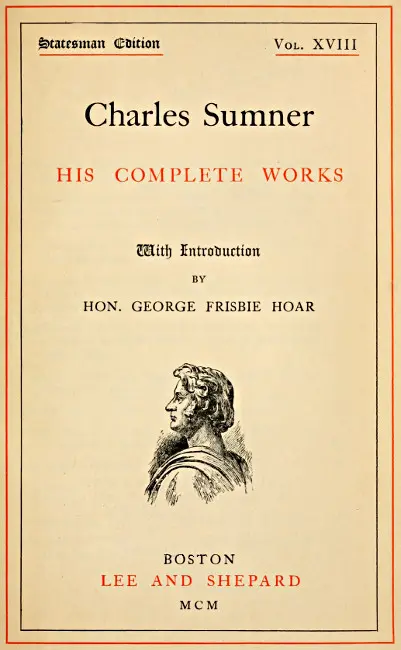
"Charles Sumner: his complete works, volume 18 (of 20)" by Charles Sumner is a collection of political speeches and writings focusing on civil rights and social justice, written in the late 19th century. The volume primarily features Sumner's powerful oratory as a U.S. Senator addressing significant issues of his time, especially surrounding the post-Civil War Reconstruction era and the rights of African Americans. Sumner’s works advocate for equality and justice, emphasizing the need for a uniform national law to protect human rights against state-level injustices. The opening of this volume sets the scene for Sumner's speeches delivered in the Senate between 1870 and 1871. He discusses critical topics such as the admission of Mississippi into Congress, the first African American senator, and the ratification of the Fifteenth Amendment. In his arguments, Sumner passionately conveys the importance of human rights over the outdated notions of state rights, arguing for civil equality and moral responsibility following the nation's recovery from the Civil War. By firmly asserting that equality is the foundation of the Republic, Sumner advocates for legislation that acknowledges and protects the rights of all citizens, thereby challenging the prevailing social and political norms of his era.
Introduction adapted from the source catalogue; source summaries may be automatically generated.
Free to read · English · 86,620 words · No account needed
MAKE TIME FOR A GOOD BOOK
On by default. Untick to stop anonymous reading totals. Each page counts after 10 seconds in view. How this works.
Anonymous counting is on unless you have switched it off.
[245] Suetonius: Titus, Cap. IX. Merivale, History of the Romans under the Empire, (London, 1862,) Ch. LX., Vol. VII. p. 56.
[246] St. Telemachus, A. D. 404. Gibbon, Decline and Fall of the Roman Empire, ed. Milman, (London, 1846,) Ch. XXX., Vol. III. p. 70. Smith, Dict. Gr. and Rom. Biog. and Myth., art. TELEMACHUS.
[247] Decline and Fall of the Roman Empire, ubi supra.
[248] Scene after the Battle of Sedan: Herald of Peace for 1870,
October 1st, p. 121.
[249] De l’Esprit des Lois, Liv. XI. Ch. 6.
[250] “La France se perdra par les gens de guerre.”--Pensées Diverses,--Variétés: Œuvres Mélées et Posthumes, (Paris, 1807, Didot,) Tom. II. p. 138.
[251] Almagest, ed. et tr. Halma, (Paris, 1816-20,) Tom. II. pp. 72, 73.
[252] Naturales Quæstiones, Lib. I. Cap. 1.
[253] Dionysius Halicarnassensis, Antiquitates Romanæ, Lib. IV. Capp.
59-61.
[254] Travels of the Russian Mission through Mongolia to China, and
Residence in Peking, in 1820-21, by George Timkowski, Vol. I. pp.
460-64.
[255] See the New York Times of August 11, 1870, where the reputed prophecy is cited in these terms, in a letter of the 27th July from the London correspondent of that journal, with remarks indicating an expectation of its fulfilment in the results of the present war. This famous saying has been variously represented; but the following are its original terms, as recorded at the time by Las Cases, to whom it was addressed in conversation, and as authenticated by the Commission appointed by Louis Napoleon for the collection and publication of the matters now composing the magnificent work entitled “Correspondance de Napoléon Ier”:--
“Dans l’état actuel des choses, avant dix ans, toute l’Europe peut être cosaque, ou toute en république.”--LAS CASES, Mémorial de Sainte-Hélène, (Réimpression de 1823 et 1824,) Tom. III. p. 111,--Journal, 18 Avril 1816. Correspondance de Napoléon Ier, (Paris, 1858-69,) Tom. XXXII. p. 326.
[256] Columbian Centinel, June 18, 1825.
[257] Address at the Consecration of the National Cemetery at Gettysburg, November 19, 1863: McPherson’s Political History of the United States during the Great Rebellion, p. 606.
[258] “The cause of Liberty in Italy needs the word of the United States Government, which would be more powerful in its behalf than that of any other.”--Message to Mr. Sumner from Caprera, May 24, 1869.
[259] Statutes at Large, Vol. XI. pp. 52-65.
[260] The Select Committee appointed to investigate the Memorial of Davis Hatch.--See Senate Reports, 41st Cong. 2d Sess., No. 234.
[261] Senate Reports, ut supra, p. 188.
[262] Ollivier: Debate in the Corps Législatif, July 15, 1870, previous to the Declaration of War against Prussia.--Journal Officiel du Soir, 17 Juillet 1870.
[263] Dana’s edition. Lawrence, 2d edit., pp. 455-56.
[264] Dana’s edition. Lawrence, 2d edit., p. 884.
Your reading position is saved on this browser. Take it to another device with a library code. Reading pages adapt to text, rather than matching a printed edition.
Charles Sumner

Charles Sumner

Charles Sumner

Charles Sumner
BEHIND THE BOOK
This eBook is for the use of anyone anywhere in the United States and most other parts of the world at no cost and with almost no restrictions whatsoever. You may copy it, give it away or re-use it under the terms of the Project Gutenberg License included with this eBook or online at www.gutenberg.org. If you are not located in the United States, you will have to check the laws of the country where you are located before using this eBook. Read the source licence.
The original source file, including credits and licence, is retained by this library. Request an original-format copy at no charge. Please include the book title and Project Gutenberg identifier #48314.
KEEP YOUR CURIOSITY GOING

David Patterson (Spirit) Hatch

David Patterson (Spirit) Hatch

David Patterson (Spirit) Hatch
Cécile Tormay

Moritz Busch
John L. Ransom