
Charles Sumner: his complete works, volume 20 (of 20)
Charles Sumner
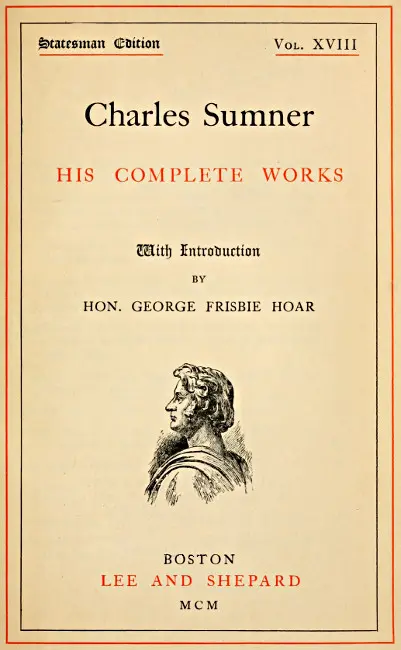
THE CLASSIC COLLECTION · 1880
"Charles Sumner: his complete works, volume 18 (of 20)" by Charles Sumner is a collection of political speeches and writings focusing on civil rights and social justice, written in the late 19th century. The volume primarily features Sumner's powerful oratory as a U.S. Senator addressing significant issues of his time, especially surrounding the post-Civil War Reconstruction era and the rights of African Americans. Sumner’s works advocate for equality and justice, emphasizing the need for a uniform national law to protect human rights against state-level injustices. The opening of this volume sets the scene for Sumner's speeches delivered in the Senate between 1870 and 1871. He discusses critical topics such as the admission of Mississippi into Congress, the first African American senator, and the ratification of the Fifteenth Amendment. In his arguments, Sumner passionately conveys the importance of human rights over the outdated notions of state rights, arguing for civil equality and moral responsibility following the nation's recovery from the Civil War. By firmly asserting that equality is the foundation of the Republic, Sumner advocates for legislation that acknowledges and protects the rights of all citizens, thereby challenging the prevailing social and political norms of his era.
Introduction adapted from the source catalogue; source summaries may be automatically generated.
Free to read · English · 86,620 words · No account needed
MAKE TIME FOR A GOOD BOOK
On by default. Untick to stop anonymous reading totals. Each page counts after 10 seconds in view. How this works.
Anonymous counting is on unless you have switched it off.
[159] “Puro pioque duello.”--Historiæ, Lib. I. cap. 32.
[160] “Arte duellica.”--Epidicus, Act. III. Sc. iv. 14.
[161] “Vacuum duellis.”--Carmina, Lib. IV. xv. 8.
[162] La tres joyeuse, plaisante et recreative Hystoire, composée par le Loyal Serviteur, des Faiz, Gestes, Triumphes et Prouesses du Bon Chevalier sans Paour et sans Reprouche, le Gentil Seigneur de Bayart: Petitot, Collection des Mémoires relatifs à l’Histoire de France, Tom. XV. pp. 241, 242.
[163] Table-Talk, ed. Singer, (London, 1856,) p. 47,--Duel.
[164] Robertson, History of the Reign of Charles V.: View of the Progress of Society in Europe, Section I. Note XXII.
[165] Coxe, History of the House of Austria, (London, 1820,) Ch. XIX.,
Vol. I. p. 378.
[166] Acte pour la Constitution fédérative de l’Allemagne du 8 Juin 1815, Art. 11: Archives Diplomatiques, (Stuttgart et Tubingue, 1821-36,) Vol. IV. p. 15.
[167] Journal Officiel du Soir, 3 Juillet 1870.
[168] Journal Officiel du Soir, 2 Juillet 1870.
[169] Ibid., 8 Juillet.
[170] Ibid.
[171] Ibid.
[172] Bismarck to Bernstorff, July 19, 1870, with Inclosures: Parliamentary Papers, 1870, Vol. LXX.,--Franco-Prussian War, No. 3, pp. 5-8. Gerolt to Fish, August 11, 1870, with Inclosures: Executive Documents, 41st Cong. 3d Sess., H. of R., Vol. I. No. 1, Part 1,--Foreign Relations, pp. 219-221. The reader will notice that the copy of the Telegram in this latter volume is the paper on p. 221, with the erroneous heading, “Count Bismarck to Baron Gerolt.”
[173] Bismarck to Bernstorff, July 18, and to Gerolt, July 19, 1870: Parliamentary Papers and Executive Documents, Inclosures, ubi supra.
[174] Journal Officiel du Soir, 17 Juillet 1870.
[175] “De ce jour commence pour les ministres mes collègues, et pour moi, une grande responsibilité. [“Oui!” à gauche.] Nous l’acceptons, le cœur léger.”
[176] For the full debate, see the Journal Officiel du Soir, 17 Juillet 1870, and Supplément.
[177] Earl Granville to Lords Lyons and Loftus, July 15, 1870,--Correspondence respecting the Negotiations preliminary to the War between France and Prussia, p. 35: Parliamentary Papers, 1870, Vol. LXX.
[178] Lord Lyons to Earl Granville, July 15, 1870,--Correspondence respecting the Negotiations preliminary to the War between France and Prussia, pp. 39, 40: Parliamentary Papers, 1870, Vol. LXX.
[179] See references, ante, p. 19, Note 1. For this telegram in the original, see Aegidi und Klauhold, Staatsarchiv, (Hamburg, 1870,) 19 Band, s. 44, No. 4033.
[180] Journal Officiel du Soir, 17 Juillet 1870.
[181] Ibid., 20 Juillet.
[182] Ibid., 23 Juillet.
[183] Substance of Speech of Bismarck to the Reichstag, [July 20, 1870,] explanatory of Documents relating to the Declaration of War,--Franco-Prussian War, No. 3, p. 29: Parliamentary Papers, 1870, Vol. LXX. Discours du Comte de Bismarck au Reichstag, le 20 Juillet 1870: Angeberg, [Chodzko,] Recueil des Traités, etc., concernant la Guerre Franco-Allemande, Tom. I. p. 215.
[184] Aegidi und Klauhold, Staatsarchiv, 19 Band, s. 107, No. 4056.
Parliamentary Papers, 1870, Vol. LXX.: Franco-Prussian War, No. 3, pp.
2-3.
[185] For the foregoing statistics, see Almanach de Gotha, 1870, under the names of the several States referred to,--also, for Areas and Population, Tableaux Comparatifs, I., II., III., in same volume, pp. 1037-38.
Your reading position is saved on this browser. Take it to another device with a library code. Reading pages adapt to text, rather than matching a printed edition.
Charles Sumner

Charles Sumner

Charles Sumner

Charles Sumner
BEHIND THE BOOK
This eBook is for the use of anyone anywhere in the United States and most other parts of the world at no cost and with almost no restrictions whatsoever. You may copy it, give it away or re-use it under the terms of the Project Gutenberg License included with this eBook or online at www.gutenberg.org. If you are not located in the United States, you will have to check the laws of the country where you are located before using this eBook. Read the source licence.
The original source file, including credits and licence, is retained by this library. Request an original-format copy at no charge. Please include the book title and Project Gutenberg identifier #48314.
KEEP YOUR CURIOSITY GOING

David Patterson (Spirit) Hatch

David Patterson (Spirit) Hatch

David Patterson (Spirit) Hatch
Cécile Tormay

Moritz Busch
John L. Ransom