
Charles Sumner: his complete works, volume 20 (of 20)
Charles Sumner
THE CLASSIC COLLECTION · 1880
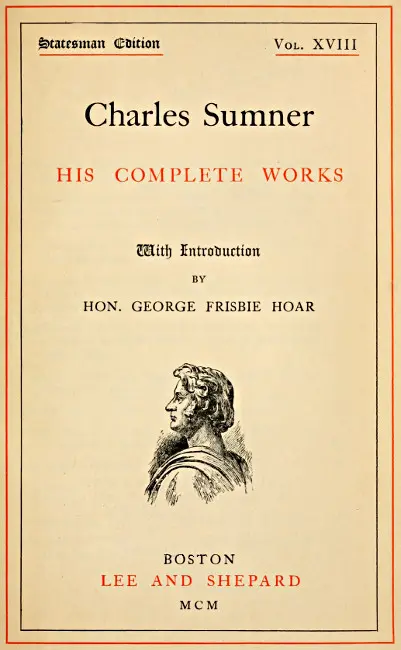
"Charles Sumner: his complete works, volume 18 (of 20)" by Charles Sumner is a collection of political speeches and writings focusing on civil rights and social justice, written in the late 19th century. The volume primarily features Sumner's powerful oratory as a U.S. Senator addressing significant issues of his time, especially surrounding the post-Civil War Reconstruction era and the rights of African Americans. Sumner’s works advocate for equality and justice, emphasizing the need for a uniform national law to protect human rights against state-level injustices. The opening of this volume sets the scene for Sumner's speeches delivered in the Senate between 1870 and 1871. He discusses critical topics such as the admission of Mississippi into Congress, the first African American senator, and the ratification of the Fifteenth Amendment. In his arguments, Sumner passionately conveys the importance of human rights over the outdated notions of state rights, arguing for civil equality and moral responsibility following the nation's recovery from the Civil War. By firmly asserting that equality is the foundation of the Republic, Sumner advocates for legislation that acknowledges and protects the rights of all citizens, thereby challenging the prevailing social and political norms of his era.
Introduction adapted from the source catalogue; source summaries may be automatically generated.
Free to read · English · 86,620 words · No account needed
MAKE TIME FOR A GOOD BOOK
On by default. Untick to stop anonymous reading totals. Each page counts after 10 seconds in view. How this works.
Anonymous counting is on unless you have switched it off.
Parliament responded sympathetically to the King, and made the
necessary appropriations. And thus the two champions stood front to
front.
Throughout France, throughout Germany, the trumpet sounded, and everywhere the people sprang to arms, as if the great horn of Orlando, after a sleep of ages, had sent forth once more its commanding summons. Not a town, not a village, that the voice did not penetrate. Modern invention had supplied an ally beyond anything in fable. From all parts of France, from all parts of Germany, armed men leaped forward, leaving behind the charms of peace and the business of life. On each side the muster was mighty, armies counting by the hundred thousand. And now, before we witness the mutual slaughter, let us pause to consider the two parties, and the issue between them.
France and Germany are most unlike, and yet the peers of each other, while among the nations they are unsurpassed in civilization, each prodigious in resources, splendid in genius, and great in renown. No two nations are so nearly matched. By Germany I now mean not only the States constituting North Germany, but also Würtemberg, Baden, and Bavaria of South Germany, allies in the present war, all of which together make about fifty-three millions of French hectares, being very nearly the area of France. The population of each is not far from thirty-eight millions, and it would be difficult to say which is the larger. Looking at finances, Germany has the smaller revenue, but also the smaller debt, while her rulers, following the sentiment of the people, cultivate a wise economy, so that here again substantial equality is maintained with France. The armies of the two, embracing regular troops and those subject to call, did not differ much in numbers, unless we set aside the authority of the “Almanach de Gotha,” which puts the military force of France somewhat vaguely at 1,350,000, while that of North Germany is only 977,262, to which must be added 49,949 for Bavaria, 34,953 for Würtemberg, and 43,703 for Baden, making a sum-total of 1,105,867. This, however, is chiefly on paper, where it is evident France is stronger than in reality. Her available force at the outbreak of the war probably did not amount to more than 350,000 bayonets, while that of Germany, owing to her superior system, was as much as double this number. In Prussia every man is obliged to serve, and, still further, every man is educated. Discipline and education are two potent adjuncts. This is favorable to Germany. In the Chassepot and needle-gun the two are equal. But France excels in a well-appointed Navy, having no less than 55 iron-clads, and 384 other vessels of war, while Germany has but 2 iron-clads, and 87 other vessels of war.[185] Then again for long generations has existed another disparity, to the great detriment of Germany. France has been a nation, while Germany has been divided, and therefore weak. Strong in union, the latter now claims something more than that dominion of the air once declared to be hers, while France had the land and England the sea.[186] The dominion of the land is at last contested, and we are saddened inexpressibly, that, from the elevation they have reached, these two peers of civilization can descend to practise the barbarism of war, and especially that the land of Descartes, Pascal, Voltaire, and Laplace must challenge to bloody duel the land of Luther, Leibnitz, Kant, and Humboldt.
Your reading position is saved on this browser. Take it to another device with a library code. Reading pages adapt to text, rather than matching a printed edition.
Charles Sumner

Charles Sumner

Charles Sumner

Charles Sumner
BEHIND THE BOOK
This eBook is for the use of anyone anywhere in the United States and most other parts of the world at no cost and with almost no restrictions whatsoever. You may copy it, give it away or re-use it under the terms of the Project Gutenberg License included with this eBook or online at www.gutenberg.org. If you are not located in the United States, you will have to check the laws of the country where you are located before using this eBook. Read the source licence.
The original source file, including credits and licence, is retained by this library. Request an original-format copy at no charge. Please include the book title and Project Gutenberg identifier #48314.
KEEP YOUR CURIOSITY GOING

David Patterson (Spirit) Hatch

David Patterson (Spirit) Hatch

David Patterson (Spirit) Hatch
Cécile Tormay

Moritz Busch
John L. Ransom