
Charles Sumner: his complete works, volume 20 (of 20)
Charles Sumner
THE CLASSIC COLLECTION · 1880
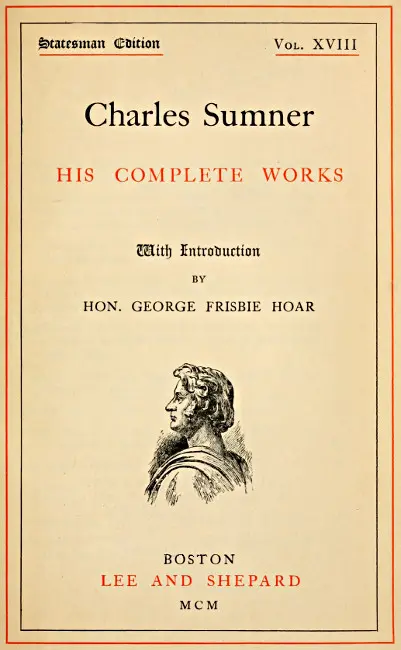
"Charles Sumner: his complete works, volume 18 (of 20)" by Charles Sumner is a collection of political speeches and writings focusing on civil rights and social justice, written in the late 19th century. The volume primarily features Sumner's powerful oratory as a U.S. Senator addressing significant issues of his time, especially surrounding the post-Civil War Reconstruction era and the rights of African Americans. Sumner’s works advocate for equality and justice, emphasizing the need for a uniform national law to protect human rights against state-level injustices. The opening of this volume sets the scene for Sumner's speeches delivered in the Senate between 1870 and 1871. He discusses critical topics such as the admission of Mississippi into Congress, the first African American senator, and the ratification of the Fifteenth Amendment. In his arguments, Sumner passionately conveys the importance of human rights over the outdated notions of state rights, arguing for civil equality and moral responsibility following the nation's recovery from the Civil War. By firmly asserting that equality is the foundation of the Republic, Sumner advocates for legislation that acknowledges and protects the rights of all citizens, thereby challenging the prevailing social and political norms of his era.
Introduction adapted from the source catalogue; source summaries may be automatically generated.
Free to read · English · 86,620 words · No account needed
MAKE TIME FOR A GOOD BOOK
On by default. Untick to stop anonymous reading totals. Each page counts after 10 seconds in view. How this works.
Anonymous counting is on unless you have switched it off.
In likening war between nations to the duel, I follow not only reason, but authority also. No better lawyer can be named in the long history of the English bar than John Selden, whose learning was equalled only by his large intelligence. In those conversations which under the name of “Table-Talk” continue still to instruct, the wise counsellor, after saying that the Church allowed the duel anciently, and that in the public liturgies there were prayers appointed for duellists to say, keenly inquires, “But whether is this lawful?” And then he answers, “If you grant any war lawful, I make no doubt but to convince it.”[163] Selden regarded the simple duel and the larger war as governed by the same rule. Of course the exercise of force in the suppression of rebellion, or in the maintenance of laws, stands on a different principle, being in its nature a constabulary proceeding, which cannot be confounded with the duel. But my object is not to question the lawfulness of war; I would simply present an image, enabling you to see the existing war in its true character.
The duel in its simplest form is between two individuals. In early ages it was known sometimes as the Judicial Combat, and sometimes as Trial by Battle. Not only points of honor, but titles to land, grave questions of law, and even the subtilties of theology, were referred to this arbitrament,[164]--just as now kindred issues between nations are referred to Trial by Battle; and the early rules governing the duel are reproduced in the Laws of War established by nations to govern the great Trial by Battle. Ascending from the individual to corporations, guilds, villages, towns, counties, provinces, we find that for a long period each of these bodies exercised what was called “the Right of War.” The history of France and Germany shows how reluctantly this mode of trial yielded to the forms of reason and order. France, earlier than Germany, ordained “Trial by Proofs,” and eliminated the duel from judicial proceedings, this important step being followed by the gradual amalgamation of discordant provinces in the powerful unity of the Nation,--so that Brittany and Normandy, Franche-Comté and Burgundy, Provence and Dauphiny, Gascony and Languedoc, with the rest, became the United States of France, or, if you please, France. In Germany the change was slower; and here the duel exhibits its most curious instances. Not only feudal chiefs, but associations of tradesmen and of domestics sent defiance to each other, and sometimes to whole cities, on pretences trivial as those which have been the occasion of defiance from nation to nation. There still remain to us Declarations of War by a Lord of Frauenstein against the free city of Frankfort, because a young lady of the city refused to dance with his uncle,--by the baker and domestics of the Margrave of Baden against Esslingen, Reutlingen, and other imperial cities,--by the baker of the Count Palatine Louis against the cities of Augsburg, Ulm, and Rottweil,--by the shoe-blacks of the University of Leipsic against the provost and other members,--and by the cook of Eppstein, with his scullions, dairy-maids, and dish-washers, against Otho, Count of Solms.[165] This prevalence of the duel aroused the Emperor Maximilian, who at the Diet of Worms put forth an ordinance abolishing the right or liberty of Private War, and instituting a Supreme Tribunal for the determination of controversies without appeal to the duel, and the whole long list of duellists, whether corporate or individual, including nobles, bakers, shoe-blacks, and cooks, was brought under its pacific rule. Unhappily the beneficent reform stopped half-way, and here Germany was less fortunate than France. The great provinces were left in the enjoyment of a barbarous independence, with the “right” to fight each other. The duel continued their established arbiter, until at last, in 1815, by the Act of Union constituting the Confederation or United States of Germany, each sovereignty gave up the right of war with its confederates, setting an example to the larger nations. The terms of this important stipulation, marking a stage in German unity, were as follows:--
Your reading position is saved on this browser. Take it to another device with a library code. Reading pages adapt to text, rather than matching a printed edition.
Charles Sumner

Charles Sumner

Charles Sumner

Charles Sumner
BEHIND THE BOOK
This eBook is for the use of anyone anywhere in the United States and most other parts of the world at no cost and with almost no restrictions whatsoever. You may copy it, give it away or re-use it under the terms of the Project Gutenberg License included with this eBook or online at www.gutenberg.org. If you are not located in the United States, you will have to check the laws of the country where you are located before using this eBook. Read the source licence.
The original source file, including credits and licence, is retained by this library. Request an original-format copy at no charge. Please include the book title and Project Gutenberg identifier #48314.
KEEP YOUR CURIOSITY GOING

David Patterson (Spirit) Hatch

David Patterson (Spirit) Hatch

David Patterson (Spirit) Hatch
Cécile Tormay

Moritz Busch
John L. Ransom